Objectives
WP4 develops the educational content of FORWARD.
It creates integrated training modules on open science and urban resilience, supported by real case studies, and transforms them into open educational resources and MOOCs for scalability and long-term use.
WP4 aims to:
- Create training modules in open science and urban resilience themes.
- Develop gender-sensitive content to ensure inclusivity across diverse contexts.
- Transform content into OERs and MOOCs for open access.
- Integrate modules and case studies into local university curricula in Palestine and Ukraine.
Tasks
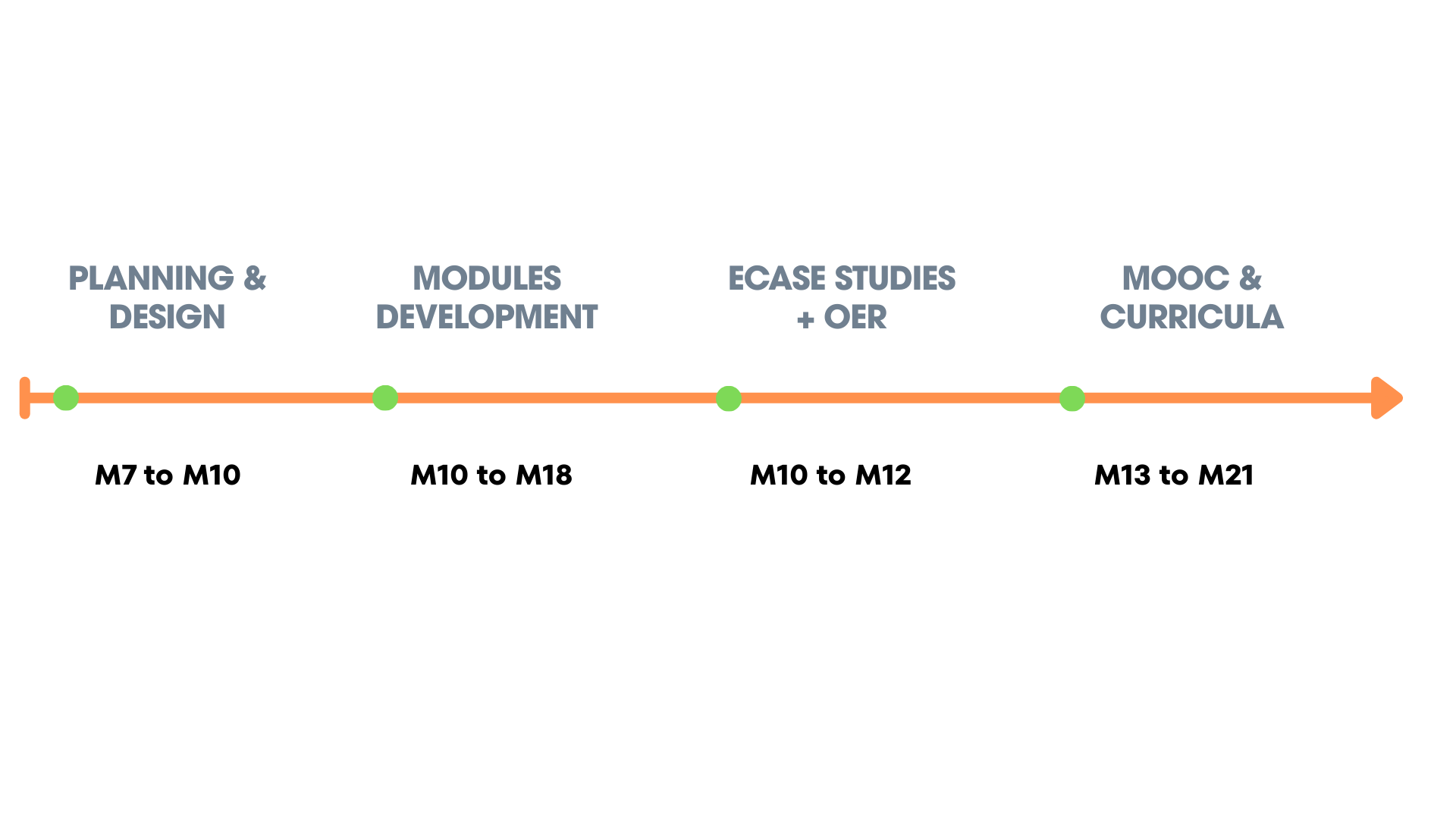
T4.1 — Training Module Development Plan
Development of a roadmap for six training modules: one open science module and five urban resilience modules (water management, energy sustainability, food security, housing/sheltering, and gender equity).
Roadmap includes: learning objectives, structure, technical requirements, and evaluation methods.
T4.2 — Stakeholder Workshop 2
A one-day online workshop involving 50 stakeholders from academia, civil society, and local institutions to validate module topics and case study priorities.
T4.3 — Development of Six Training Modules
Six one-week modules are developed collaboratively:
- OS (Open Science): OsloMet
- ES (Energy Sustainability): IUG
- FS (Food Security): POLIMI
- GE (Gender Equity): KKNU
- HS (Housing/Sheltering): LPNU
- WM (Water Management): POLIMI
Each module is 10–14 learning hours.
Partners contribute hours and content according to shared allocations.
KKNU leads integration of gender-sensitive content into all modules.
T4.4 — Case Study Design
Development of 40 real-world case studies across urban resilience topics:
- 15 in Palestine
- 15 in Ukraine
- 10 joint Palestine-Ukraine cases
Cases support practical learning and include field data collection and local problem-solving.
T4.5 — Training on OER & MOOC Design
A 3-day online workshop for 18 local trainees (9 Palestine, 9 Ukraine) on creating OERs and MOOC components, delivered by IUG and OsloMetX.
T4.6 — Transformation into OERs & MOOCs
Modules and case studies are converted into OERs and integrated into a MOOC course.
Materials are uploaded to the data repository and online learning platform for open access.
T4.7 — Integration into Local Curricula
Partner universities integrate the modules and case studies into existing courses, including engineering and urban studies programs.
Emphasis is placed on institutionalising gender-inclusive content.
T4.8 — Quality Assurance of WP4
POLIMI, OsloMet, and all partners perform QA reviews to ensure that modules, case studies, and OER/MOOC materials meet pedagogical, technical, and contextual criteria and align with FAIR principles.
T4.9 — Dissemination of WP4 Outputs
Updates to the project website and social media platforms highlight WP4 activities, materials, and achievements.
Deliverables
D4.1 — Training Modules and Case Studies Integrated
Six modules (1 open science, 5 urban resilience) and 40 case studies uploaded as OERs to the data repository and online learning platform.
English content with Arabic and Ukrainian subtitles/translations.
D4.2 — MOOC with Training Modules
A full MOOC published on the online learning platform, including:
- video lectures
- interactive exercises
- quizzes
- integrated case studies
D4.3 — Integration into Local Curricula Report
A report documenting how modules were included in local curricula, including updated syllabi, faculty approvals, and student feedback.
Timeline