
Suggested sites to visit in Oslo
Text and concept: Professor emerita Astrid Skjerven (oslomet.no).
Photos: The photographs have been provided by the 1st year bachelor students at the department of journalism and media, OsloMet, headed by associate professor Rebecca Renee Beamer (oslomet.no).
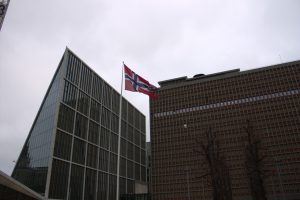
THE POLITICAL META PERSPECTIVE:
The Government Building Complex
Built in the 1950s by the architect Erling Viksjø and decorated by Pablo Picasso, Carl Nesjar, and other renowned artists. A major symbol of the success of the Norwegian welfare state. Found worthy of preservation by the Directorate for Cultural Heritage. On July 22, 2011, it was bombed by a person whom the welfare state had not managed to handle.
Thereby, the place was transformed into a symbol of the failures and vulnerability of social democracy. It was a blow to the Norwegian complacency and self-understanding as a nation taking care of its environment and inhabitants. This was probably one of the reasons why it was decided not to be rebuilt.
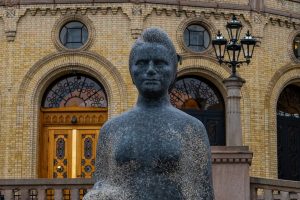
INTRODUCING THE BASIS FOR SUSTAINABILITY IN POLITICS:
Anna Rogstad
A portrait sculpture of the teacher and
politician Anna Rogstad, at Eidsvolls plass outside the Parliament Building. Made by the artist Christine Aspelund and unveiled in 2025. Rogstad was the first female politician at the Parliament. She introduced social politics, based on her experience as a schoolteacher for children in working-class areas in Oslo.Thereby, she paved the way for a new social dimension in politics that enabled the politics of sustainability. This was further emphasised when more females were elected to the Parliament.
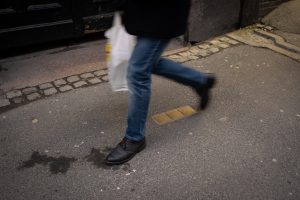
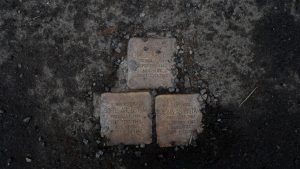
IN REMEMBRANCE OF WAR TRAUMAS
Stumble stones
The small, humble cobblestones are made of brass and set into sidewalks to commemorate victims of the Nazi era during World War II. Each stone is placed in front of the last freely chosen residence of an individual victim. They exist all over theworld. In Oslo, there are presently 467 plaques, and new ones are constantly added. They remind us of the significance of including various religions and ethnic groups.
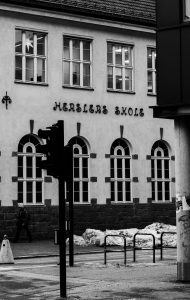
NATURE AND DIVERSITY IN A HISTORICAL PERSPECTIVE
Hersleb High School
Built in 1922, renovated in 2011. Contains fresco paintings byAxel Revold, Alf Rolfsen, and Per Krogh from 1927: “History”, “Geography”, and “Nature”, which displayed what might be interpreted as a conception of the superiority of the Western world. Accused of being racist and attempted to be removed in 2022 (refused). The decoration in 2011 was done by the sculptor Mikkel Wettre and consisted of two-dimensional elements in copper and brass. With a departure point in the school’s emphasis on natural sciences, his starting point was light as a precondition for life. He also attached it to urban life and the school’s situation between the old and poor, and the new and flourishing part of Oslo. The division walls in the entrance hall symbolisethis. The abstract style requires awareness and knowledge for the message to be perceived. Like our dependency on natural resources, it requires a certain alertness not be noticed.
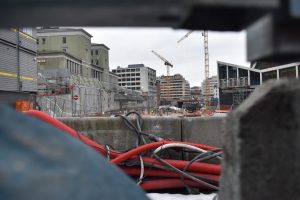
DISREGARDING POLLUTION, MAINTENANCE
AND CULTURAL VALUES
The Garden of Eden
Decoration of the tunnel walls below the Government buildings. It consisted of a painted frieze and depicted human beings, animals, and nature in peaceful coexistence. It was made by the artist Arne Lindaas in 1972, on commission of the Municipality of Oslo. After 18 years of decay due to contamination from exhaust from passing cars and lack of maintenance by the municipality, the artist demanded that it be demolished. Nowadays, the pictorial motif and how it was treated are regarded as a precursor of July 22,2011, which represents our loss of innocence. Fortunately, the sketches have been taken care of and are to be permanently displayed in the new Government Buildings.

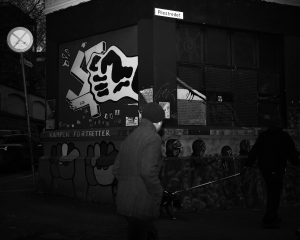
FROM PROTEST TO HARMLESS TOURIST ATTRACTION
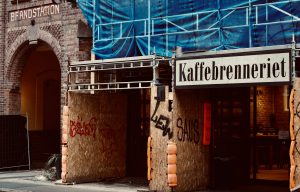
The Blitz House
Founded in 1982 as a squat by young left-wing anarchists. It used to be a self-managed social centre which arranged political riots against political authorities and right-wing groups, but also ran the world’s first female radio channel, a music scene, and a café. It was a hub for various subcultures and represented an alternative to mainstream values, thereby enabling alternative ways of life. Today, there is no political or other activity. It has become a harmless tourist attraction promoted by Visit Oslo.
MULTICULTURAL MEETING PLACE THREATENED
BY “URBAN DEVELOPMENT” AND GENTRIFICATION
Grønlands torg
The lively square is a living quarter and a social and commercial centre in one of Oslo’s most ethnically diverse neighbourhoods. It also attracts citizens from other parts of the city. Many of the buildings are remains of an old working quarter, worn down and threatened by demolition. Commercial building contractors are competing to get the right to build new high-rise buildings. Thereby, the area will be made into a far more expensive place where the current inhabitants cannot afford to live, meet, and do their business.

TAKING CARE OF DISCARDED OBJECTS BY FINDING NEW FORMS OF USE
“Untuned Bell” Honnørbrygga by the City Hall
In 2000, one of the tower bells of the City Hall was removed from its 48 “sister clocks” because it wasout of tune. The multimedia artist A. K. Dolven discovered the 1.4-ton bell mute on the ground and has conserved its voice. In 2022, it was installed close to Honnørbrygga, close to the City Hall. Apedal of the same type used by rock guitarists has been set into the ground. By pushing the pedal, the audience can call forth sound from the long-silenced bell. Each day over the course of a week, a music composition made by Rolf Wallin gradually activates the bells remaining in the City Hall’s carillon. As always, when an outcast is welcomed back into the fold, only a few initially dare to speak out on the outcast’s behalf. Close to its original home, the bell can once again converse with its former community at the top of the tower.
THE CITY ARMS MADE SUSTAINABLE BY CHILDREN’S CREATIVITY
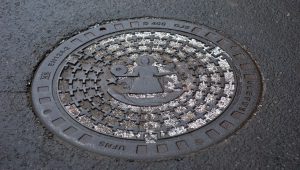
Manhole covers
The patron saint of Oslo, St. Hallvard (1020-1043), is depicted on many of the city’s manhole covers. He was sanctified because he had defended a pregnant woman against her persecutors, who shot him with arrows and hid his corpse in the sea by means of millstones. These became his attributes. The manhole covers were made of welded iron by Ulefos, a renowned iron factory that no longer exists. At the saint’s 1000th anniversary, the municipality of Oslo engaged school children to make colour drawings of the motif, and 150 of them have been placed on the covers. In this way, sustainable development has been executed through the creativity of school children as a pedagogic task.
ORGANIZATION + TECHNOLOGICAL INNOVATION + CITIZENSHIP = POSITIVE IMPACT
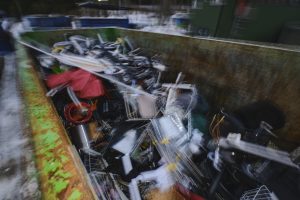
Grønmo recycling station
This is Oslo’s biggest recycling station, with its area of 538.000 square meters and ca. 7 million cubic meters of waste. It organizes waste sorting of material delivered by the citizens. Some of this is transformed into compost that the citizens can buy at low prices. Offering waste for sale to commercial enterprises, which, with the help of advanced technology, can recycle it to various useful materials, is yet to come. The amount of waste is decreasing, which indicates that we are becoming more aware of the disadvantages of waste.
WHAT WILL HAPPEN NEXT?