Kategorier
Internationalization

Another exciting day of learning!

National Library, Royal Institute of Management, Folk Heritage Museum, and the Tarayana Center for Research and Development

First, we were honoured to visit the National Library and Archives of Bhutan and learn much from Yeshey Lhendup, the Chief Research Officer, about Bhutan’s and Buddhist literary heritage and culture, the organization and research performed at the institution, as well as the ongoing efforts at manuscript conservation and digitalization. The institution preserves and promotes literary and cultural heritage, supports research communities, builds and maintains national collections, and provides access to Bhutan’s documentary heritage and information resources. It possesses over a million Buddhist scriptures and texts in the languages of Dzongkha and Chöké, and Sanskrit books, in addition to other books and documents and has digitized thousands of rare manuscripts. We were impressed with the ongoing work and the efforts at preservation, as well as work with local communities, students and researchers.
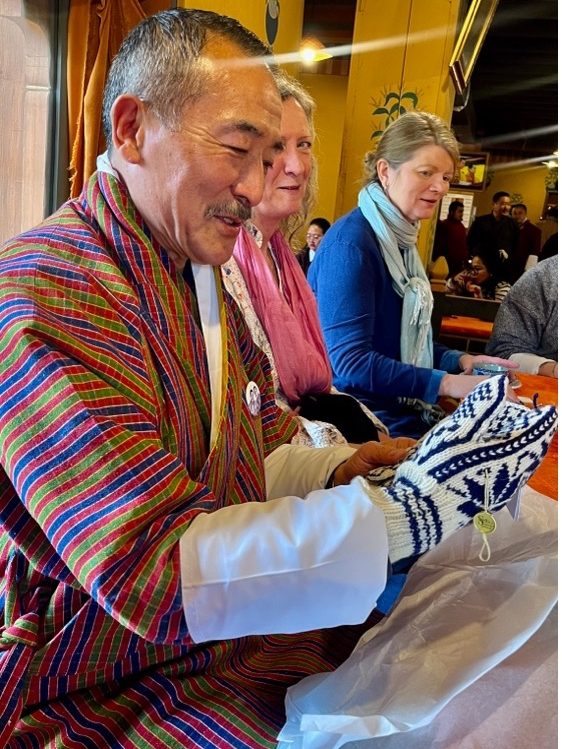
Dasho Kesang Wangdi receiving a small gift from our OsloMet delegation, the traditional Norwegian Selbu mittens.

Our next meeting was digital, with Dasho Tashi, former Auditor General, who is now the Head of Gelephu Mindfulness City’s new Audit and Anti-corruption Investigation Bureau (ACIB). This was particularly insightful meaning for both Kristin and Tereza who learnt a lot about the ongoing anti-corruption work (for more see here) and the organization and ideas that drive Bhutanese audit institutions.

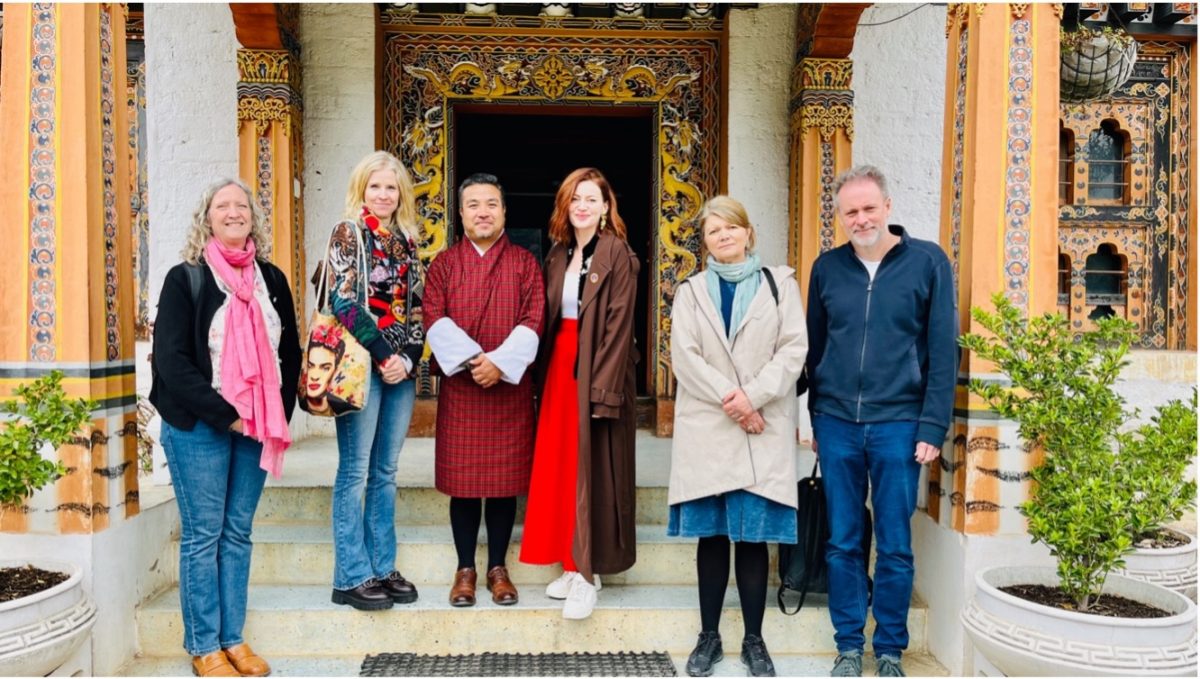
Afterwards, we headed towards the Folk Heritage Museum where our OsloMet delegation received a guided tour and lunch at the kind invitation of Dasho Kesang Wangdi, Deputy Chairman of the Royal Privy Council, chair of the Bhutan Trust Fund for Environmental Conservation and the Snowman Run and former ambassador to Thailand and Australia, among his other diplomatic engagements. We learnt a lot during our tour of the museum about Bhutanese traditional crafts, and we even got to dance together with local performers. Thereafter, we enjoyed the traditional Bhutanese lunch at the museum restaurant and engaged in enlightening conversation about Bhutan, sustainability, happiness and geopolitics. In addition to Dasho Kesang Wangdi, we had the pleasure to speak to Pema Lektup Dorji, Foreign Secretary and former Permanent Representative of Bhutan to the United Nations and to Kama Tshering, Managing Director of the Bhutan Trust Fund.

Our next stop was the Royal Institute of Management, which educates the civil servants of Bhutan and performs research on many overlapping subjects to those of our Work Research Institute. We had the pleasure to meet with Dorji Penjore, Head of the Centre for Research & Innovation at RIM and editor of the Bhutan Journal of Management, and an engaged anthropologist, Namgay, Assistant Professor working on anti-corruption, and a young bright researcher Kuenga Norbu, specializing on research methods. We discovered many shared interests in regard to labour regulation, anti-corruption, future studies and foresight, and decided to continue our collaboration.
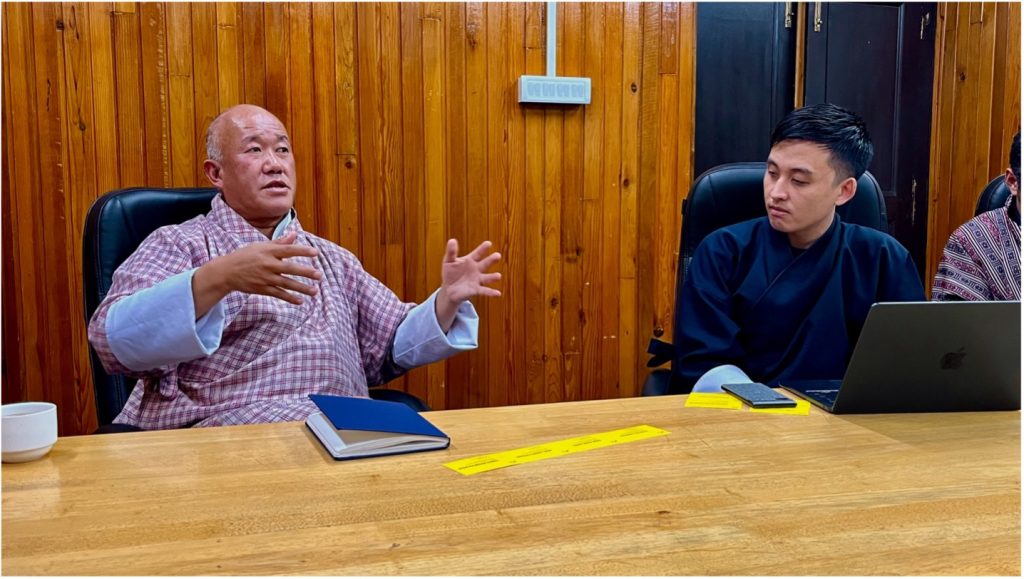
Dorji Penjore (left) explaining the role of RIM in educating civil servants in Bhutan and the ways in which its approach differs from American and Western approaches to management education. Kuenga Nordu (to the right). 

After this enlightening meeting, we had the pleasure to visit the Tarayana Centre for Research and Development (TCRD), part of the Tarayana Foundation, which performs action-oriented research and seeks to develop and empower local communities. Sonam Pem, the Executive Director of the Tarayana Foundation, held an impressive presentation on the holistic development model of Gross National Happiness at the grassroots level which they developed – originally in the Rukha village in Wangdue Phodrang district and later implemented across other locations and rural communities, while each time attentive to the local conditions, modifying the approach as necessary. This was particularly interesting to us, given our own action-oriented research traditions at the Work Research Institute (AFI). We much appreciated the long-term and genuine engagement with local communities, taking the time needed to create meaningful and lasting change. We also discussed the problems of sectorization and the ways in which they can be ameliorated by actors such as Tarayana; this also resonated with challenges we experience in Norway.
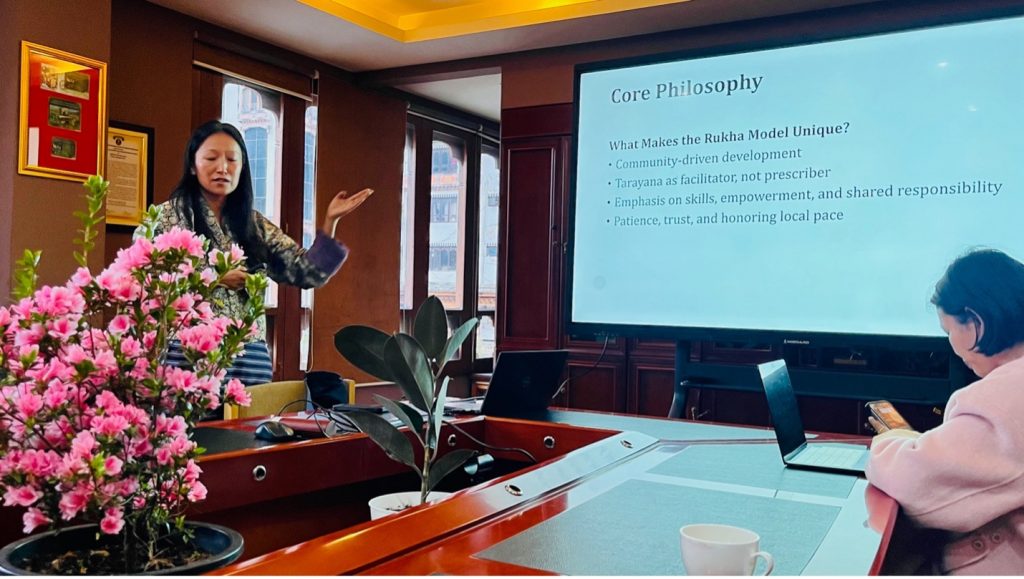
Sonam Pem, the Executive Director of the Tarayana Foundation.
Kategorier
Internationalization

Visions of the Future

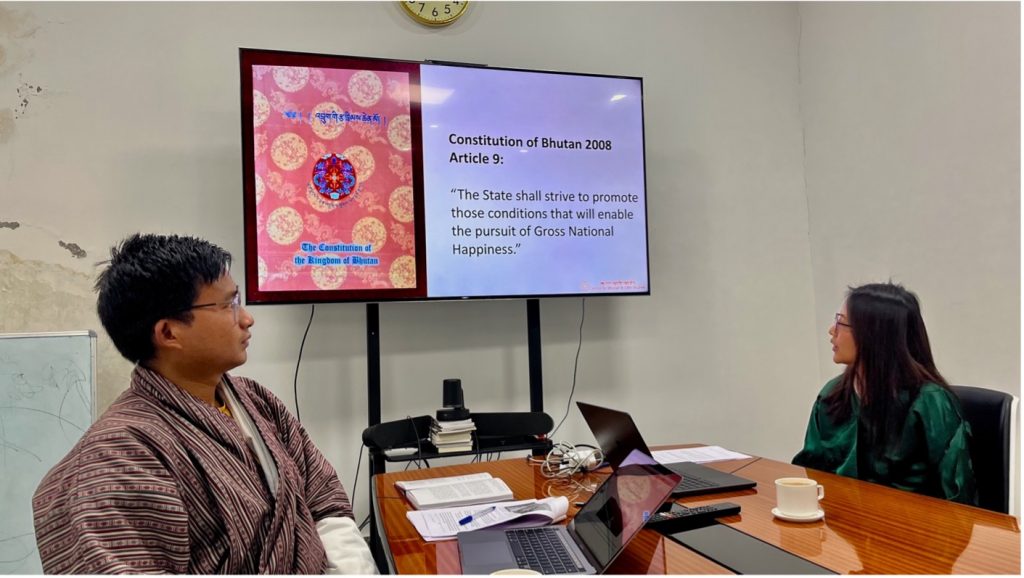
We continued to explore the theme of future and governance. Dendup Chophel accompanied us to the Center for Bhutan and GNH Studies, which is an autonomous government research institute for social science and public policy, conducting inter-disciplinary studies on Bhutan’s economy, polity, history, religion, society, culture, and related themes.

One of the major areas of focus since mid-2000s was on deepening the understanding of Gross National Happiness concept to influence public policy and development discourse. Two researchers from CBS offered us an in-depth presentation of the GNH Index, GNH Policy Screening Tools, and GNH of Business Assessment Tools which were developed at the center.

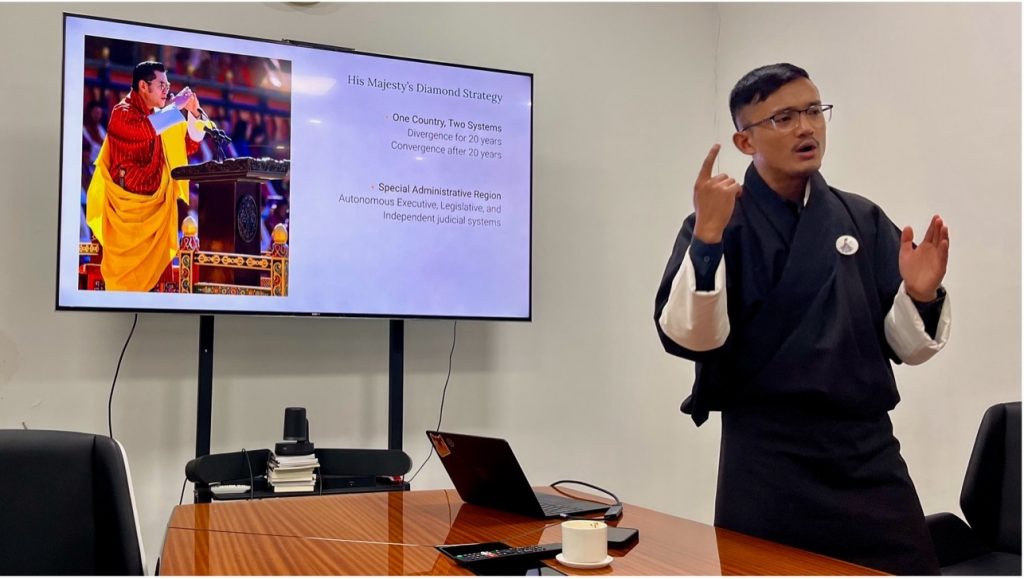
Jigme and Kinley Pema, researchers at CBS, presenting the GNH philosophy, index and operationalization in policy and screening.

We were also happy to receive some of the books published by CBS, offering thorough introductions into the subject and we were much impressed by the extensive work on the ground put into the GNH Index, such as the extensive in-person interviews with the 11 000 respondents across the whole territory of Bhutan. The GNH 2022 report can be found here (bhutanstudies.org).

After the presentation by CBS researchers and consequent discussion, we had the pleasure to listen to meet with Dasho Kinley Dorji, former editor of Kuensel and former information secretary and Sherub Dorji, Communications Officer of Gelephu Mindfulness City (GMC). Sherub was kind to hold an in-depth presentation of the vision behind GMC and answer all our questions.

Sherub Dorji presenting the vision of GMC.

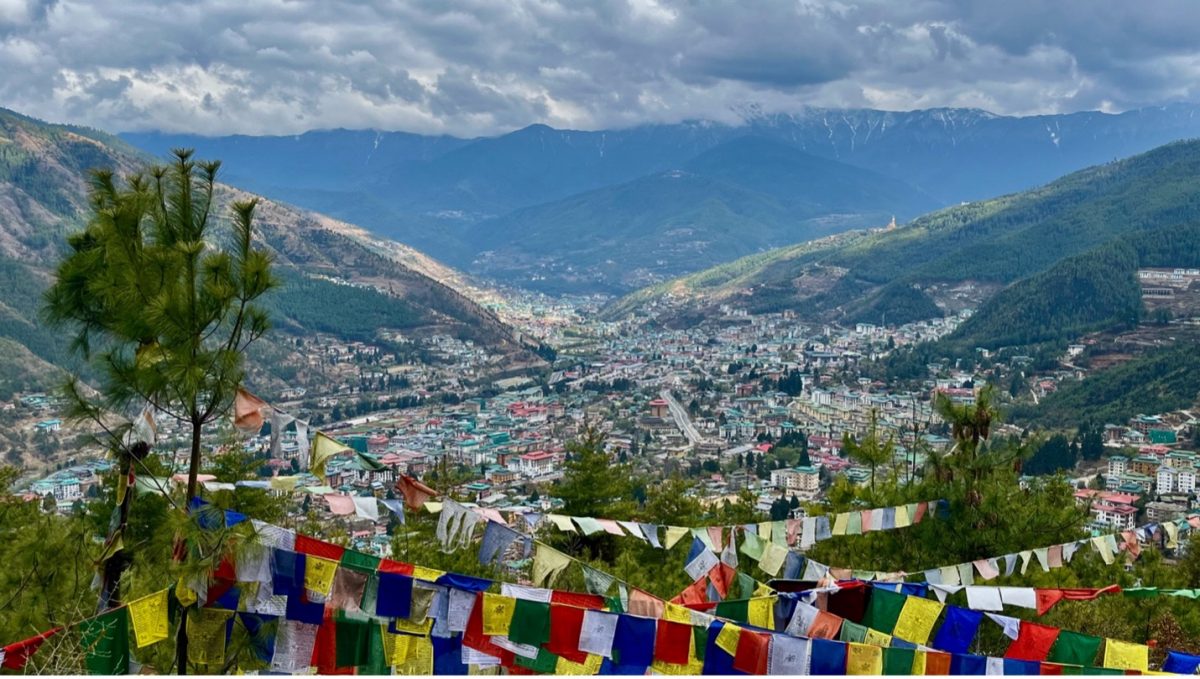
But this eventful day was far from over, following a light lunch, we drove up the mountains, on our way to the Audience with HRH Princess Sonam Dechan Wangchuck, who is also the President of JSW Law School. On the way to Her Royal Highness, we stopped at a beautiful viewing point, calming our nerves prior to this important meeting.

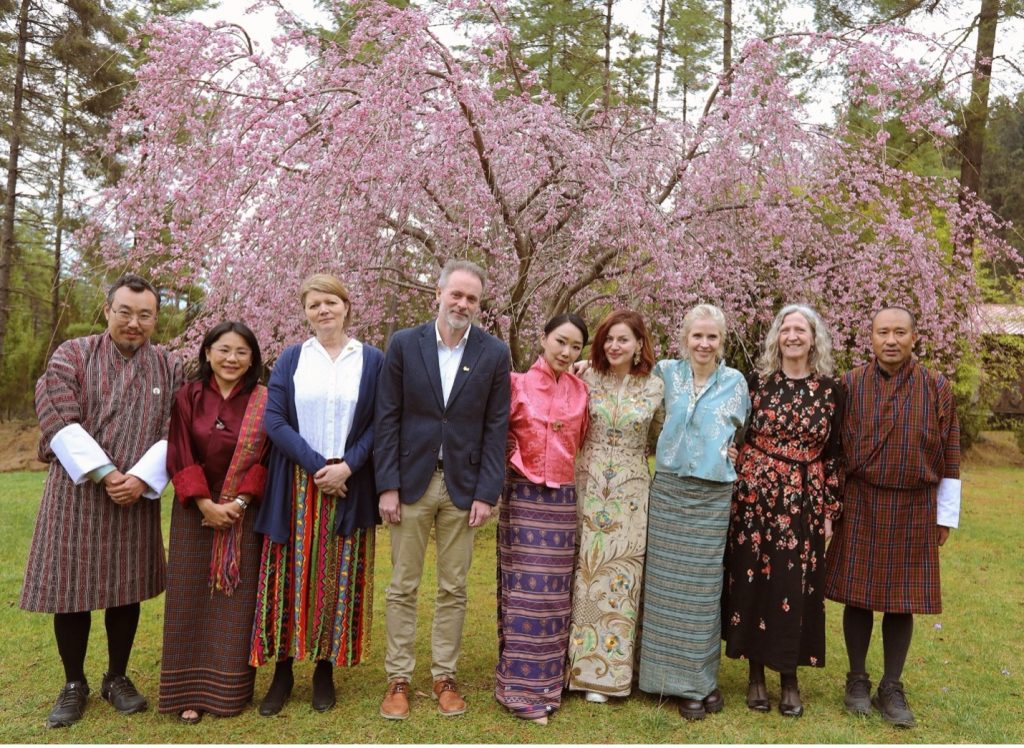
Her Royal Highness Princess Sonam Dechan Wangchuck, daughter of the Fourth King, received us in her beautiful, tasteful and modest private residence. We were extremely honoured to engage in over an hour-long conversation with Her Royal Highness on Bhutanese-Norwegian relations, research collaboration between JSW and OsloMet, as well as legal developments, GNH or the criminal justice system reform in which Her Royal Highness is deeply involved, emphasizing modernization and rehabilitation, drawing some inspiration from the Norwegian prison of Halden and promoting alternative dispute resolution and mediation.

From left to right: Dendup Chophel, Karma Choden, Inger Marie Hagen, Arne Bygdås, HRH Sonam Dechan Wangchuck, Tereza Østbø Kuldova, Kristin Reichborn-Kjennerud, Christina Lindskog and Tshering Tashi.

Her Royal Highness also shared stories from her studies at Stanford and Harvard Law School (here (jswlaw.bt) you can learn more about HRH Princess Sonam Dechan Wangchuck).

We also reflected on the normative power of small states, sovereignty and our shared interests amid rising global tensions. We were touched by HRH’s enlightened and ethereal being and the spirit of deep care for both the Bhutanese people and the world. We were delighted to receive a signed copy of The Raven Tells a Story, a children’s book written by HRH Princess Sonam Dechan Wangchuck of Bhutan, published in 2011 to teach young readers about the Bhutanese Constitution, democracy, and national values.

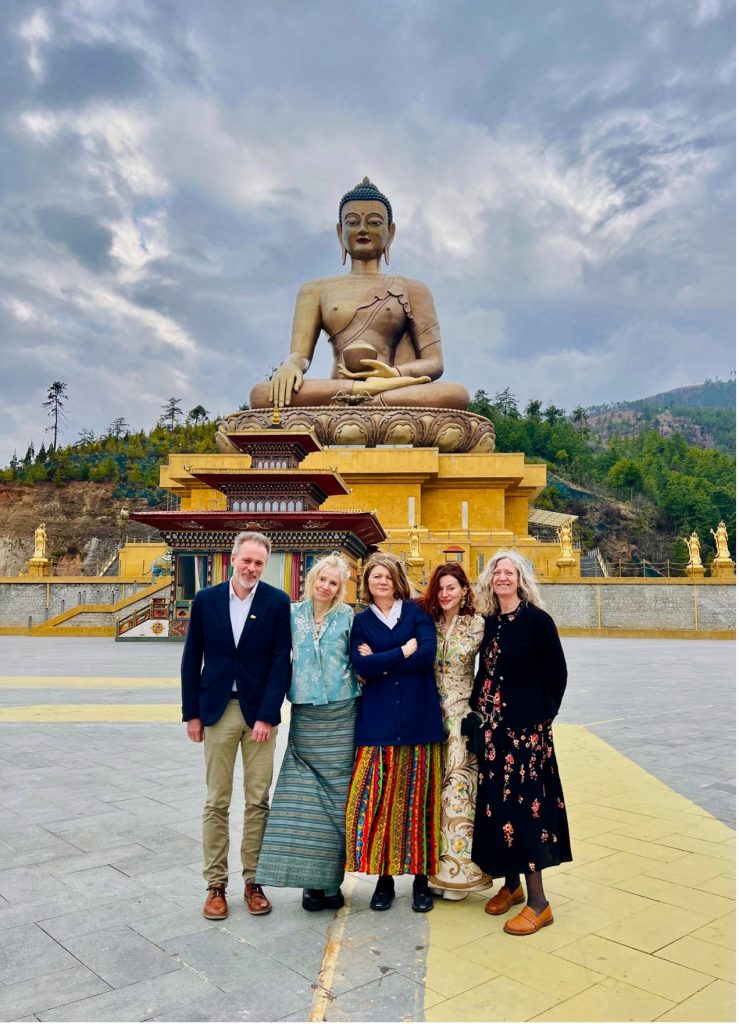
AFI team in front of Buddha Doredenma, popularly known as Buddha Point

Following our audience, we took an early evening trip to the massive 51,5-meters tall Buddha Doredenma statue of bronze and coated in gold, overlooking Thimphu and housing 125 000 smaller Buddha statues and a meditation hall. The total cost ran up to US$100 million, and the statue was built by Aerosun Corporation of Nanjing, China, and sponsored by Rinchen Peter Teo a Singaporean businessman and Danny Wong, a Hong Kong based Malaysian businessman, and it was inaugurated in 2015.

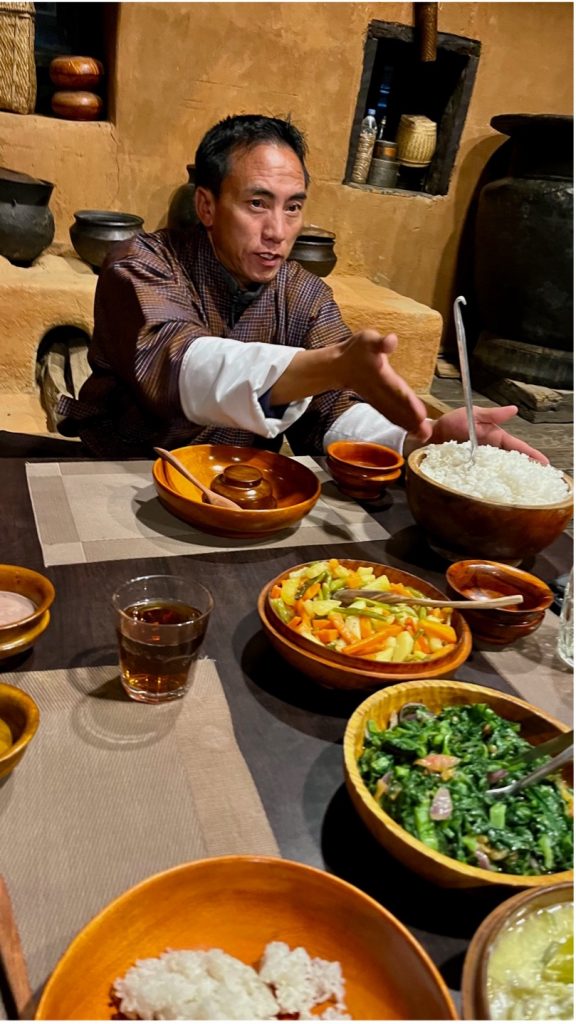
In the evening we enjoyed a traditional Bhutanese dinner, seated on the floor, tasting the famous butter tea (suja) with puffed rice (zhou), ema datshi, a spicy stew made from hot chili peppers and cheese, and a range of other dishes, such a spinach, asparagus and fried pork.

Dining with our precious driver Tsheltrim Tenzin who took care of us throughout the whole week and navigated the demanding terrain with grace.
Kategorier
Internationalization

Bridges to the Future: Cultivating Norway-Bhutan Research Synergies

Our next day in Paro began with sunshine, announcing the bright future of our research collaboration. This day was dedicated to a futures workshop designed by Arne Bygdås and employed futures thinking methods to explore shared interests and to deepen our mutual understanding.

But prior to that, Arne introduced the OsloMet Policy Lab, an initiative dedicated to strengthening the capacity to anticipate and shape long-term societal developments for a more just and sustainable world. He showed how the lab’s intention to move beyond purely utilitarian foresight and to help researchers break out of disciplinary silos and imagine positive, alternative futures amidst a global reality of ‘polycrisis’ aligns with the visions that underpin both the GNH and the work of legal researchers at JSW, as they are deeply futures-oriented. By integrating futures studies with a holistic focus on human security, well-being, and dignity, the Policy lab links academic insights to real-world policy innovation – in this sense, there is a deeply shared interest with the work at JSW.

Nima Dorji presenting the outline of our future joint research project.

Through international research collaborations, both institutions seek to enrich our collective visions of the future in active dialogue with their international partners. Establishing this shared baseline, we moved on to engage in the dialogic futures workshop.

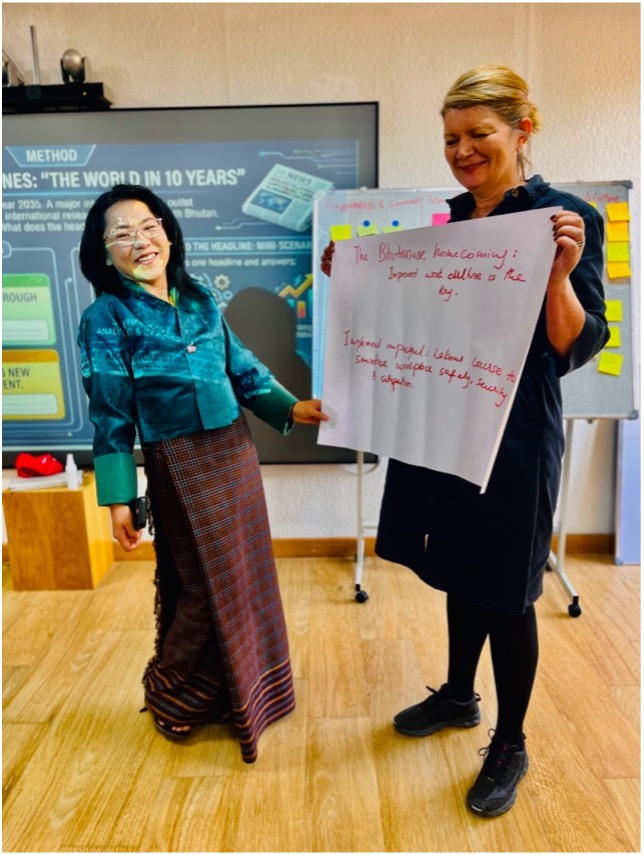
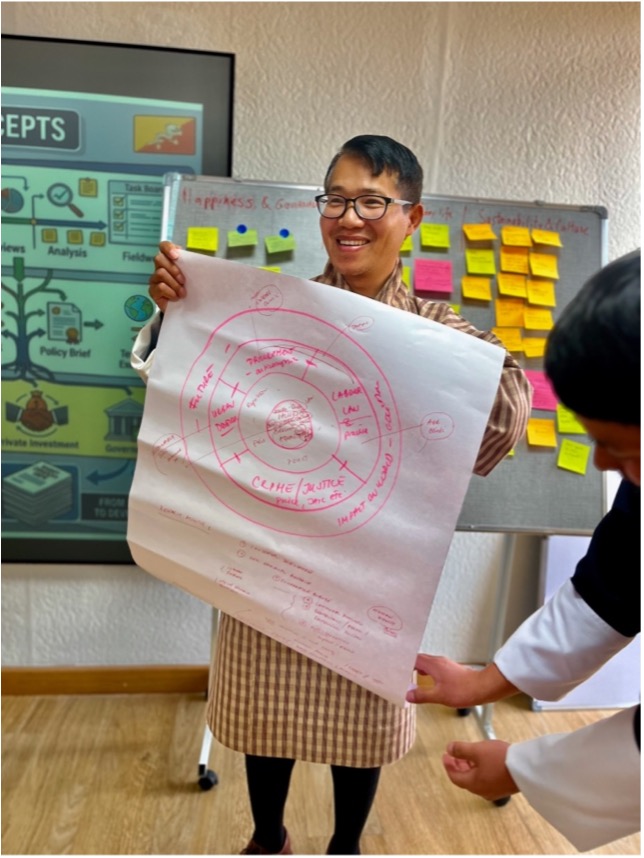
With eight participants from JSW and the five of us, the rooms filled with lively and constructive debate and we developed an outline for a joint research project. We concluded the day by thanking each other for a rewarding experience and with a shared commitment to continue developing our plans for collaboration.

After concluding our intensive workshop and parting with our newly found colleagues and friends, we journeyed to the capital of Thimphu, where we were to stay for the next three nights.

From left to right, top to bottom: Pema Wangdi, Dema Lham, Inger Marie Hagen, Christina Lindskog, Kristin Reichborn-Kjennerud, Arne Bygdås, ….Mahesh Gajmer, Karma Choden, Nima Dorji, Tereza Østbø Kuldova, Chencho Tshering, Tenzin Wangchuk, Ugyen Wangdi.
Kategorier
Internationalization

On the green campus of the JSW School in Paro

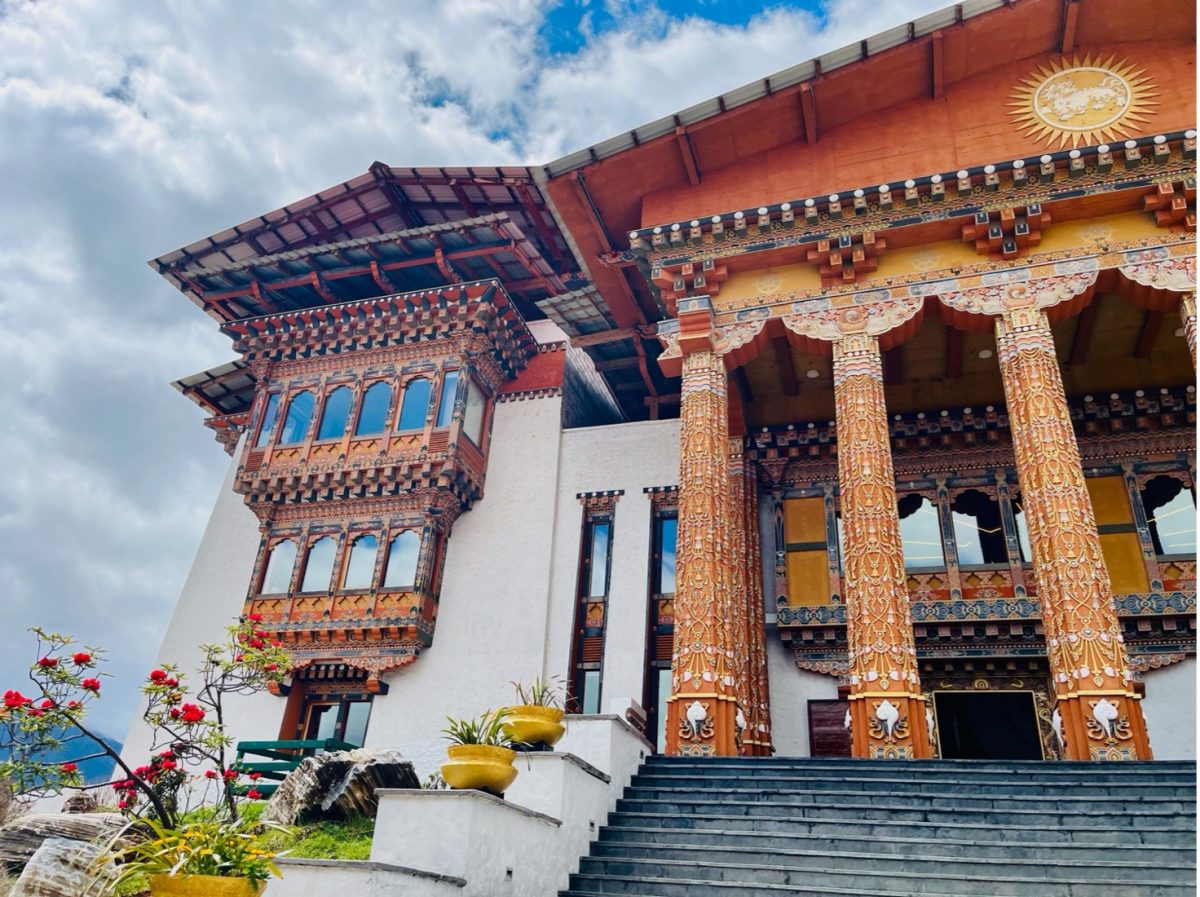
The beautiful and peaceful campus of JSW School of Law immediately impressed us. It is located on a hillside overlooking the town and the Himalayan mountains, at 2700 meters above sea level. For a tour of the campus, see: https://www.youtube.com/watch?v=xyslybnn2Do

We were welcomed by Sangay Dorjee, founding Dean, the Chief Executive Officer of the Law School and Nima Dorji, Vice Dean for Academic Affairs and other faculty members.

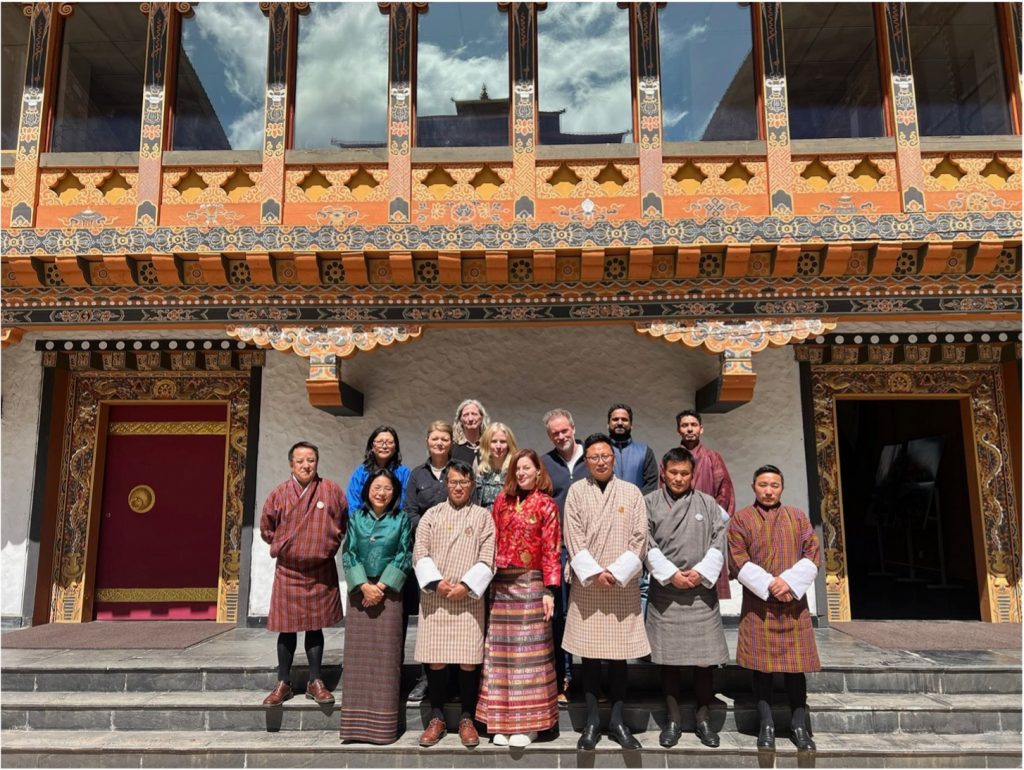
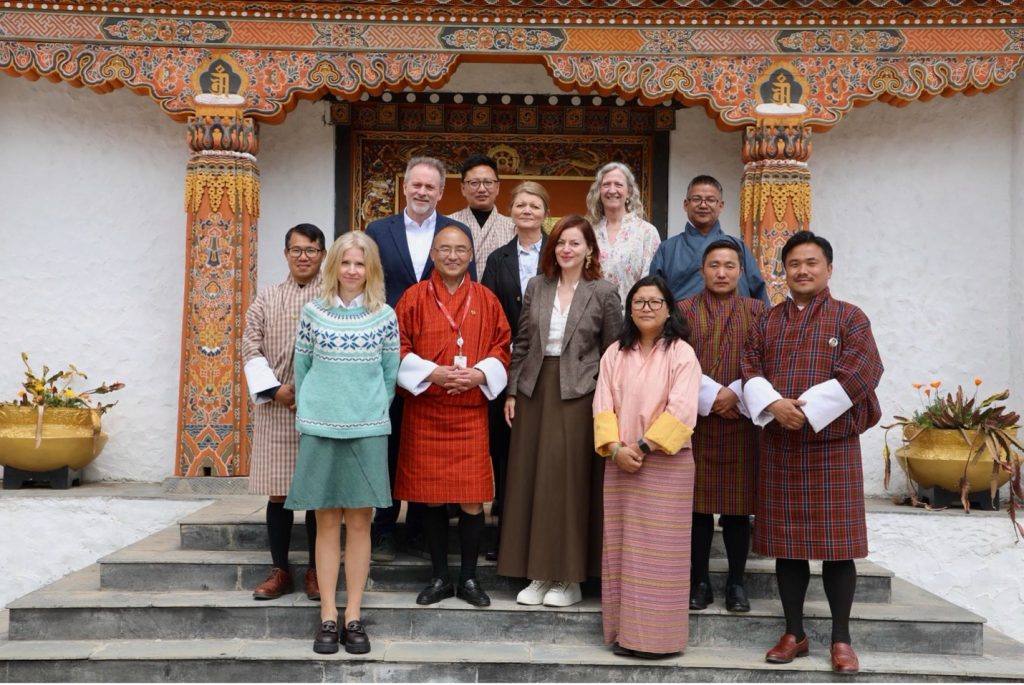
From left to right, top to bottom: Arne Bygdås, Chencho Tshering, Inger Marie Hagen, Christina Lindskog, Sonam Tshering, Nima Dorji, Kristin Reichborn-Kjennerud, Sangay Dorjee, Tereza Østbø Kuldova, Dema Lham, Ugyen Wangdi, Ugyen Dorji.

Following a series of mutual introductions, we began learning more about policy development and the legal and regulatory history and system in Bhutan and the conversation soon turned to potential shared interests, areas for collaboration, and common challenges.

The representatives of JSW School of Law expressed their interest in collaborating with institutions in Nordic countries, provided they are based on principles of equity – values that we, too, naturally cherish. We took a small step towards establishing future research collaborations and institutional partnership.

Following our morning meeting and a tour of the spectacular campus, we were treated to a wonderful and colourful Bhutanese lunch.

In the afternoon, AFI researchers held a series of lectures in in what must be among the most beautiful conference rooms in the world, with a spectacular view of the Himalayas.

  • Tereza presented her work on anti-corruption and regulation under the title Regulatory Capitalism, Anti-Policies and the Compliance-Industrial Complex: On the Cascading Failures of Dominant Governance Regimes and the Need for Alternatives,
  • Inger Marie offered an in-depth introduction into the Norwegian labour regulation, under the title The Norwegian Working Life Model: A Bundle of Productive Tensions and
  • Kristin Reichborn-Kjennerud presented her critique of New Public Management under the heading Sacrificing Sustainability at the Altar of Efficiency? The Case of Urban Development and Public Procurement of Food in Norway.

The lectures were well-received and offered a productive starting point for discussions that followed the next day.

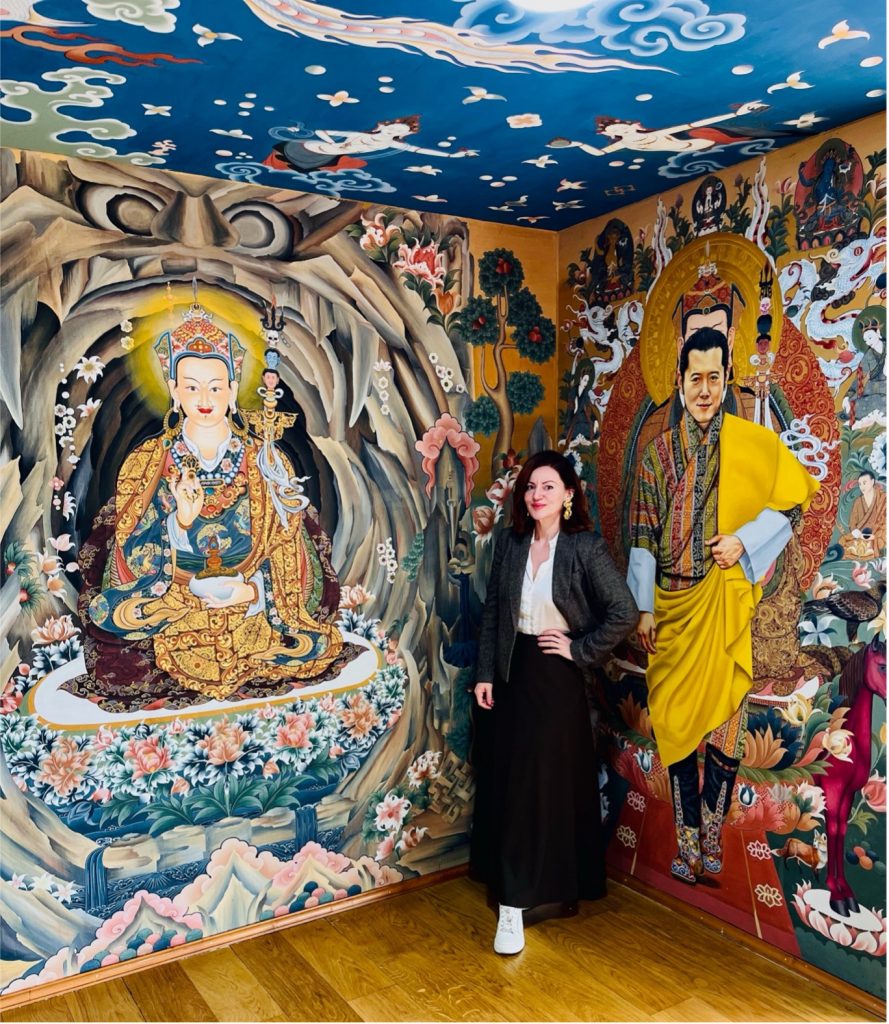
Tereza Østbø Kuldova inside the temple at the JSW School of Law campus, between the paintings of Guru Rinpoche (Padmasambhava or ‘Born from Lotus’) who brough Buddhism to Bhutan in the 8th century and His Majesty Jigme Khesar Namgyel Wangchuck, the current, Fifth King of Bhutan.
Kategorier
Internationalization

Where GDP is replaced by GNH: Gross National Happiness

Bhutan. Traditionally portrayed as ‘sandwiched’ between the powerful geopolitical players, India and China, this small Himalayan kingdom is set on building a brand new Gelephu Mindfulness City (GMC) and on repositioning itself as a strategic economic gateway connecting South Asia with Southeast Asia.

About the size of Switzerland and home to roughly 800,000 people, Bhutan has earned global attention for doing something radically different: instead of measuring progress through Gross Domestic Product (GDP), it focuses on Gross National Happiness (GNH). It is the GNH principles that Bhutan – led by the global vision of its fifth king, His Majesty King Jigme Khesar Namgyel Wangchuck, seeks to embed in the emerging megacity of Gelephu – a special administrative region (SAR) envisioned as an oasis of mindfulness, prosperity, compassion and human flourishing, an alternative path of development amidst increasing global uncertainties and geostrategic challenges – one grounded in Bhutanese values.

Can this vision succeed and become a real alternative to the failed megacities of South Asia and the Middle East mired by corruption scandals, financial speculation, labour and human rights abuses, and failures to deliver on their utopian promises?

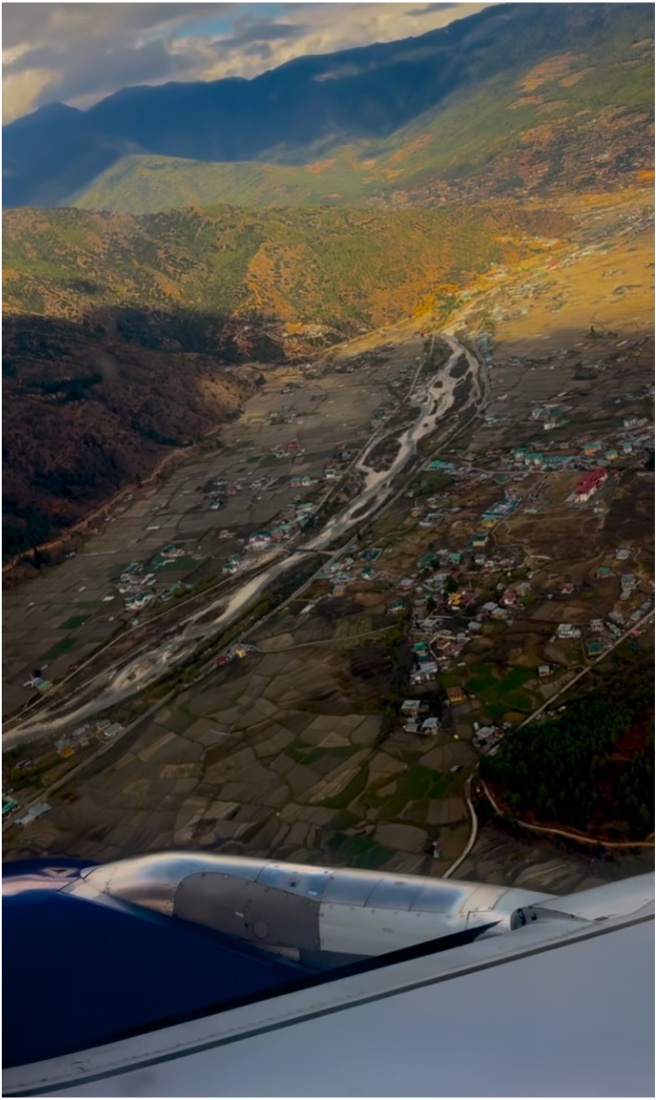
This was just one of the questions we, four researchers and one HR-advisor from The Work Research Institute at Oslo Metropolitan University, contemplated as we landed at the Paro airport. Our mission — sparked by the Policy Lab at OsloMet — was to search for inspiration for new ways of thinking about future, governance and regulation, while building new international research collaborations, partnerships and developing future research projects.

So how did we end up on a plane to Bhutan? It all began when one of the research directors at AFI, Tereza Østbø Kuldova, was contacted by the Indian embassy in Oslo and asked whether she would like to meet with a delegation from Bhutan in search of new research collaborations and networks in Norway. Few weeks later, Tereza and her colleague Kristin Reichborn-Kjennerud welcomed Dendup Chophel, a Bhutanese anthropologist and a postdoctoral fellow at the University of Copenhagen, at AFI.

The hours spent discussing the Norwegian and Bhutanese model, the similarities and differences between our countries and the ideologies underpinning our governance models, both grounded in strong societal values, sparked an immediate desire to learn more, explore, understand and collaborate for mutual benefit.

While Bhutan may look to the Norwegian model and to Nordic countries as an inspiration for its own reforms, there is much that Norway could learn from Bhutan’s focus on the primacy of happiness and sustainability in governance.

Both Tereza and Kristin have spent years researching the failures, pitfalls and unintended consequences of western governance and regulatory models, from anti-corruption, compliance to urban transitions. When Dendup extended an invitation to Bhutan on behalf of the JSW School of Law in Paro, we immediately recognized multiple possible and exciting paths for future research collaboration.

But Tereza also recognized that we needed more expertise from our side to address the questions raised in our discussion, hence, she recruited three more team members onto this mission of OsloMet to Bhutan: Inger Marie Hagen, an expert on the Nordic model of industrial relations, Arne Bygdås, who is enthusiastically building up future studies at OsloMet, and Christina Lindskog, HR advisor and university diplomat in the making.

Few months and several Zoom meetings later, our team, equipped with a letter from the rector, Christen Krogh, designating Tereza as the Special Envoy for Research Internationalization to the Kingdom of Bhutan, and supported by funding from the Policy Lab at OsloMet and encouragement from its leader, Kåre Hagen, finally landed in Paro on the 22nd of March, welcomed by representatives of the JSW School of Law and Tshering Tashi.

What follows is a blog summarizing some of our encounters with the beautiful country, its scholars, lawyers, intellectuals, diplomats – and even the princess Sonam Dechan Wangchuck.

We thank Dendup Chophel and Nima Dorji for organizing our visit and putting together such an exciting program which has given us a unique insight into the Kingdom of Bhutan, we remain eternally grateful.

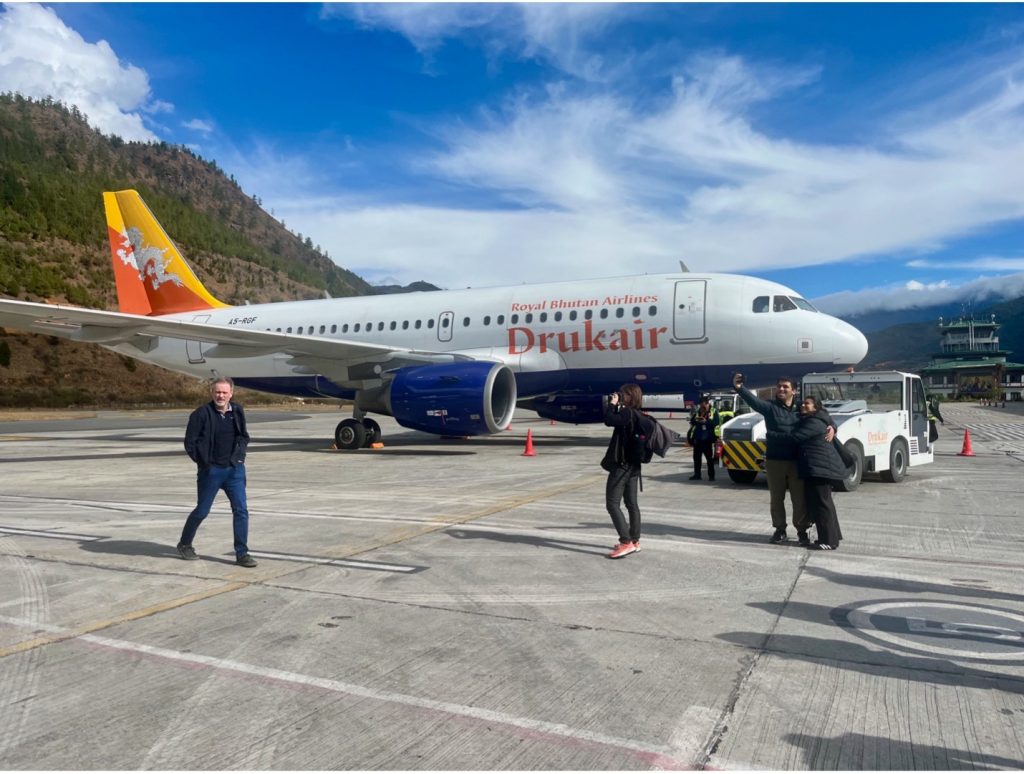
Arne Bygdås in front of Drukair plane, the national flag carrier of the Kingdom of Bhutan owned by the Royal Government in Bhutan. Druk stands for ‘Thunder Dragon’ in Dzongkha, the national language – a vital national symbol; Bhutan is known as Druk Yul, the Land of the Thunder Dragon, its people as Drukpa and its leaders as Druk Gyalpo or Dragon Kings.
Kategorier
Internationalization

On our way to Bhutan!

Part of the Policy Lab team is on its way to Bhutan. Watch this space for updates from their trip!

Kategorier
Event Internationalization

Guest Lecture: Cris Shore

The Policy Lab (SVA) and Labour and Democracy Hub (AFI) at OsloMet are hosting a guest lecture with Cris Shore, Emiritus Professor of anthropology at Goldsmiths University of London, on 9 June 2026.

The lecture is titled Management Consultants, University Futures, and the New Academic Capitalism, and will be followed by a panel discussion.

Read all about the event (and put it in your calendar):