
Welcome to the 12th International
Conference on the Safety of Journalists at OsloMet
The research group MEKK at OsloMet, in cooperation with the Fritt Ord Foundation and UNESCO Norway invites you to this year’s conference on the safety of journalists in war reporting. As armed conflicts continue in Gaza, Ukraine, Lebanon, Congo, Sudan, Myanmar and many other places, journalists and media workers face unprecedented risks. More journalists and media workers were killed in 2025 than in any other year since the Committee to Protect Journalists started collecting data more than three decades ago. We dedicate this year’s conference to examining journalist safety in conflict reporting, while maintaining our broader commitment to all aspects of journalist safety worldwide.
Please register here: https://nettskjema.no/a/663709#/page/1
Programme Day 1: Monday 2nd of November 2026
08:30: Registration and Coffee, OsloMet, Pilestredet 46, Athene.
09:00: Conference Opening
Welcome by Professors Kristin Skare Orgeret & Roy Krøvel, the MEKK group, OsloMet.
Opening by Tanja Storsul, Pro-Rector for Research and Development, OsloMet
Opening Video from UNESCO, Paris
Kjersti Løken Stavrum, CEO of the Tinius Trust.
Music by Svein Amund Skara
Frédéric Chopin: Prelude in d minor, Opus 28 No.24
Edvard Grieg: Trolltog/ March of the Trolls
Harald Sæverud: Ballad of Revolt
09:30: Opening Keynote:
Bruce Mutsvairo, Professor, Utrecht University/Interim Dean Amsterdam University:
No Ceasefire for Facts: Navigating New Realities of Conflict Journalism in an era of Perpetual Geopolitical Hostilities
10:00: Ghada Oueiss, Journalist and Principal Presenter, Al Jazeera:
When Journalism Becomes a War Zone: Violence, Surveillance, and Trauma.
10:30: Break
10:45: Nataliya Gumenyuk, Ukrainian journalist, CEO & Co-Funder, Public Interest Journalism Lab:
Message from the Kill Zone: This Is What War Reporting Will Look Like
11:15 -11:20 Oleksandra Hrybenko, Ph.D. Candidate and project coordinator OsloMet:
Introduction to the Shared Frontlines and Democracy Project.
11:20 – 11:45 Olha Kyrylenko, Reporter, Ukrainska Pravda:
On How Ukrainian Journalism Changed After the Russian Full-scale Invasion
11:45 : Q&A
12:00: Lunch
13:00 – Paper Sessions, P46 3rd floor (see detailed programme)

Programme Day 2: 3rd of November 2026
09:00: Nabeelah Shabbir, Deputy Director of the Information Integrity Initiative, The Nerve. Presenting the 2026 UN Women report
09:30: A Conversation between Anders Hammer, Oscar and Emmy-nominated Documentary Filmmaker & Stefan Brenner, Ph.D. candidate at OsloMet
10:15: Break
10:30: Leire Iturregui Mardaras:
Exploring Journalist Safety in Conflict Reporting Through Collaborative Research (JOSAFCON).
11:00: Panel: “International Media and the Changing Landscape of Solidarity with Local Journalists“
- Hanan Badr, Professor of Public Spheres & Inequalities, University of Salzburg
- Vera Slavtcheva-Petkova, Professor of Global Journalism and Communication, University of Liverpool
- Thais Armengol, Independent investigative journalist and criminologist, and Ph.D. candidate at Blanquerna – Universitat Ramon Llull
- Maria Gabrielsen Jumbert, Senior Researcher, Peace Research Institute Oslo (PRIO)
12:00: Lunch
13:00: Keynote: Scott Griffen, Executive Director, The International Press Institute
Safety of Journalists and War Reporting, from the IPI Archive to the Impunity Day Campaign.
14:00: Break
14:15: Paper Sessions P46 3rd floor (see detailed programme)
November 2025:
Welcome to the 11th International
Conference on the Safety of Journalists hosted by the Oslo MEKK research group at OsloMet
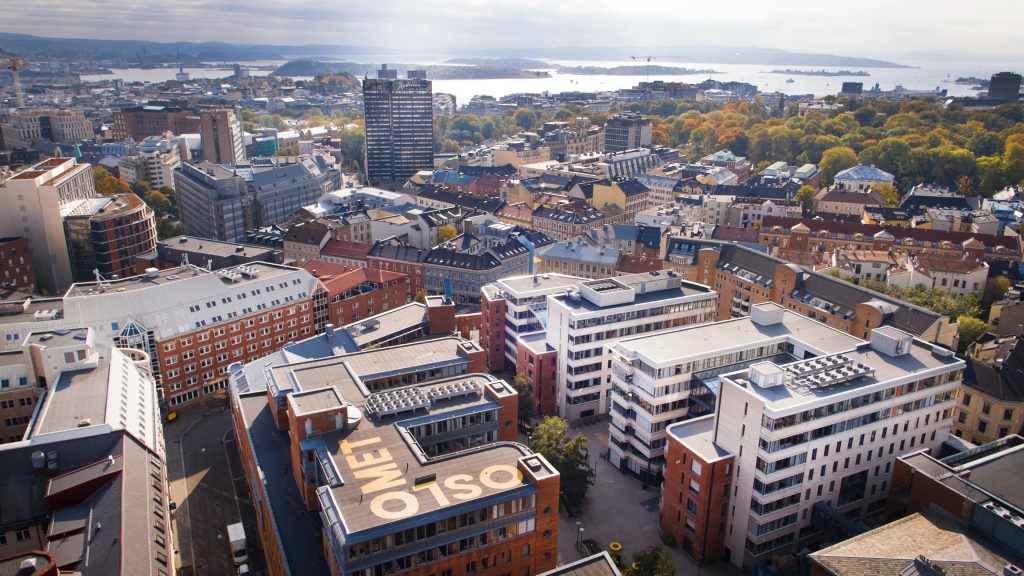
2025: Safety of Journalists Conference: Journalism Under Pressure – Reporting in Authoritarian Democracies

This 11th annual conference on the Safety of Journalists addresses two converging Threats: Blurring Lines Between Democratic Backsliding and Authoritarian Façades
We are currently seeing two parallel and concerning developments. On the one hand, some established democracies are gradually taking into use techniques often linked to authoritarian systems. These include surveillance technologies, SLAPP lawsuits, manipulation of media ownership, and regulatory restrictions limiting press freedom.
On the other hand, authoritarian regimes increasingly adopt superficial democratic elements such as controlled elections or managed civil society organisations to appear more legitimate while keeping strict control. This conference explores these developments through two connected research themes.
Theme One: Eroding from Within – The Updated Authoritarian Playbook in Democracies
This theme explores how established democracies are undermining press freedom from within. Governments are using legal, economic, and technological tools to slowly weaken the protections that have traditionally supported journalism.
Rather than using direct repression, these governments apply more subtle but very effective methods to control or reduce the influence of independent media.
Theme Two: Democratic Façades – Working in Authoritarian Systems That Use Democratic Language
This theme examines how journalists carry out their work in countries that use the appearance of democracy while functioning in authoritarian ways. These regimes often allow some opposition and media space, but within tight boundaries designed to maintain control and avoid true accountability.
Special Focus – Vulnerable Communities and Press Freedom
This year’s conference pays particular attention to how violations of press freedom affect vulnerable groups. Journalists who belong to or report on these communities often face extra risks.
Programme Day 1: 3rd of November 2025
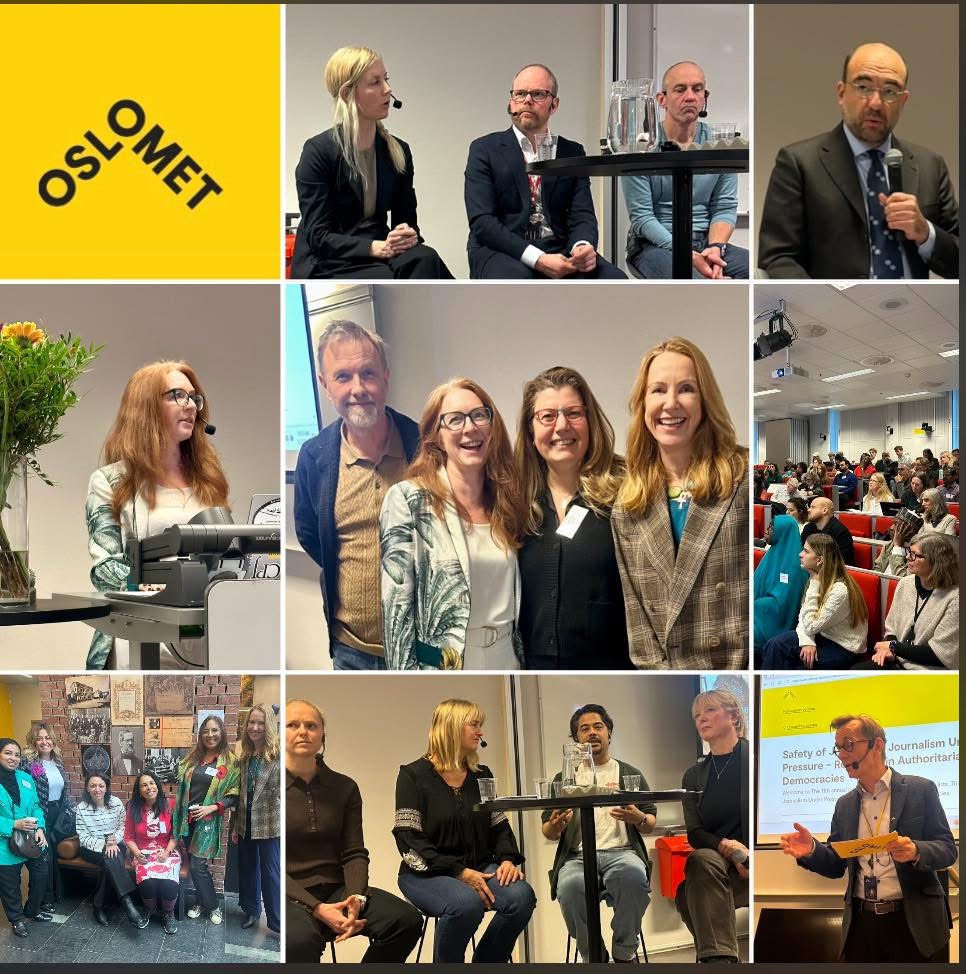
08:30: Registration and coffee, Pilestredet 46, Athene.
09:00: Conference opening
Welcome by Professors Kristin Skare Orgeret & Roy Krøvel, from the MEKK research group, OsloMet
Opening by OsloMet Rector Christen Krogh
Introduction, by Andrea Cairola, Advisor, Section for Freedom of Expression and Safety of Journalists, UNESCO, Paris
Music by Svein Amund Skara
Harald Sæverud: Ballad of Revolt (Kjempeviseslåtten)
Frédéric Chopin: Revolutionary etude (Revolusjonsetyden)
09:30: Opening Keynote: Jodie Ginsberg, Director of the Committee to Protect Journalists
10:00: Dr. Zahera Harb, City St George’s, University of London: “Rethinking Impartiality in times of Human Tragedies
10:30: Q&A
10:50: Break
11:10: Panel: Norwegian media’s reactions to the War on Gaza
Randi S. Øgrey, Norwegian Media Businesses’ Association, Margrethe Håland Solheim, Norwegian Union of Journalists, Yohan Shanmugaratnam, Norwegian newspaper Klassekampen.
Chair: Anne Hege Simonsen, Head of Department of Journalism & Media Studies, OsloMet
12:00: Lunch
13:00: Coping with Threats
Gard Steiro, VG, Norway
Rolf Widerøe, VG, Norway
Jessikka Aro, Investigative reporter, Finland, specialized in Russian information warfare.
Professor Elana Newman, Tulsa University, USA.
14:15–16:30: Paper Sessions (please see programme below)
Programme Day 2: 4th of November 2025
Athene, Pilestredet 46, Oslo
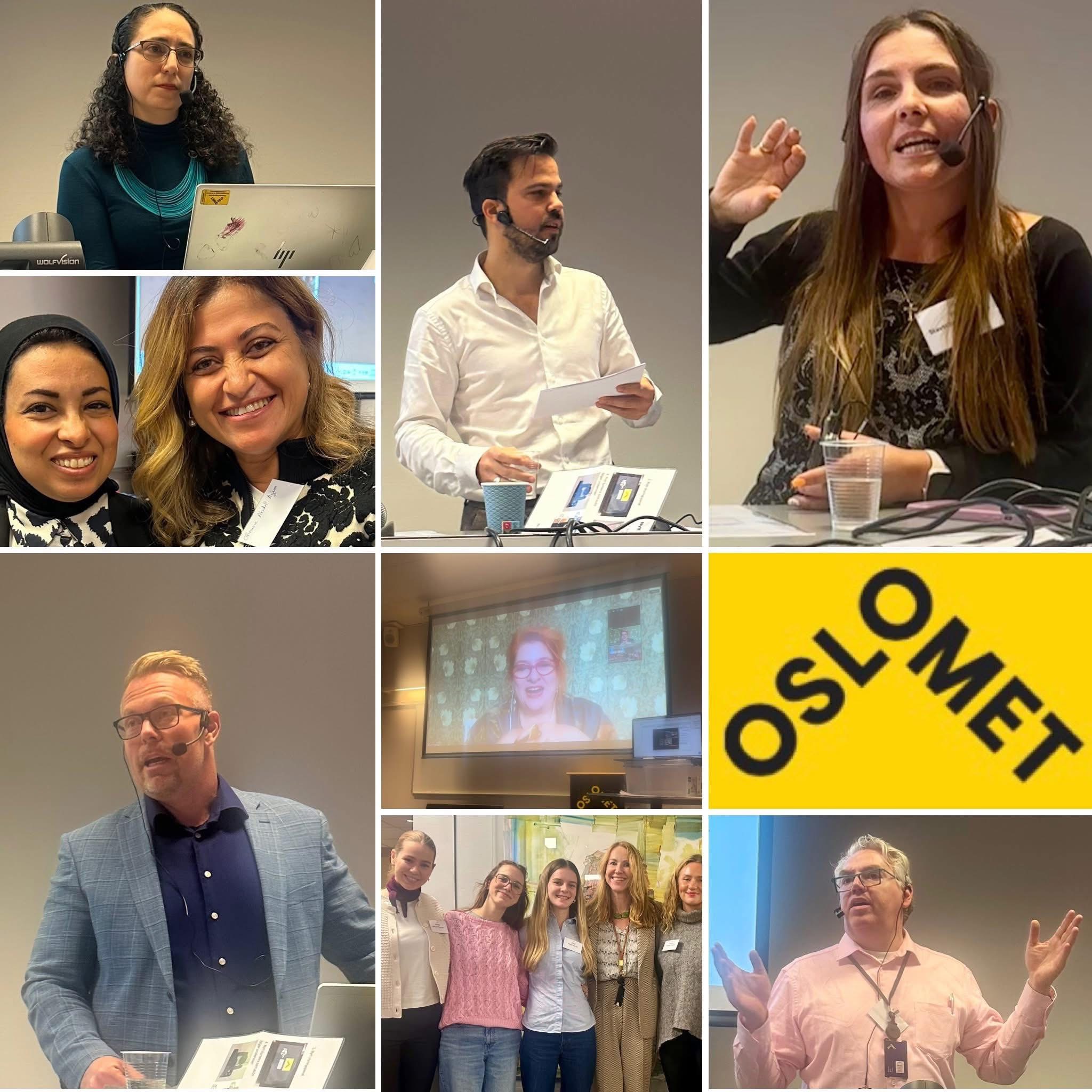
09:00: Keynote: Emilia Díaz-Struck, (Global Investigative Journalism Network): «Safety and Investigative Journalism».
09:30: Panel: The safety of journalists in times of increased influencing campaigns
Introduction by Dr. Paul M. H. Buvarp, Norwegian Defence Research Establishment
Neena Kapur, Senior Director of Information Security at The New York Times.
Lothar Fritch, Professor of Applied Cybersecurity at OsloMet.
10:30: Break
11:00: Dr. Vera Slavtcheva-Petkova, University of Liverpool: Introducing the Global Safety of Journalism Index.
11:30: Panel: Notes on Exile
Professor Claudia Tazreiter in conversation with journalist, filmmaker, writer, human rights defender Behrouz Boochan
A discussion with Cherine Abdelazim Ahmed Alsanea and Noha Lamlom, Egyptian journalists and safety trainers working with exiled journalists.
12:30: Lunch
13:30: Dr. Julie Posetti, City University, London, ICFJ: «The Chilling: Online Violence in the Age of AI.» Presenting the top line findings, released on November 3rd, of a large study with UN Women.
14:00: William Bird, Media Monitoring Africa: Introducing the Joburg Declaration – an independent initiative for media integrity and healthy information ecosystems launched at the Media20 ahead of the upcoming G20 in South Africa.
14:30: Oscar Westlund, Professor at OsloMet: «Public Knowledge and Expertise Under Authoritarian Siege: A Defense of Academic Freedom».
15:15–17:00: Paper sessions
(Please see Programme below)
Paper Sessions
NOVEMBER 3, 2025 – AFTERNOON SESSIONS
SESSION 1: Digital Surveillance, digitally enabled repression and cybersecurity.
Room: PA314 | Time: Nov 3, 14:15-15:15
Chair: Hanan Badr (University of Salzburg, Austria).
1. Gifty Appiah-Adjei (University of Education, Winneba)
Digital Surveillance Technologies: The Case of Ghana.
2. Miral AlAshry (University of East London/ EUE, Egypt (EUE)
Hacking vs. Cybersecurity: How Governments Use Digital Tools to Suppress Journalists in the MENA region.
3. Arulchelvan Sriram (Anna University)
The Use of Surveillance Technologies Against Journalists in Democratic States – Watching the Watchdogs.
SESSION 2: SLAPP Lawsuits, legal harassment and intimidation
Room: PA318 | Time: Nov 3, 14:15-15:15
1. Allen Munoriyarwa (Walter Sisulu University) Courage Under Fire: SLAPP and the Botswanian Media Experiences.
2. Athina Simatou (National and Kapodistrian University of Athens)
SLAPPs in Greece: Oppressive Legal Tactics in a Democratic State and the Limits of the EU Anti-SLAPP Directive.
3. Luciano Teixeira (USP – São Paulo University)
Silencing through the courts: Luciano Hang, Bolsonarism and the rise of SLAPPs in Brazil
Katharina Wuropulos (Bergen University)
Working with diffuse fear: Personalised intimidation of journalists (Authors: Katharina Wuropulos and Alexia Hack)
SESSION 3: AI, Technology and journalistic practices
Room: PA 329 | Time: Nov 3, 14:15-15:15
1. Abit Hoxha and Georgios Terzis (University of Agder) Artificial Intelligence as safety agent: Between threat and opportunity of AI influence on journalistic work.
2. Jannis Frech (University of Hamburg) Threats from abroad: How a shifting global context influences German journalists’ perception of digital security
3. Ioanna Georgia Eskiadi (Aristotle University of Thessaloniki), presented by Ilias Nikezis :
Immersive Journalism under Authoritarian Pressure: Risks, Resistance and the Future of XR in Global Newsrooms
4. Svea Vikander (University of the Basque Country) Machine Translation and Sámi Journalism: AI’s Impact on Minority Languages.
SESSION 4: Turkey’s Authoritarian Playbook
Room: PA 301 | Time: Nov 3, 14:15-15:15
1. Özge Somlyai (Eötvös Loránd University (ELTE)
The changing scope and role of alternative media in countering authoritarian narratives in Turkey.
2. Barış Çoban (Dogus University)
Authoritarian Playbook for Silencing Journalism: Surveillance, Disinformation, and the Criminalisation of Independent Journalism in Turkey.
3. Deniz Demir (Marmara University)
Journalism Under Symbolic Pluralism: The Illusion of Media Freedom in Turkey.
4. Elif Yılmazlı (Bianet)
Weaponizing the Law: Criminalizing of Journalism in Turkey.
SESSION 5: Alternative Spaces and Institutional Resilience
Room: PA347 | Time: Nov 4, 14.15-15.15
1. Mercedes De Luis Andrés (University of Klagenfurt)
Reading as Resistance: BoJoClubs and the Critical Reader.
2. ILIAS NIKEZIS (Aristotle University of Thessaloniki)
The Challenges of Building Resilience: Lessons from the International Center for the Safety of Journalists (ICSJ).
3. Murtaza Mohiqi (Agder University)
Code-Switching for Survival within Linguistic, Legal, and AI-Informed Frameworks of Press Freedom.
COFFEE BREAK: 15:15-15.30
SESSION 6: Violence against journalists in conflict zones
Room: PA314 | Time: Nov 3, 15:30-16:30
1. Muluken Asegidew Chekol (Northumbria University)
Ethnic Identity and the Repression of Journalists Covering Conflict: The case of Ethiopia (2020–2024)
2. Shahira Fahmy (American University of Cairo)
Identity as Resistance: Digital Journalism in the Time of Genocide.
3. Samuel Kazibwe (Uganda Christian University)
Between Violence, Trauma, and Resilience: Journalists’ Mental Health in Uganda and Greece (Authors: Samuel Kazibwe, Fred Kakooza, Pantelis Vatikiotis, Athina Simatou).
SESSION 7: Latin America’s press freedom crisis
Room: PA318 | Time: Nov 3, 15:30-16:30
1. Luis Rodrigo Pesce Villagómez (Universität Heidelberg)
Information Contro: Corruption and Impunity as Determinants of Anti-Press Violence in Mexico
2. Jose Luis Benitez (Independent researcher and consultant)
Central American journalism under the attacks of authoritarianism.
3. Daniela Osvald Ramos (University of São Paulo (USP)
Longitudinal aspects of violence against journalists in presidential election years in a (not-so) Democratic Brazil.
4. Elisabeth Saad (University of São Paulo)
Press Freedom, Expression, and Democracy Under Tension: A Study of Recent Cases in Brazil. (Authors: Elisabeth Saad, Daniela Ramos and Aianne Amado Costa)
SESSION 8: Foreign agents, laws and institutional exclusion
Room: PA329 | Time: Nov 3, 15:30-16:30
1. Kata Horváth and Gábor Polyák (Eötvös Loránd University)
Agents of Whose Interest? The Weaponisation of Legal Labels Against Critical Media.
2. Elisabeth Eide (OsloMet University)
No Reporting? Afghanistan’s New Dark Ages.
3. Syed Ashraf (University of Peshawar)
The Killer Geography of ‘Tribal’ Journalism: Existential Threats to News Labor in Pakistan’s Troubled Pashtun Periphery.
4. Abdur Khan (University of Dhaka)
Silencing the Fourth Estate: Authoritarian Consolidation, Ultra-Rightist Appropriation, and the Systemic Repression of Media
SESSION 9: Press freedom crisis, self-censorship and source protection
Room: PA301 | Time: Nov 3, 15:30-16:30
1. Sara Kezia Heinonen (Tampere University)
Rewriting Reality: Everyday Authoritarianism. Against Independent Journalists in Lebanon and Jordan.
2. Smitha Khorana (Independent scholar and journalist)
Surveillance and Source Protection.
3. Peter Tiako Ngangum (Université Libre Bruxelles (ULB)
Journalism under Pressure – Reporting in Authoritarian Democracies: The case of Amakembe Ekouli Emmanuel of La Voix du Centre.
Oleksandra Hrybenko (OsloMet University)
News fixing at the intersection of journalism fields: challenges and strategies of the Ukrainian fixers
NOVEMBER 4, 2025 – AFTERNOON SESSIONS
SESSION 10: Intersectional Threats and Vulnerable Communities
Room: PA318| Time: Nov 4, 15:15-16.30
1. Clémence Petit (UCLouvain)
Journalism Under Pressure: Violence Against Journalists and Their Coping Strategies in French-speaking Belgium.
2. Thandi Bombi (Wits University)
Protecting journalistic integrity: Exploring an ethics of listening otherwise for representing xenophobic violence in the South African context.
3. Leire Iturregui Mardaras (University of the Basque Country UPV/EHU) Revictimization, Emotional Suppression, and PTSD: How Working Conditions Shape Journalist Safety in Conflict Zones.
4. Kruger Franz (NLA University College/Wits University)
The double vulnerability of media on South Africa’s margins.
SESSION 11: Democratic decline, inequalities and journalist safety
Room: PA314 | Time: Nov 4, 15.15-16.15
1 Desiree Hill (University of Oklahoma) Negative Attention Means More Coverage: Media’s Influence on a Presidential Election.
2. Leopold Katubayemwo (St. Augustine University of Tanzania) An Exploration of the Coverage of Journalists’ Safety and Security in Journalism Education and Training in Tanzania.
3. Hanan Badr (University of Salzburg, Austria). Exiled Journalism and Inequalities – Mapping Exiled Journalists in Germany
4. Nechama Brodie (University of the Witwatersrand) Baseline survey of local and community journalists in southern and eastern Africa
SESSION 12: Media Responsibilities and Failures
Room: PA 347 | Time: Nov 4, 15:15-16.30
1. Rune Ottosen (OsloMet, Norway)
Media’s Underreporting of Norwegian Co-Responsibility for Syrian Regime Change”
2. Janara Nicoletti (DW Akademie)
Beyond the frontlines: organizational negligence and re-victimization as converging threats to journalist safety
3. Darina Sarelska (American University in Bulgaria)
Tracing the Authoritarian Playbook: Lessons from Bulgaria’s Regressive Media Model.
4. Ayala Panievsky (City St George’s University of London)
All Eyes on Gaza? The Israel- Hamas War in the Israeli Media
SESSION 13: Intersecting Press Freedom Challenges
Room: PA 301 | Time: Nov 4, 15.15-16.15
1. Raheemat Adeniran (Fountain University)
Press Freedom and Democratic Governance in Nigeria: A Nationwide Study of Journalists and Civil Society. (Authors: Raheemat Adeniran, Ismail Ibraheem, Busola Ajibola, Vincent Obia, Godwin Iretomiwa Simon, and Mojeed Alabi)
2. Umaru A. Pate (Bayero University)
Between Surveillance and Self-Censorship: Safeguarding Sources in Nigeria’s High-Risk Media Landscape.
3. Chetana Kunwar (Kathmandu University)
Reporting Under Pressure: Threats Against Jurnalists in Nepal’s Federal Democracy.
4. Mulatu Alemayehu Moges (University of Agder)
Oscillation between libertarian and authoritarian media systems in Ethiopia: A 30-Year Historical Review (1995–2024) (Authors: Mulatu Alemayehu Moges and Dessalew Getnet Ayalew).
SESSION 14: PhD Students Safety Matters Program
60 minutes | 3 team presentations | Geographic Diversity: Brazil, South Africa, Norway, USA
| Room: PA329 | Time: Nov 4, 15.15-16.15
Team 1: TRAUMA (10 minutes)
• Edilaine Heleodoro Felix (Brazil)
• Florence de Vries (South Africa)
• Nadine Christians (South Africa)
• Vitoria Paschoal Baldin (Brazil)
Team 2: GENDER (10 minutes)
• Gillian Jones/Mouton (South Africa)
• Alvaro Leme (Brazil)
• Jimmy (South Africa)
• Edilaine Heleodoro Felix (Brazil)
Team 3: CYBER SECURITY (10 minutes)
• Solrun Dregelid (Norway)
• Matthew Adams (USA)
• Mario Andrada (Brazil)
• Stefan Brenner (Germany)
About the 2024 conference:
2024: Safety of Journalists Conference – Elections and Coverage of War and Conflict
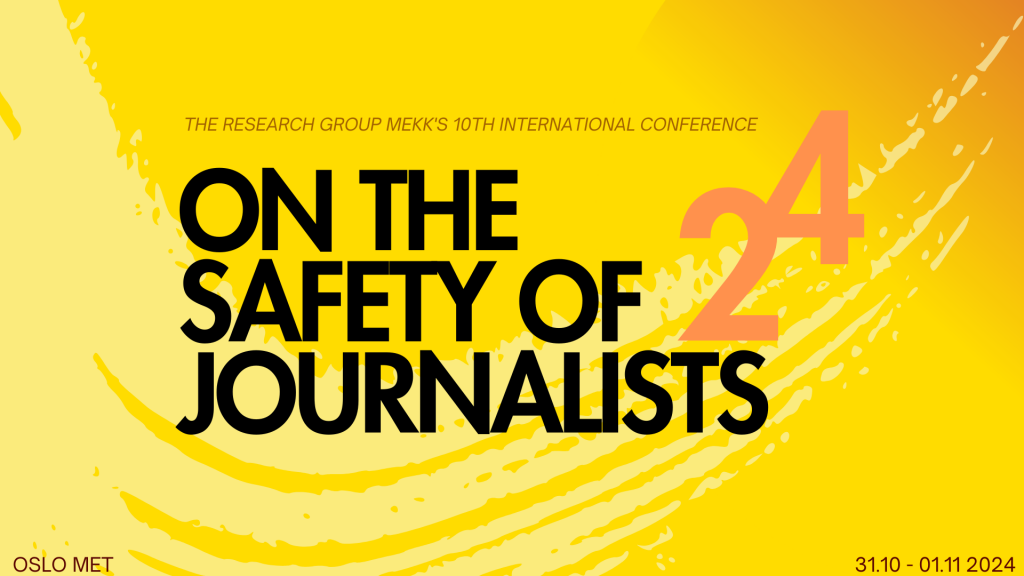
Welcome to the 10th International
Conference On the Safety of Journalists hosted by the Oslo MEKK research group.
This years conference on the Safety of journalists will address two main themes: journalists’ role in elections and their coverage of war and conflict.
We are excited to present this year´s program:
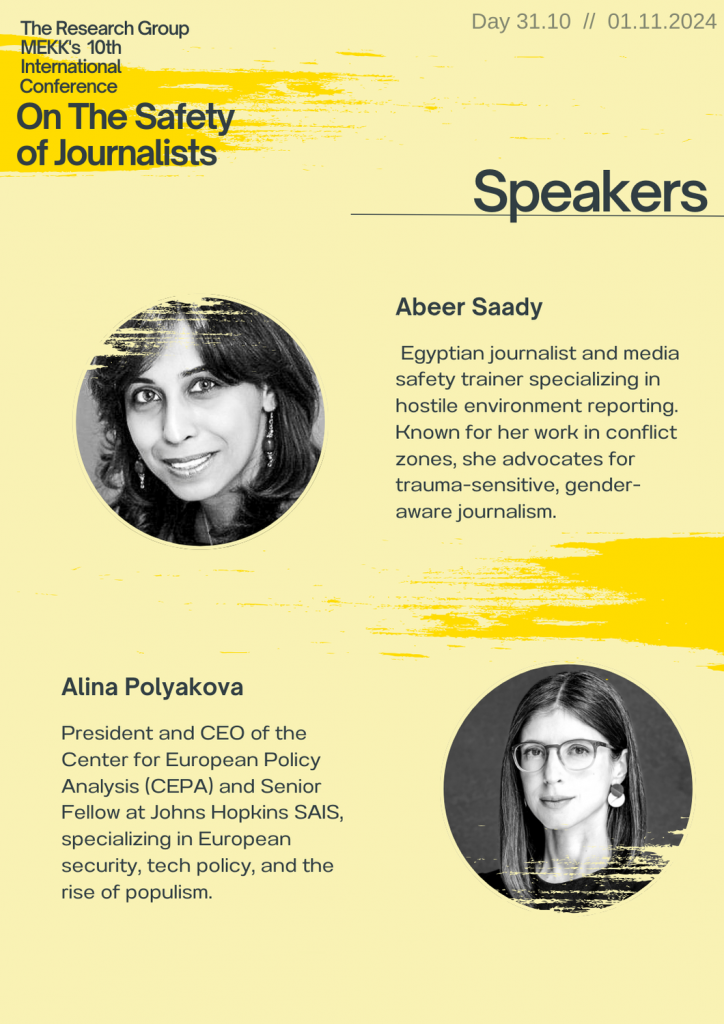
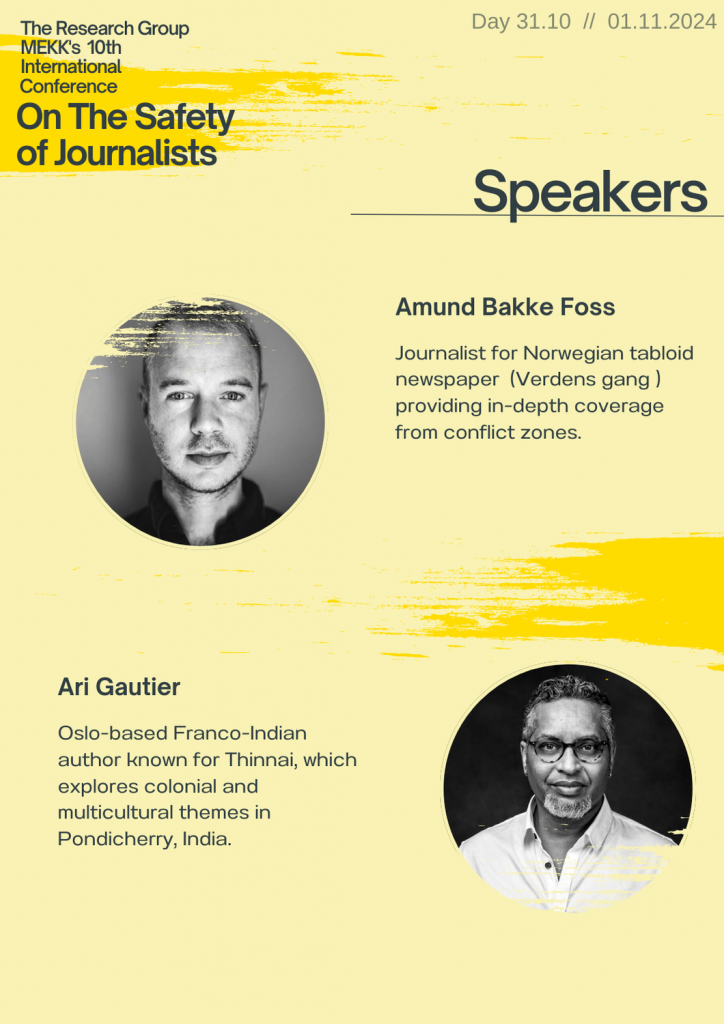
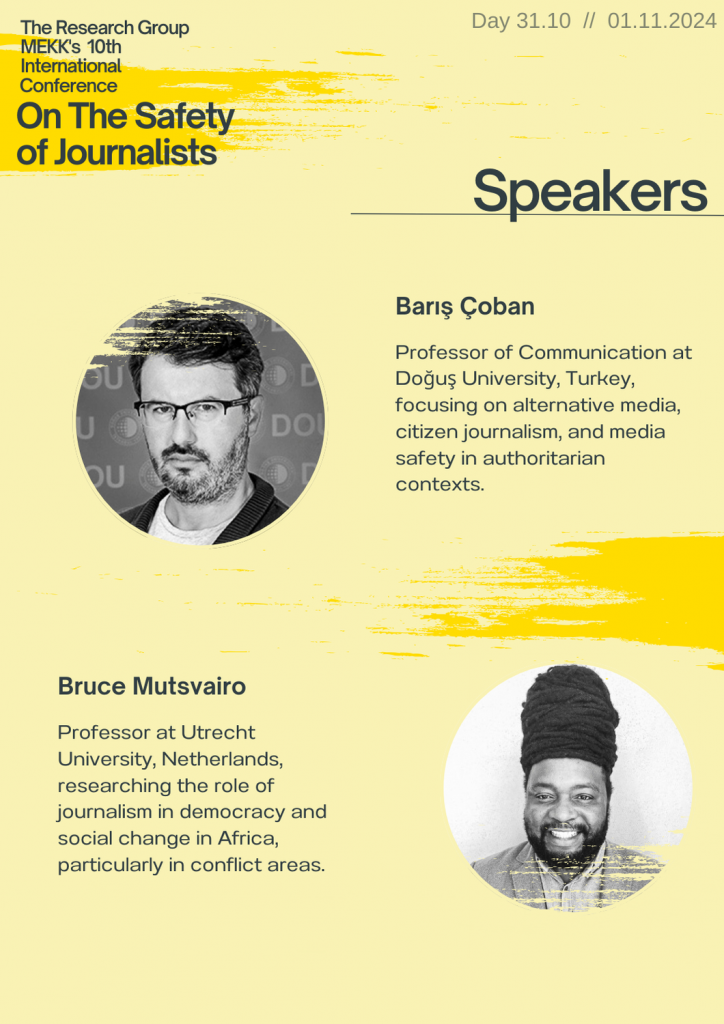
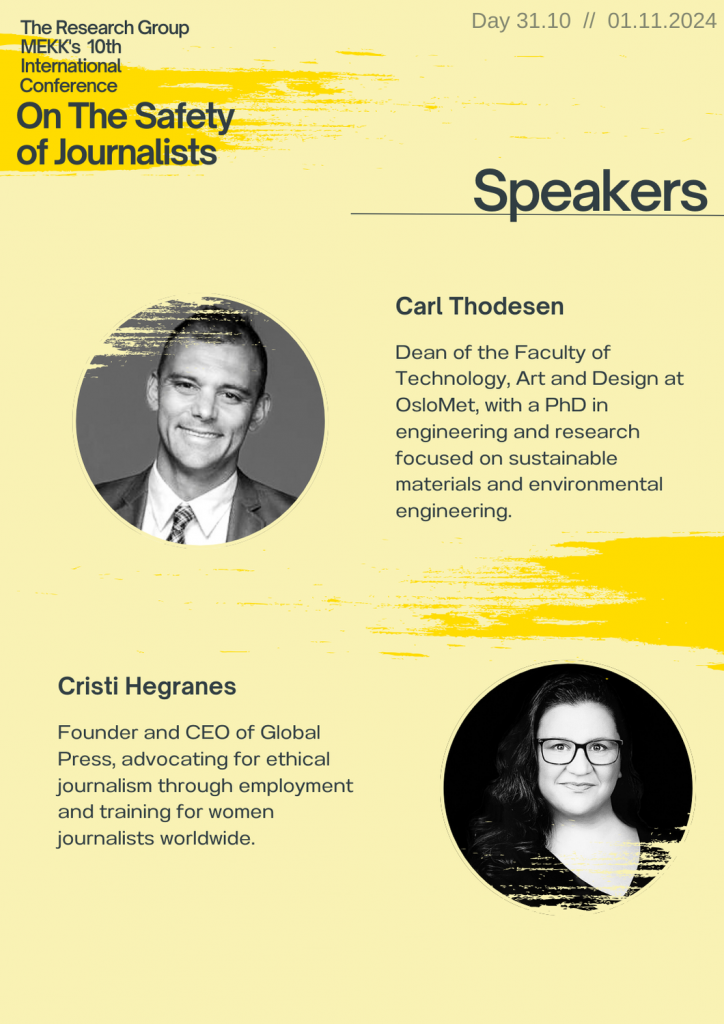
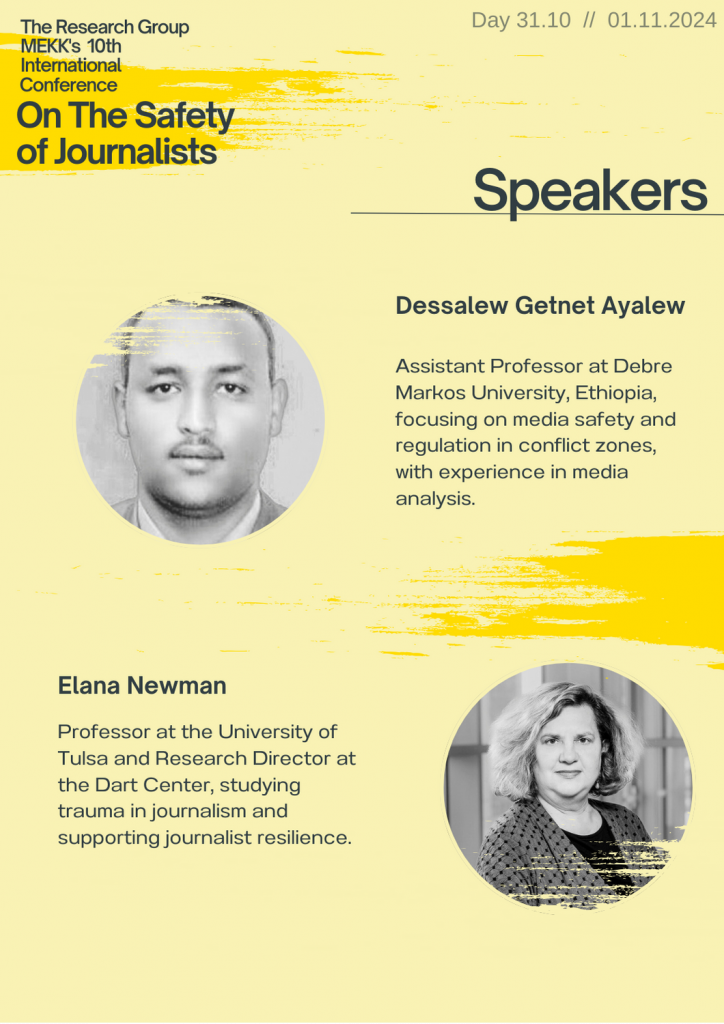
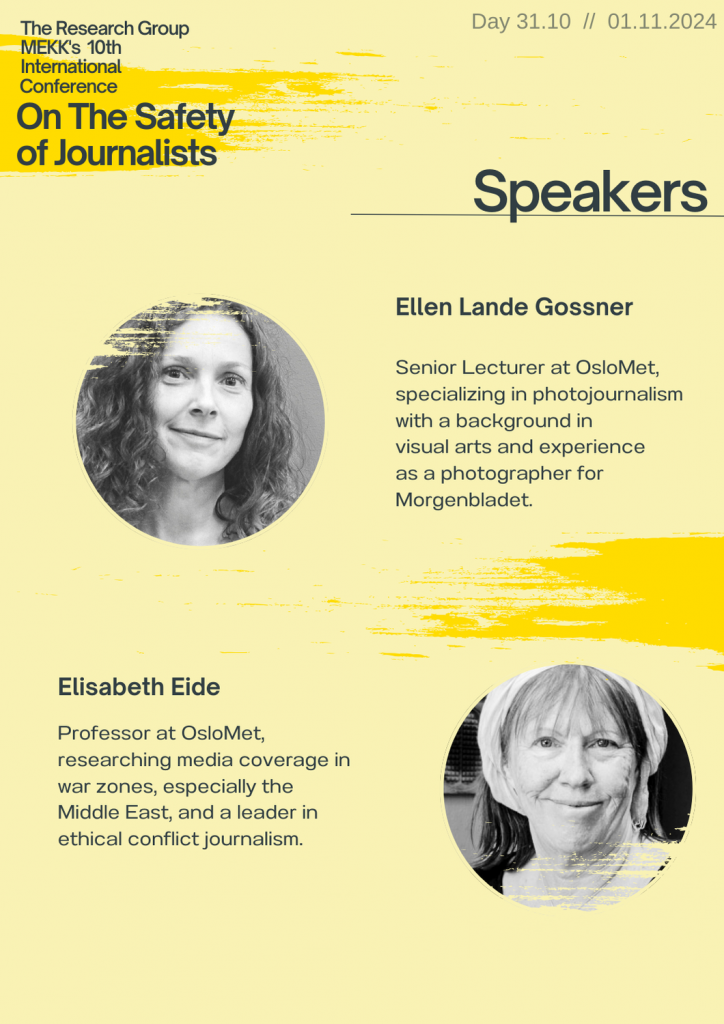
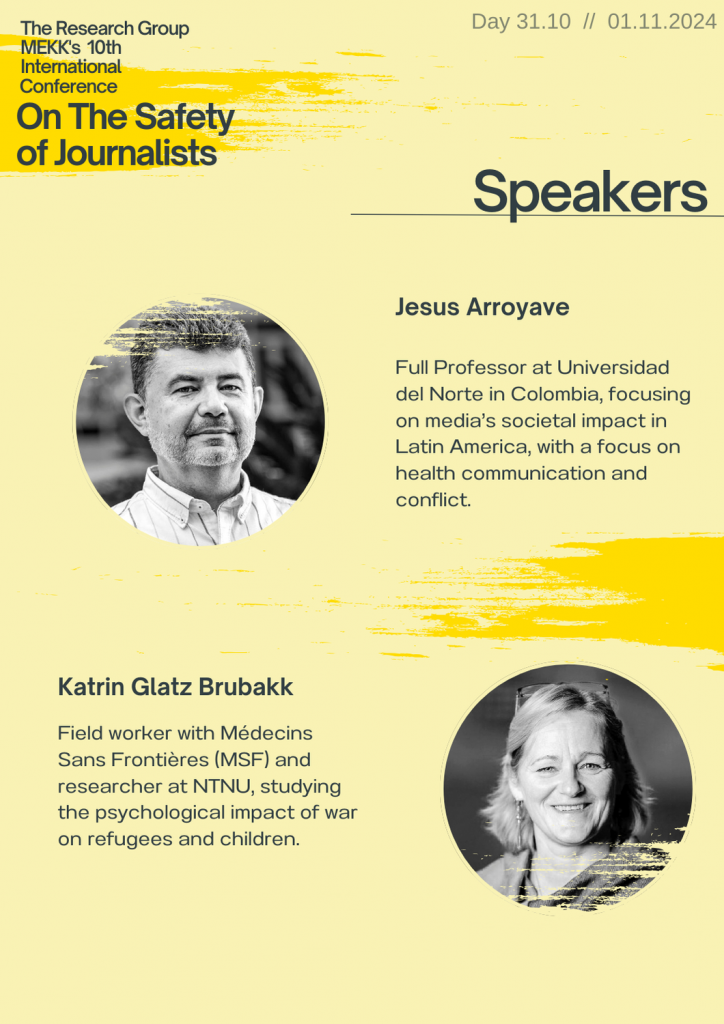
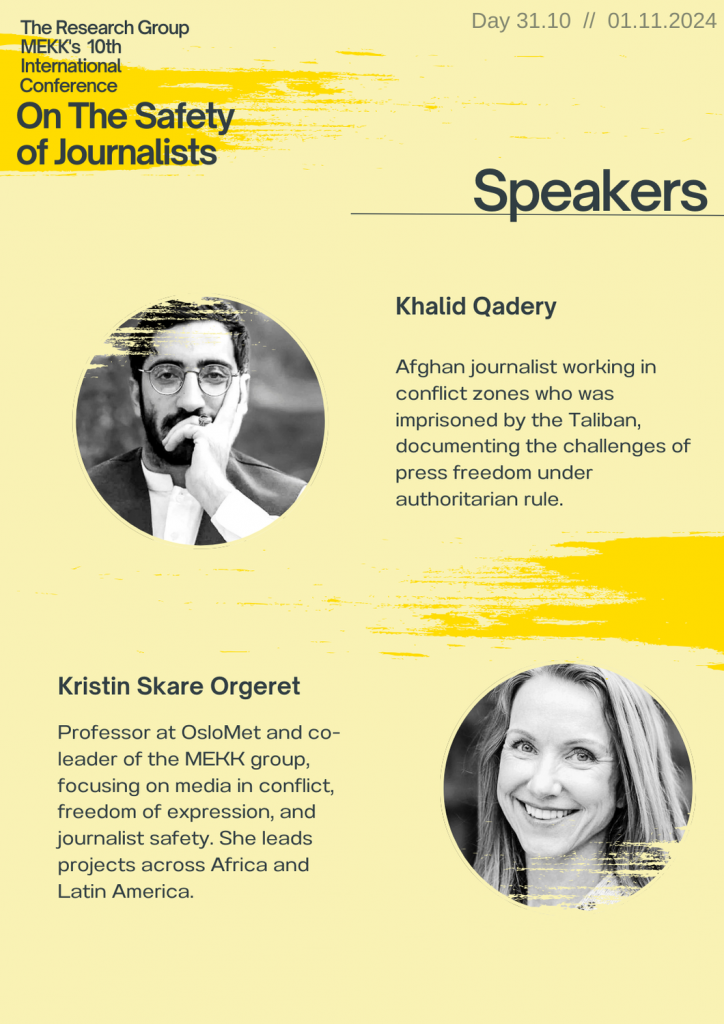
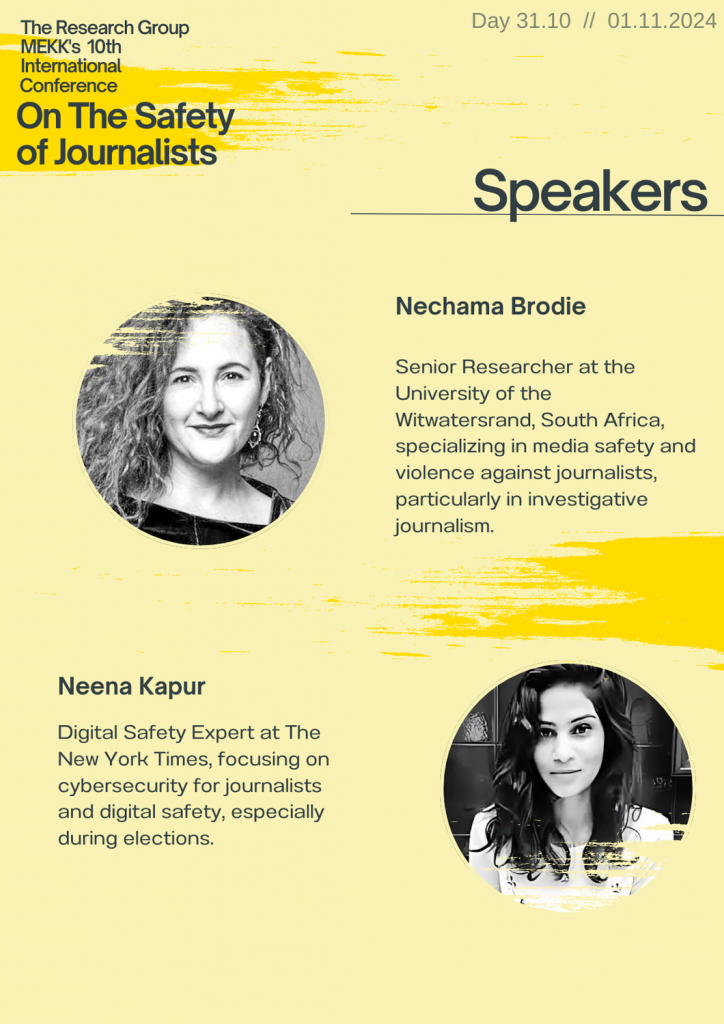
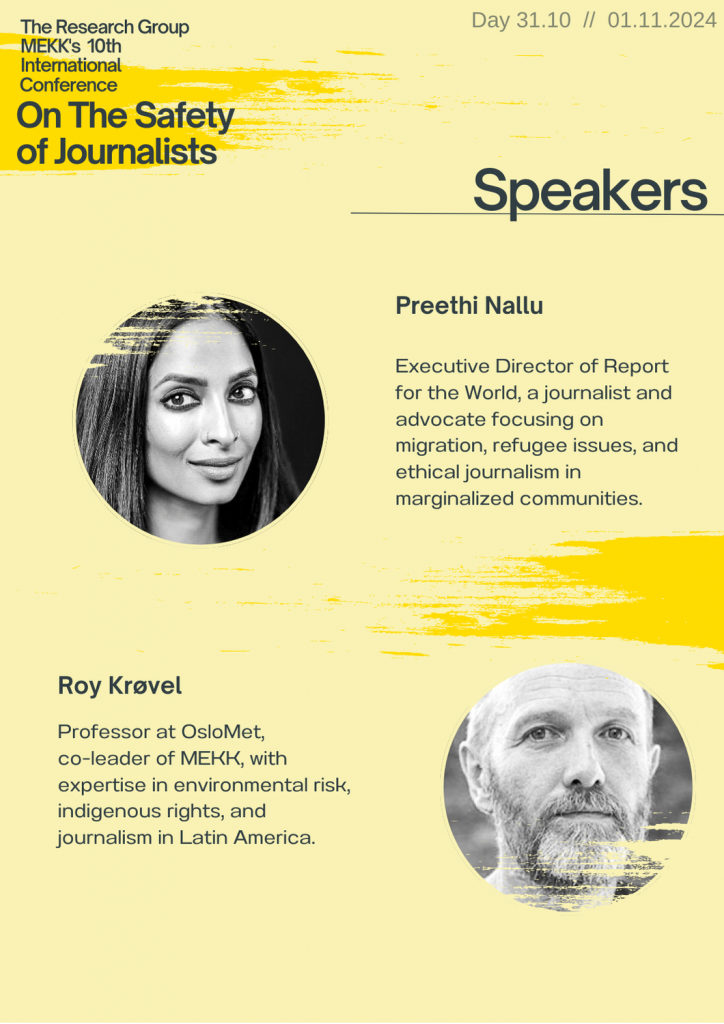
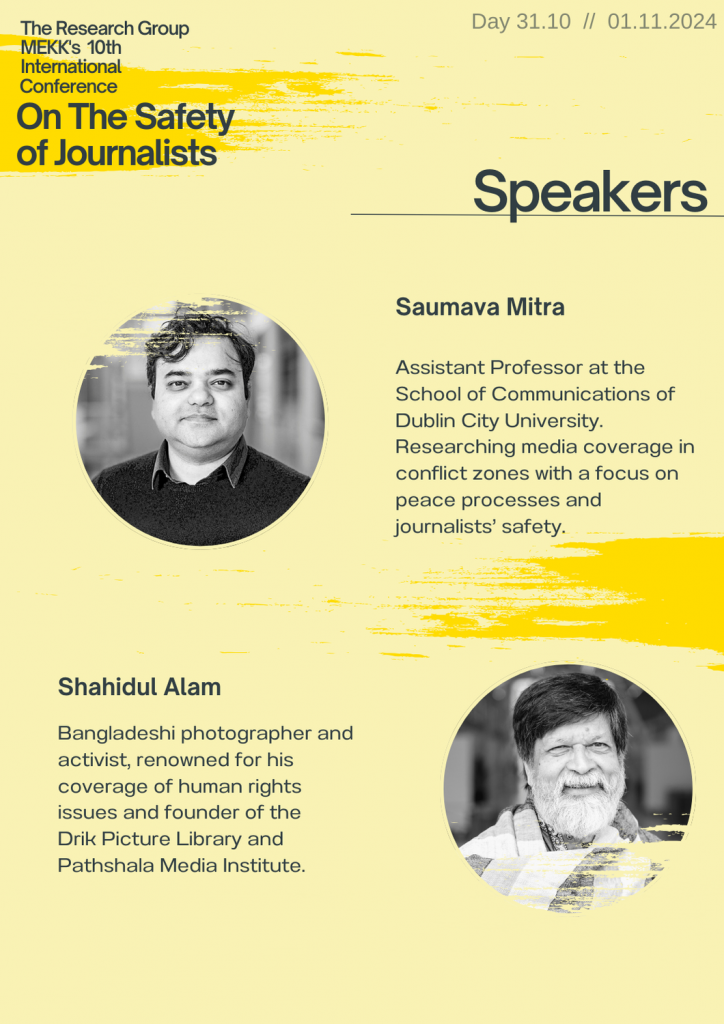
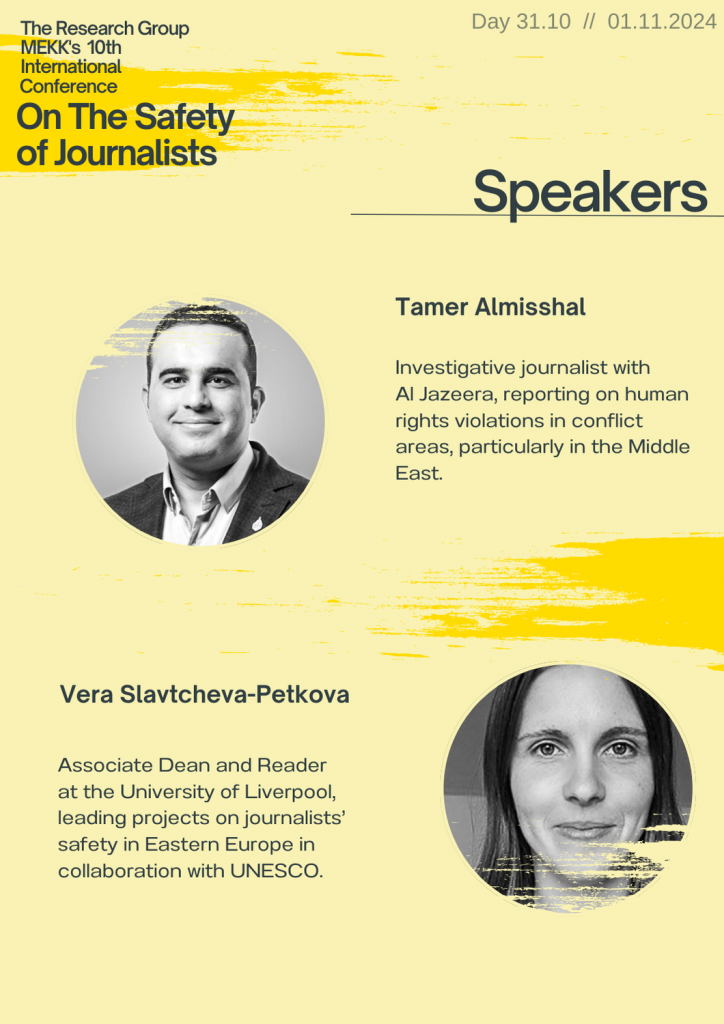
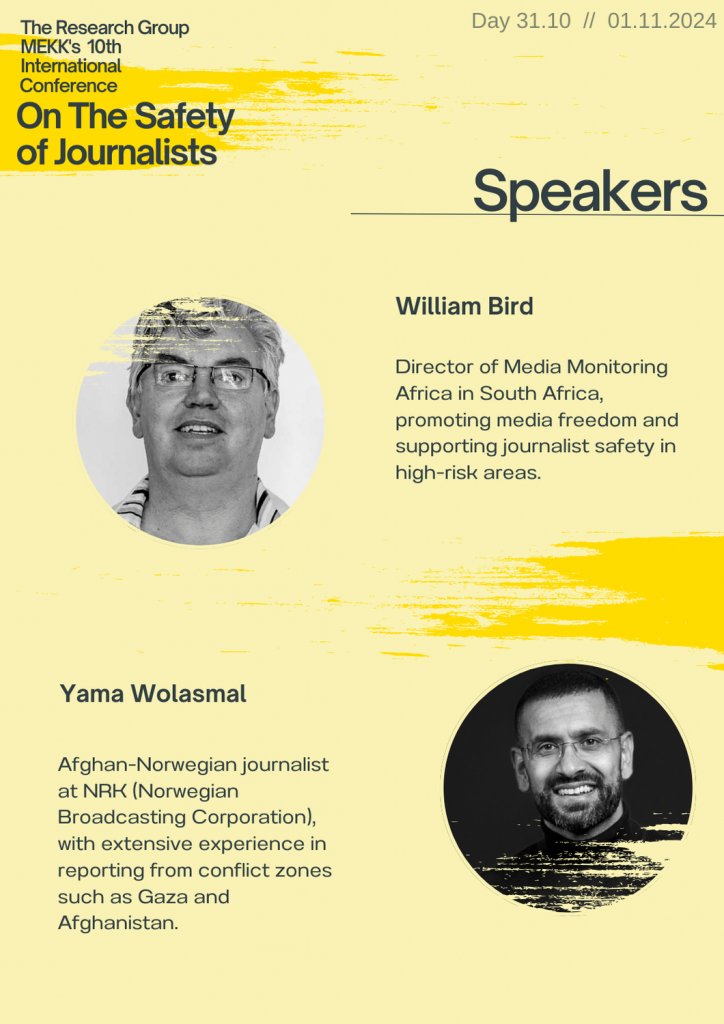
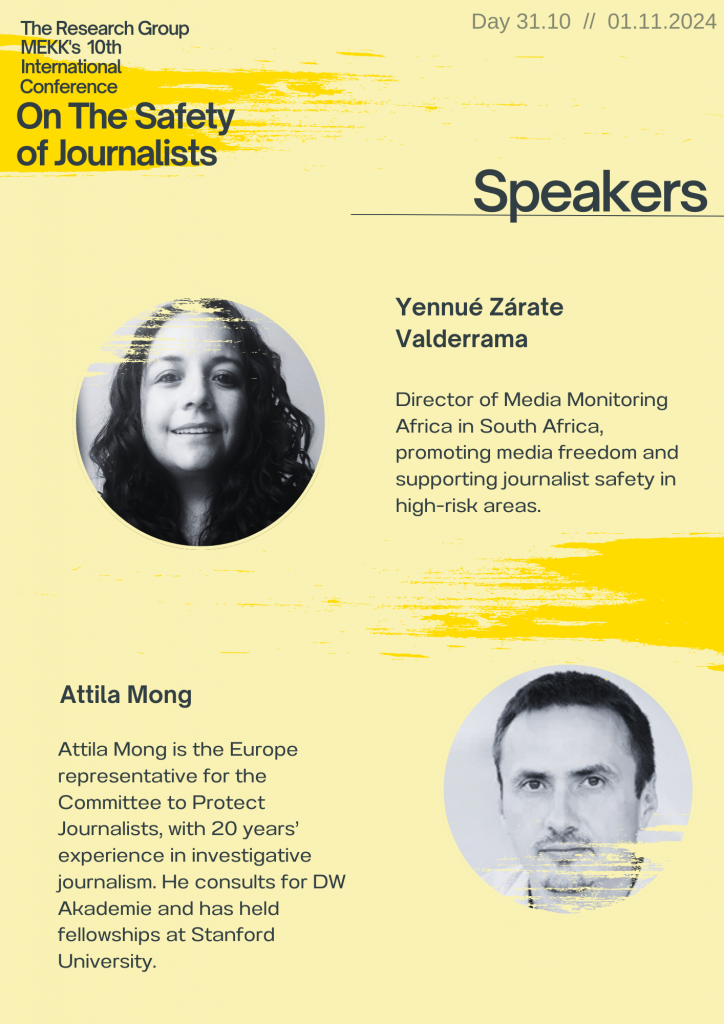
Paper sessions:

We are excited to welcome you to this year’s conference and would like to extend our thanks to everyone who has submitted their papers.

The quality of contributions this year is exceptional, and we are eager to share them with all participants
The sessions will be held in Pilestredet 46, Clara Holst hus, 3rd Floor.
· Duration: Each presentation is set to 20 minutes, with 15 minutes for the presentation and 5 minutes for questions and discussion.
· Presentation Format: The preferred format is usually a PowerPoint presentation, but it is not strictly required. You may choose another format if it suits your content better.
· Number of Presenters: We allow one presenter per presentation, but co-authors are welcome to join in the discussion.
We look forward to two days of engaging and productive paper sessions!
Download and see the full paper session program her: