We are hiring

The first two announcements for the NorQSoft/OsloMet PhD positions are now out:

One position in quantum computing, optimization on noisy gate-based NISQ platforms

One position in analogue quantum computing

Also the latter has a focus on noisy, imperfect quantum computers.

If this seems interesting to you, and you have the relevant background, do apply! Also, if you know anyone whom you think should apply, please pass this piece of news on to them.

In the ads you may notice that the scientific prerequisites span rather broadly.

The deadline is November 6th.

The Quantum Academy

May 21st we had the pleasure of meeting with Neda Maria Kaizumi. We thank Peyman for connecting us.

Neda has several successful ventures to look back on. And the next one is of particular interest to us: To establish an online, world-wide quantum academy.

Neda has seen the same need as us: We need to prepare a quantum literate workforce. With this common ambition we are confident that we supplement each other in this ambition and look forward to future interactions.

Two out of three ain’t bad

Yesteday, December 17th, the government announced which four out the 12 proposed centres for quantum technologica research gets funded. Read more about it here:

https://www.regjeringen.no/no/aktuelt/noreg-far-fire-nye-forskingssenter-for-kvanteteknologi/id3143328/

Simula did extremely well – securing no less than two centres. We at OsloMet are fortunate enough to be partners in one of them, namely the Norwegian Quantum Software Center (NorQSoft), which is lead by Shaukat Ali. Two QH members, Sølve Selstø and Sergiy Denysov, are leading one of the five research areas, “Quantum Algorithm and Applications”.

But this is not all: We are also partners in the Centre for Quantum Computing and Applications (QSTAR), headed by Frans Fuchs at Sintef. In this centre, another QH member, Andre Laestadius, is co-leading a work package related to quantum chemistry.

Unfortunately, despite very good reviews, the third proposal we were involved with did not measure up. This was a broad and, quite frankly, very strong joint effort headed by researchers at the University of Oslo.

Still: Good times ahead!

IQM: The need for Nordic players

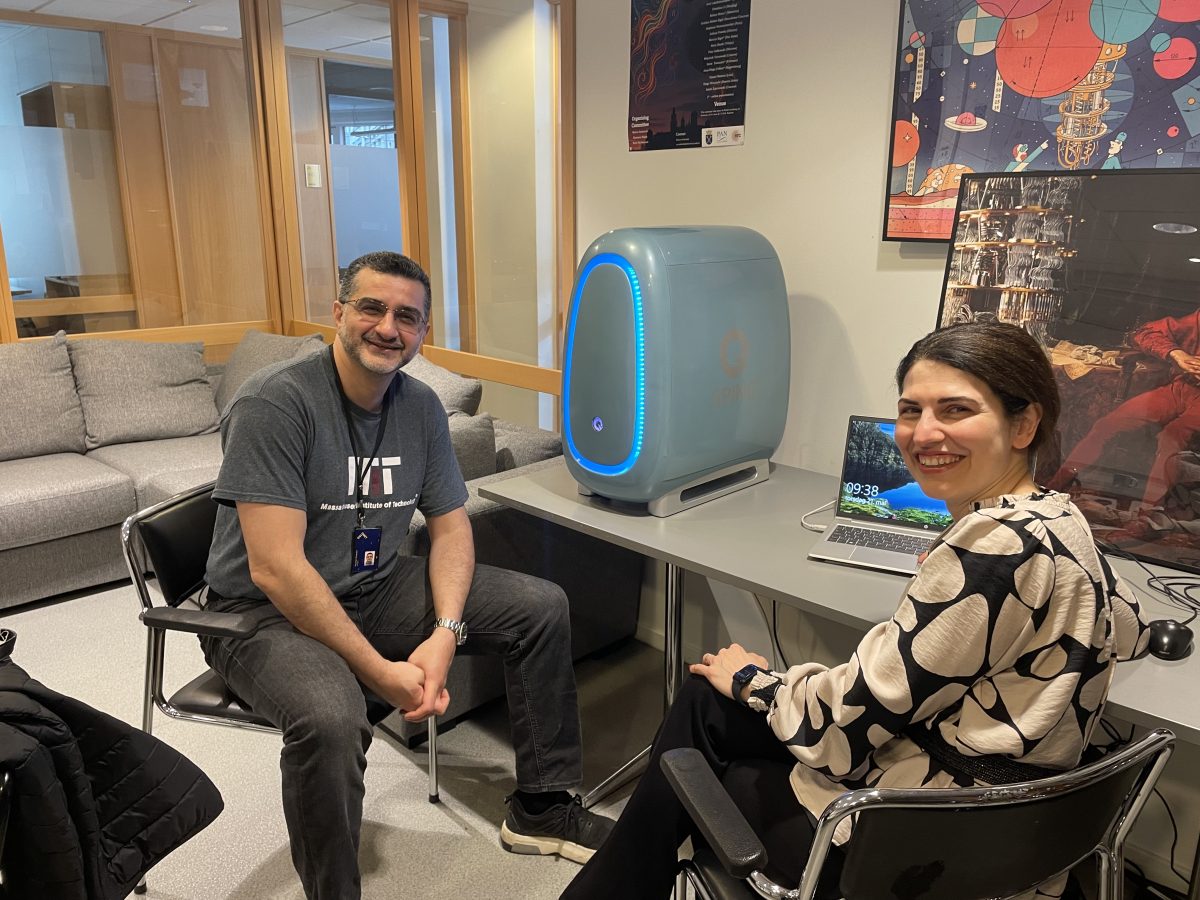
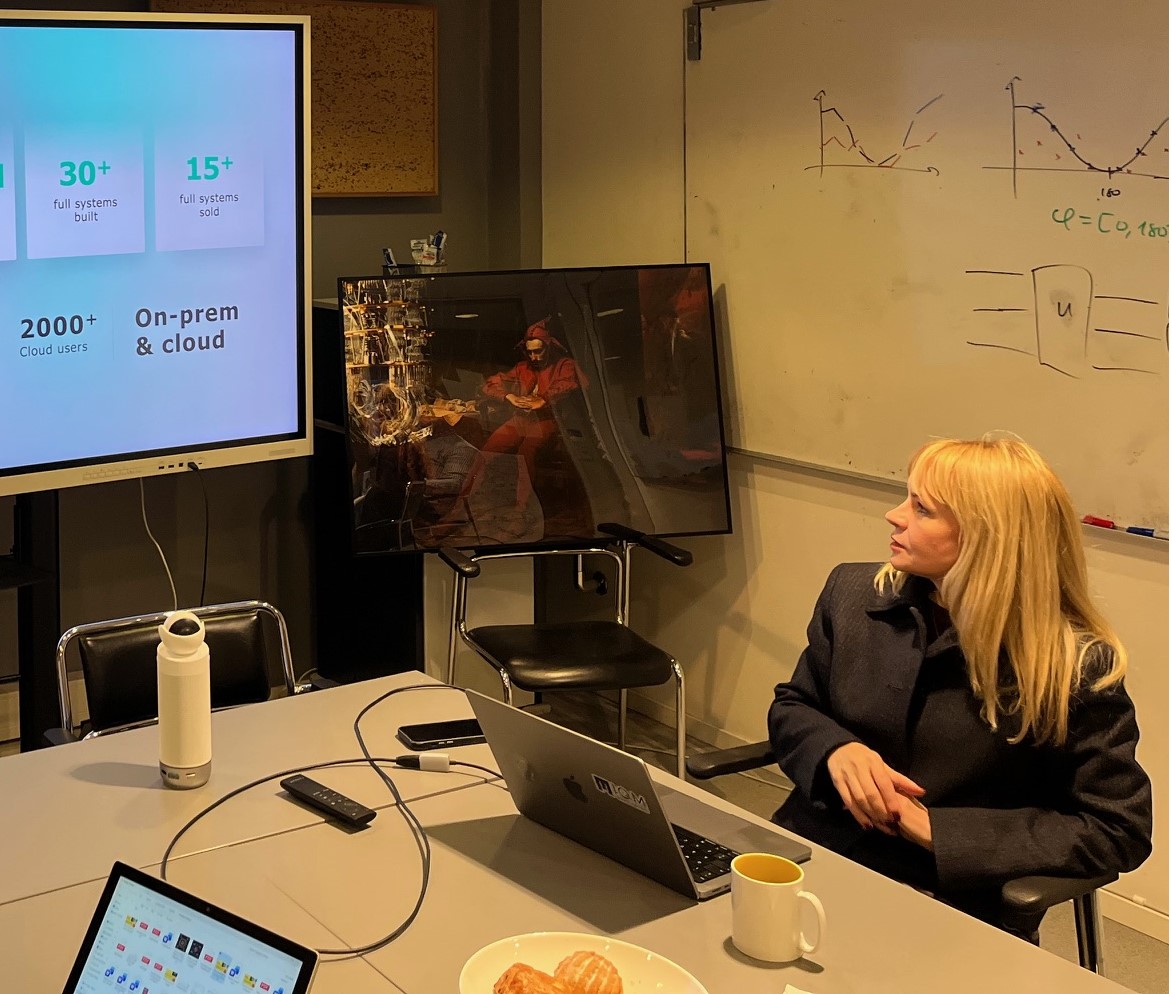
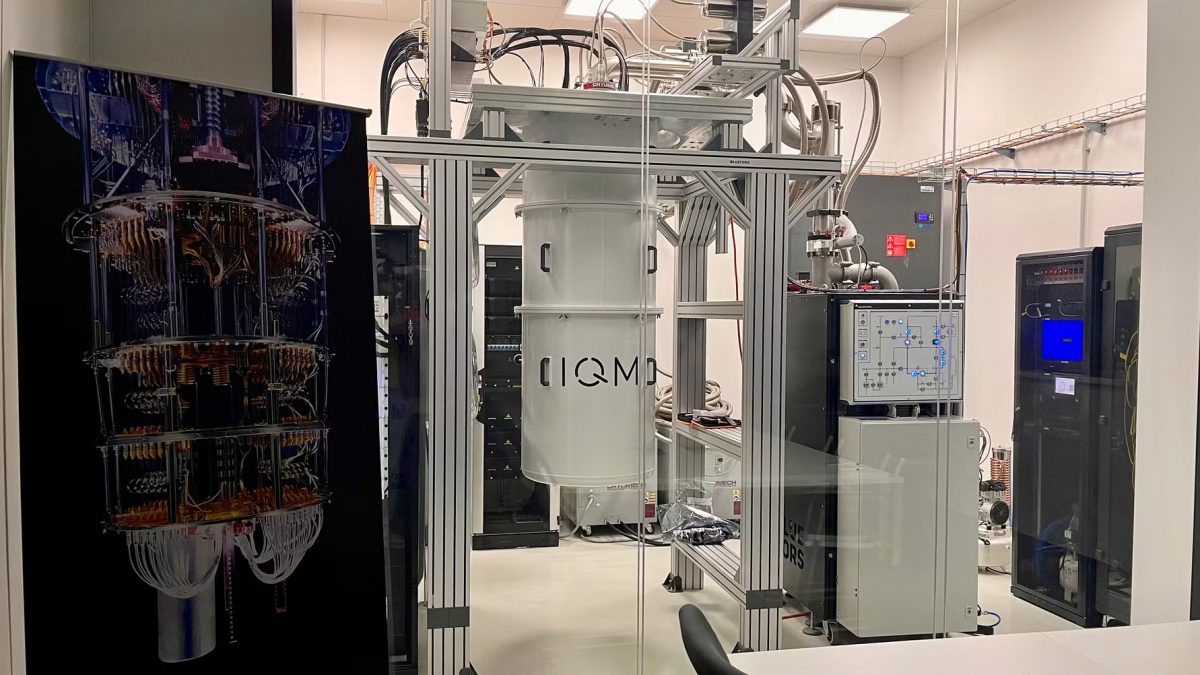
Wednesday October 29th our hub had a very pleasant and informative visit of people from IQM. This company has delivered comparatively large superconducting quantum computers such as the Helmi in Helsinki and the VLQ in the Czech republic.

The Quantum Hub preresentatives, i.e., Sergiy and Sølve in this case, were both quite impressed – not only by how far they have come when it comes to developing quantum hardware, but also by the extensive learning platform they have developed. These tools enable learners not only to familiarize themselves with theory and concepts; the also allow for implementation and testing on their own actual quantum hardware.

Our guests, Sylwia Barthel de Weydenthal in particular, stressed the need for the Nordics to claim its place on the quantum map – especially so given the current geopolitical situation and the dominance of Big Tech.

Quantum at work

For several years we have offered a 10 credit project course to our IT bachelor students. A rich plethora of topics and scientific and professional directions are eligible. This year, however, we offer – for the first time – projects on quantum technology.

We are thrilled to see that four of our students took the bait – and even more thrilled to see what they deliver!

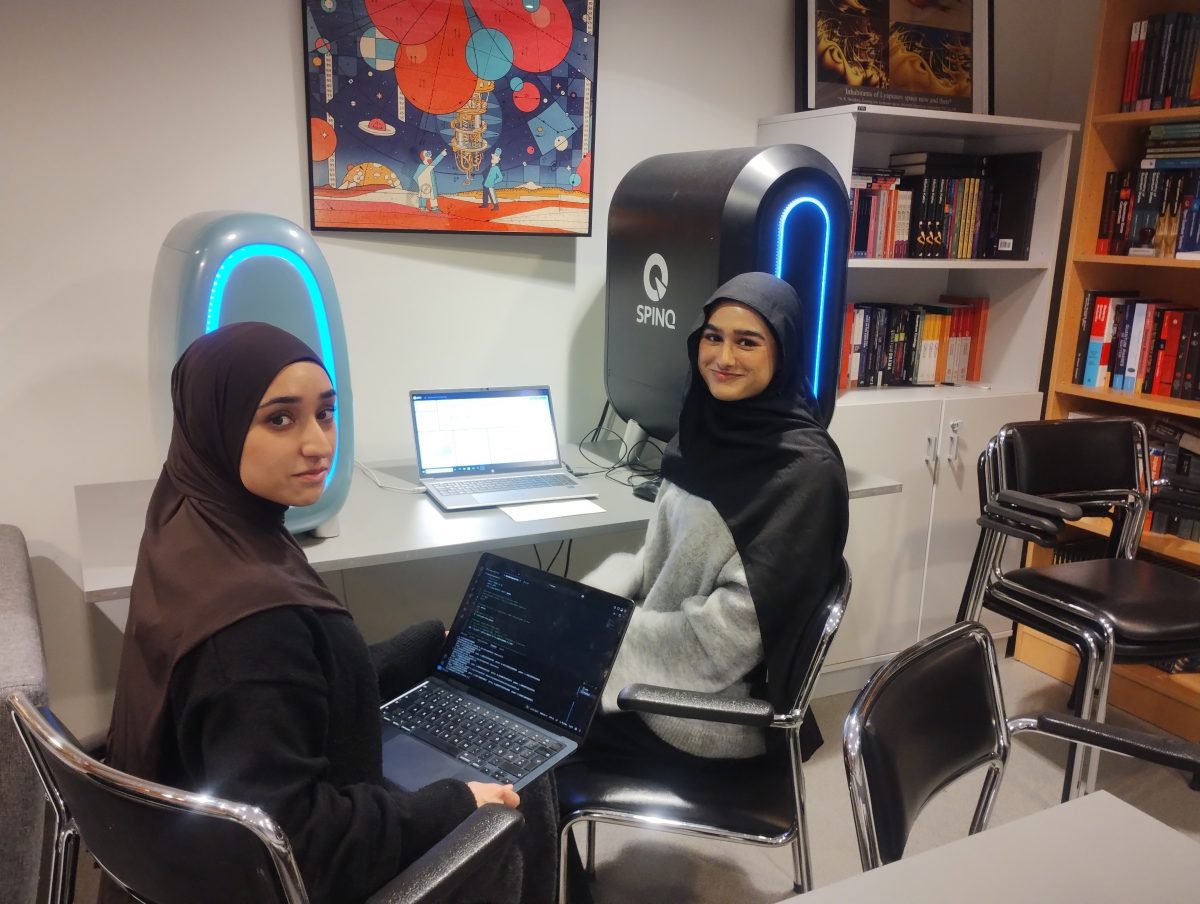
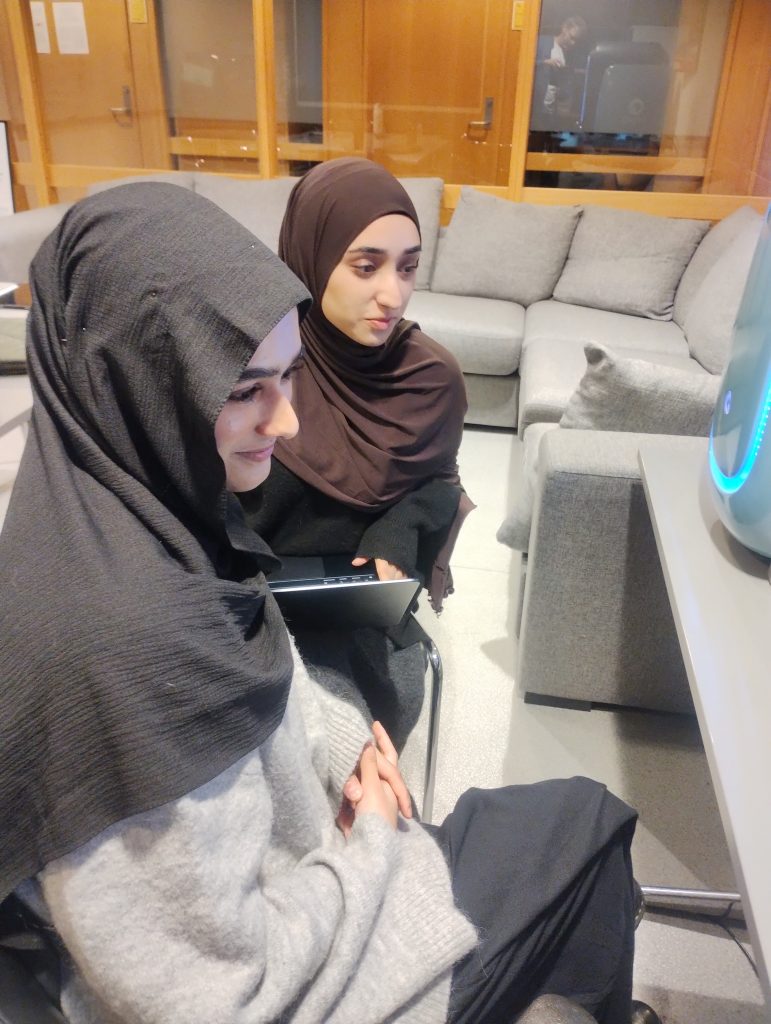
Alina Khan and Zahra Imaan Ahmad have devised, analysed, simulated and run a circuit that implements an important model in quantum physics, the Landau-Zener model.

Alina and Zahra avaiting the results of their first experiment.

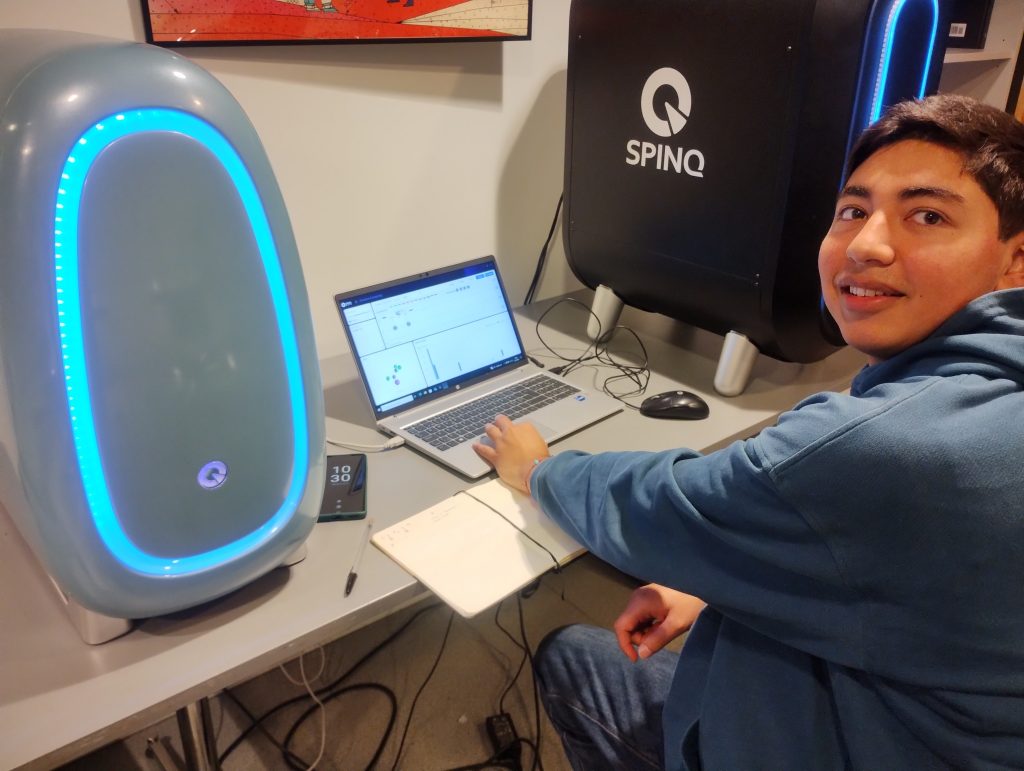
Andrés Cáceres, whom you can seen in the picture below, is – together with Lenni Tom Walter, involved in a project in which they are trying to determine a relative phase factor in a Bell-like state. This projects involves circuits with both two and three qubits. So our three-qubit machine, Munin, is used to its full potential, so to speak.

Andrés is running a two-qubit circuit carefully devised to learn the “unknown” phase of a slightly generalized Bell-state. His coworker Lenni Tom Walter was not present when the picture was taken.

It is no exaggeration to say that all four of them where thrown off the deep end here. With virtually no prior training in neither quantum phenomena nor quantum computing, it was a lot to take in the first weeks. But they did take it in. And they proved able to come up with quantum circuits that correctly solve their respective problems.

So it is fair to say that we have been impressed by the students’ performance. Are we equally impressed by Munin’s performance? Let’s wait for their reports, shall we?

Another unveiling: VLQ

It is about four years since we unveiled the first quantum computer i Norway. Yesterday, another quantum computer, admittedly a somewhat larger one, was unveiled: The VQL. It is not a Norwegian one, but Norway – and OsloMet – are involved.

This quantum computer has 24 qubits. It is not placed in Norway; it is located in the Czech Republic. But Norway is a partner – through Sigma 2.

Through the Q-NRI project, which recently received funding from the Norwegian Research Council, we aim to connect the VQL with Norwegian high performance computing resources – including the recently acquired super computer Olivia.

Please read more about it at Sigma 2’s own web pages.

We won!

Together with Sigma 2, Simula and Sintef, OsloMet was recently funded 8 million kroner for quantum technology infrastructure. We are looking forward putting this money to use!

Below you can read (in Norwegian) a bit more about what how the funding will be spent. The excerpt is from the government’s own announcement.

Quantum Extension of the Norwegian Research Infrastructure

Sigma2, Simula, SINTEF og OsloMet får 8 millioner kroner til å styrke nasjonal forskningsinfrastruktur for kvanteberegning gjennom utvidelse av de nasjonale tungregningsinfrastrukturene NRIS og eX3.  Dette vil gi norske miljøer tilgang til europeisk forskningsinfrastruktur for kvanteberegning (LUMI-Q), og til lokale emuleringsmiljøer og programvare som kombinerer kvante- og klassisk databehandling. I tillegg vil de i prosjektet utvikle en treningsplattform for å gi praktiske ferdigheter i kvantealgoritmedesign, kvanteforsterket simulering, og hybrid arbeidsflyt.

Kazi Ripon: applying quantum concepts to classical computers

Written by Noa Cecilie Sæther

– I try to blend the idea of quantum into the framework of bio-inspired algorithms. My aim is to make it available for everyone.

So says Kazi Shah Nawaz Ripon, who has been an associate professor at OsloMet since august 2023.

– Quantum computers are not expected to be on our desks very soon, so I would like to implement it into classical computers.

Ripon first moved to Norway in 2009 for his PhD in computer science at the University of Oslo, where he researched artificial intelligence, machine learning and bio-inspired techniques to optimize real-world large scale multi-objective combinatorial optimization problems.

Specifically, he developed hybrid bio-inspired algorithms, several artificial intelligence based heuristics and applied the hybrid algorithms to several real-words NP-hard problems in industries.

Ever since, Ripon has continued exploring the same field.

Traditional Methods Fail for Large-Scale Combinatorial Optimization

Many real-world problems — from logistics and scheduling to network design and resource allocation — fall under the umbrella of combinatorial optimization. These problems require finding the best solution from a vast number of possible combinations, and as the problem size increases, the number of options grows exponentially.

Take the Travelling Salesman Problem (TSP) as a classic example. It asks:
“Given a list of cities and distances between them, what is the shortest possible route that visits each city once and returns to the starting point?”
While this sounds simple, the number of possible routes grows factorially with the number of cities. For just 61 cities, the number of possible routes exceeds the number of atoms in the observable universe.

This kind of combinatorial explosion makes traditional, brute-force approaches impractical. Instead, such problems demand more advanced strategies — like heuristics, metaheuristics, or machine learning-based methods — that can intelligently explore the search space and find near-optimal solutions within a reasonable time.

These challenges are at the heart of modern optimization, where efficiency, scalability, and adaptability are key to solving complex, real-world problems.

In the real world, this way of thinking could for example be used in hospital scheduling.

– An important real-world example of combinatorial optimization is hospital surgery scheduling. Each surgery must be coordinated with available operating rooms, surgeons, anesthesiologists, nurses, and equipment — all within strict time constraints. This is a massive operation. When you are given a time for the operation, you are linked to several factors: with certain operating theaters, doctors and nurses. Then what happens if an operation is delayed? Another patient cannot be operated. Traditionally, this can’t be solved. Therefore, if one surgery is delayed, it can cascade through the schedule, affecting multiple patients and staff. The number of possible combinations becomes overwhelming, especially in large hospitals.

This is where traditional methods break down. The complexity is simply too high to handle manually or through brute-force calculations. Instead, hospitals need smart optimization techniques that can adapt, prioritize, and find efficient schedules — improving both resource use and patient outcomes.

Inspired by nature

Additionally, bio-inspired algorithms can be implemented in such problems. They are, as the name indicates, based on nature. Ripon explains that there could for example be a parallell between the human immune system and email spam detection.

That is because our immune system protects us from pathogens, by sorting them out. Inside the body, there are still helpful, “good” pathogens. In the same way, emails that are detected as “bad” are sorted into the spam folder. That means the email algorithm can differentiate between useful and harmful, Ripon explains.

Moreover, when ants detect food, they return to the nest while depositing a pheromone, which helps the next ant to detect the same food. If several ants find a food source in different places, the closest one will return to the nest first. Therefore, the next ones will follow in its steps.

– We take inspiration from nature – humans, ants, birds, and then we develop those ideas into algorithms, Ripon explains.

Detecting fake news

Recently, Ripon published a paper on detecting fake news in social media, based on an artificial immune system, using a negative selection algorithm.

This method is inspired by the the biological immune system, generating a set of detectors that can distinguish between “normal” and “abnormal” patterns in a set of data.

– The idea is to collect a list of fake news online, and then implement it in the real world. The algorithm will be able to detect the fake news, Ripon explains.

– Could do a lot in the medical field

Nowadays, he’s also trying to implement quantum algorithms with evolutionary algorithms.

– Usually, when you hear about quantum technology, you think you’ll need a quantum computer. But we’re not actually sure when we can get one in our hands. My idea is to use the quantum concept in a classical algorithm that can be applied to classical computers.

– Nobody actually knows how to use quantum in their everyday life. My dream scenario is for people to be able to use quantum computing like their laptop. That’s what’s missing in the research field.

Ripon would also like to apply quantum technology to the medical domain, for example in image segmentation or brain tumor detection. – I would like to implement techniques that can handle uncertain delays and update the hospital scheduling automatically. You could probably do a lot in the medical field.


Kazi on QAI in Trondheim

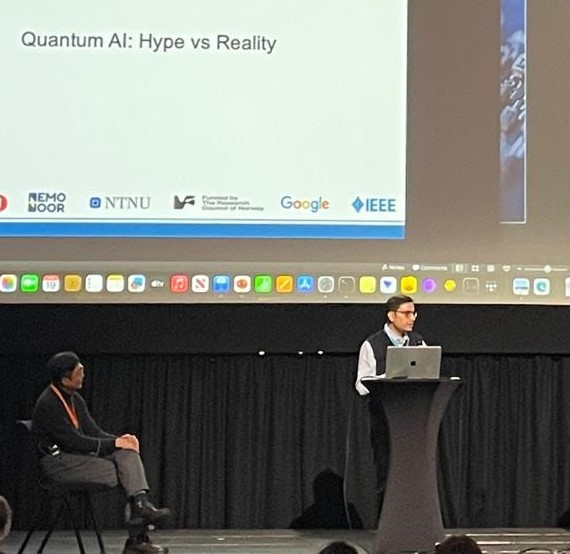
I recently attended and served as a panellist at the 2025 IEEE Symposium Series on Computational Intelligence (IEEE SSCI 2025) conference in Trondheim. I represented Oslo Metropolitan University (OsloMet) in a panel session titled “Quantum Computational Intelligence and AI” on Wednesday, March 19, 2025. The panel aimed to explore the rapidly evolving intersection of quantum computing and artificial intelligence (AI), focusing on computational intelligence (CI) techniques and their practical implications.

My contribution to the panel centred around the theme “Quantum AI: Hype vs Reality,” where I highlighted key insights into distinguishing genuine advances in Quantum AI from exaggerated claims. I aimed to clarify its realistic potential and limitations.

During the discussion, we engaged in dynamic conversations covering a range of important topics, including Quantum Evolutionary and Fuzzy Systems, quantum-inspired optimization methods for decision-making, real-world applications of Quantum Machine Learning (QML), Hybrid Quantum Genetic Algorithms (HQGA), and the role of Quantum CI in enhancing human-machine collaborative learning environments.

Participating in this event provided an excellent opportunity to represent OsloMet, exchange knowledge with leading researchers and practitioners, and gain valuable insights into future directions and challenges in Quantum AI and Computational Intelligence. This experience highlights the importance of active collaboration and ongoing research at the intersection of quantum technologies and AI—areas to which OsloMet is committed to advancing.

Kazi Ripon