
Room-level building automation trainers
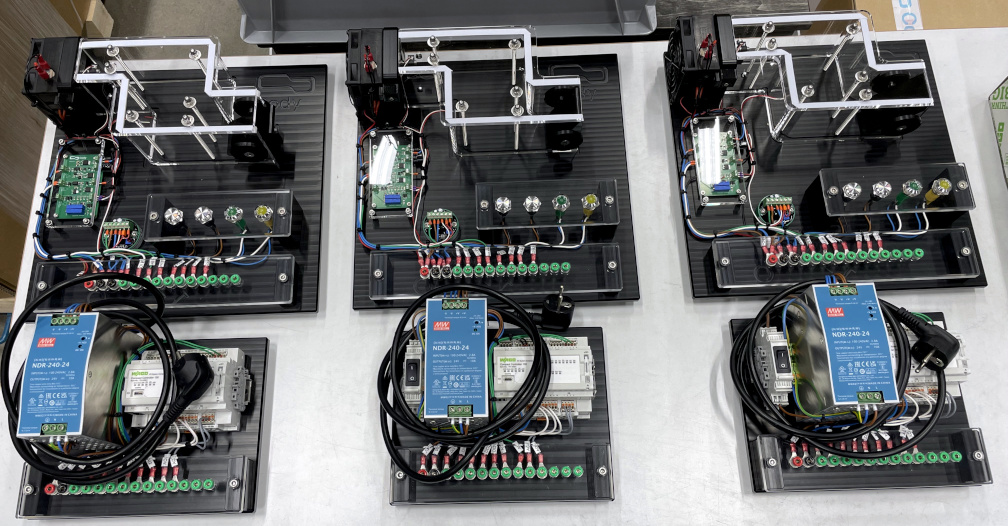
We have 3 flexible table-top training rigs for hands-on teaching in control engineering and applied building automation at bachelor’s and master’s level. The rigs provide students with a physical, programmable system in which control strategies can be implemented, tested and observed under realistic but controlled conditions.
Each rig represents a simplified room with mechanical ventilation and heating. A programmable room-level PLC/DDC controller allows students to work directly with sensors, actuators, analogue and digital signals, and closed-loop control. The compact table-top format makes the rigs suitable for laboratory exercises ranging from introductory control principles to more advanced building automation applications.
Main features
- Simulated room cavity representing a small conditioned room.
- Variable-speed supply air fan, controlled by a 0–10 V signal, for simulating mechanical demand-controlled ventilation.
- Airflow feedback provided as a 0–10 V analogue signal, enabling closed-loop airflow control and experimentation with control algorithms.
- Manual return/extract-air damper for introducing external disturbances and changes in ventilation-system pressure conditions.
- Controllable room heating, using a 100 W heating element controlled by pulse-width modulation (PWM), allowing students to investigate closed-loop room-temperature control.
- Room-temperature measurement using a Pt100 sensor with a 0–10 V transmitter.
- Programmable room-level PLC/DDC, based on the WAGO Compact Controller 100, for implementing building automation and control functions.
- Visible electrical wiring and connections, allowing students to follow the physical connections between controller, sensors and actuators and relate software functions to the underlying electrical system.
Tasks: The rigs are designed to bridge the gap between control theory and real building automation systems. Students can programme controllers, acquire sensor signals, operate actuators, introduce controlled disturbances and observe the dynamic response of the system. This enables concepts such as feedback control, PID control, control-loop tuning, demand-controlled ventilation, temperature control and building automation programming to be explored through hands-on experiments.
Documentation
To be added.