Hopp til innholdet

Reducing environmental impacts from garments through best practice garment use and care, using the example of a Merino wool sweater

Garment production and use generate substantial environmental impacts, and the care and use are key determinants of cradle-to-grave impacts. The present study investigated the potential to reduce environmental impacts by applying best practices for garment care combined with increased garment use. A wool sweater is used as an example because wool garments have particular attributes that favour reduced environmental impacts in the use phase.

modell som viser hvordan vi reparerer vaskemaskiner i Norge

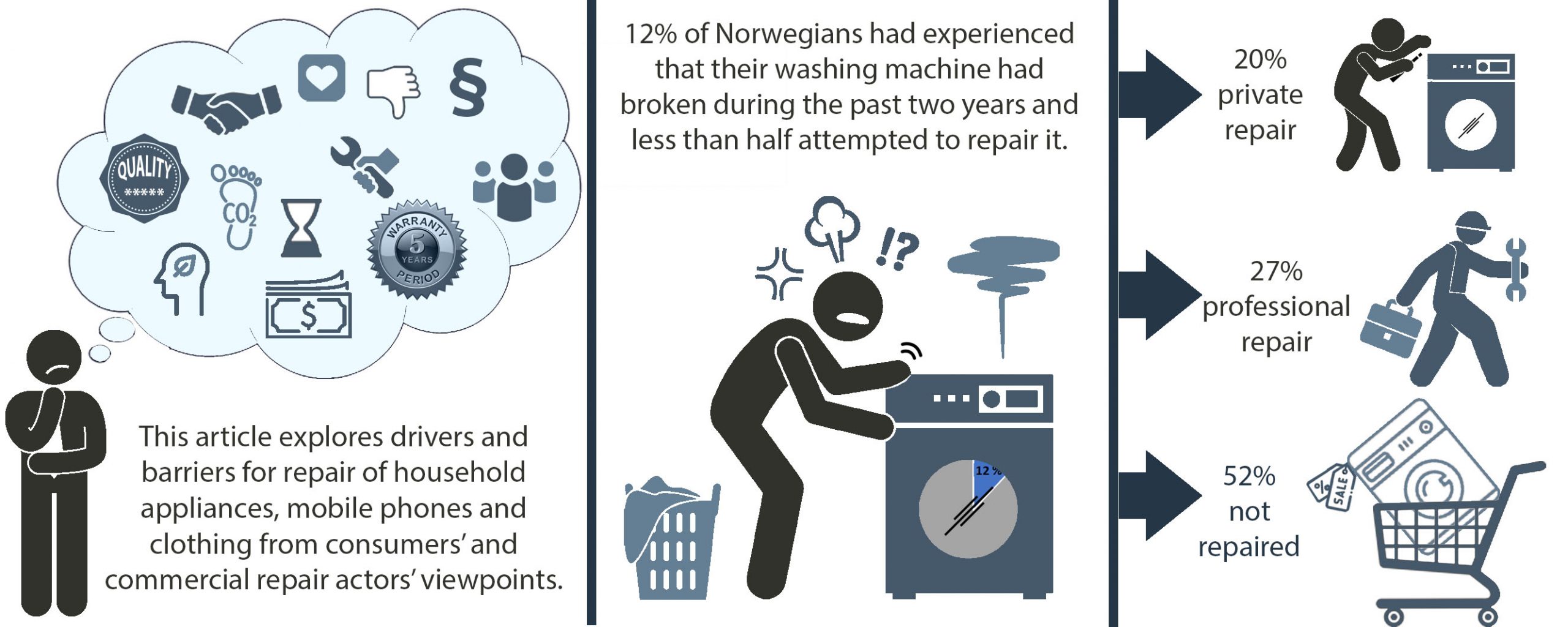
Increasing repair of household appliances, mobile phones and clothing: Experiences from consumers and the repair industry

Increasing product lifespans is one of the most effective environmental strategies and therefore repair is a part of the circular economy approach that aims to keep products and materials longer in use. This article explores drivers and barriers for repair from consumers’ and commercial repair actors view-points, in order to understand how the repair rates of household appliances, mobile phones and clothing could be increased.

Global differences in consumer practices affect clothing lifespans

  • av

Most studies of clothing and related habits are carried out within a country. However, apparel production and sales are a highly globalized industry, with many of the same large chains operating worldwide. It is thus quite possible that the use of the same mass-produced clothing differs between various geographical areas. Based on a practice theoretical approach, we have studied differences in consumption, use and disposal of clothes in different countries that may affect the lifespan of apparel.

The paper is based on an international survey in five countries with large apparel markets: China, Germany, Japan, UK and the USA. 200 respondents from each country answered to a comprehensive web-based survey on their wardrobe content. We found differences in practices that could affect the lifespans of clothing in these five countries. At the same time, we find many similarities. For clothing acquisition, buying new items dominates in all the five markets, and washing machines contribute to the main chore of keeping clothes clean. Home production and second-hand clothes constitute a very small part of clothing consumption in all five countries. Many respondents showed low sewing skills, and repair activities were done irregularly. Thus, many of the challenges to increasing the lifespans of clothing are similar for all the five countries. At the same time, there are significant differences. These differences open up for the possibility to learn «best practice» by studying the countries and transferring knowledge between regions. When defining use phase in LCA and other sustainability tools, it must be taken into account that despite the fact that clothing is a global industry, consumption is part of local practice.

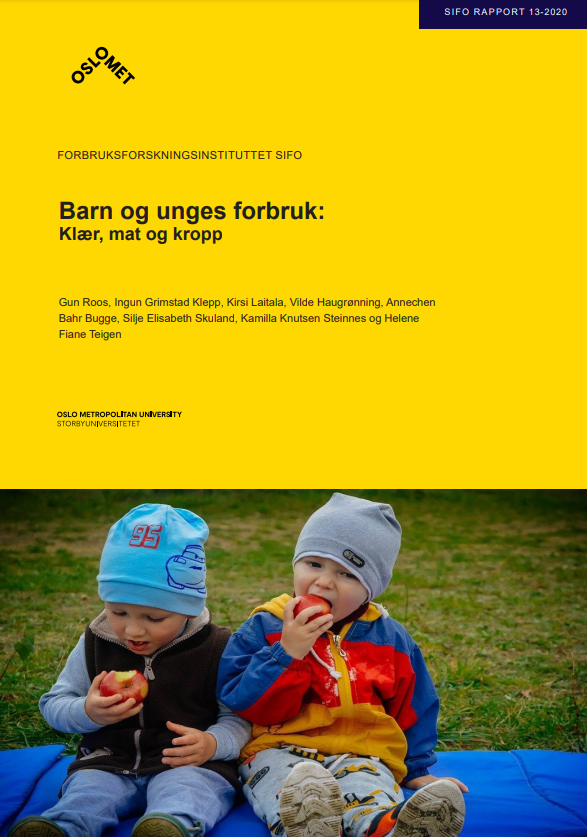
Barn og unges forbruk: Klær, mat og kropp

Denne rapporten, som i hovedsak er basert på en spørreundersøkelse om barn, klær, mat og kropp blant foreldre med barn i alderen 1-16 år, beskriver barn og unges forbruk av klær og mat og hvordan de forholder seg til kropp, helse og miljø. Undersøkelsen viser at mange foreldre gir klær til gjenbruk, men en mindre andel sier at deres barn bruker brukte klær. Spesielt klær blant de yngste barna går i arv. Det er vanlig å reparere barneklær selv, men uvanlig å betale andre for det. De færreste foreldre svarer at barna går med halvskitne klær, men helse og miljø fremstår ikke som spesielt viktige for foreldre når det gjelder klesvask. Det er delte meninger om og erfaringer omkring spørsmål om klær, klesnormer, kjønn, kjøpepress og religion. Hovedansvar for barns klær har mødrene eller ansvaret deles likt mellom foreldrene. Barn og unges meninger om klærs betydning for inkludering og erting er delte, det samme gjelder skoleuniform som mulig løsning. De er mer positive til dette tiltaket enn foreldrene. Resultatene viser at det mangler kunnskap om hvordan vi kan kle barn slik at de får en sunn, trygg og god barndom og hvem som har ansvar for at det skjer.


What Affects Garment Lifespans? International Clothing Practices Based on a Wardrobe Survey in China, Germany, Japan, the UK, and the USA

Increasing the length of clothing lifespans is crucial for reducing the total environmental impacts. This article discusses which factors contribute to the length of garment lifespans by studying how long garments are used, how many times they are worn, and by how many users. The analysis is based on quantitative wardrobe survey data from China, Germany, Japan, the UK, and the USA. Variables were divided into four blocks related respectively to the garment, user, garment use, and clothing practices, and used in two hierarchical multiple regressions and two binary logistic regressions.

The models explain between 11% and 43% of the variation in clothing lifespans. The garment use block was most indicative for the number of wears, while garment related properties contribute most to variation in the number of users. For lifespans measured in years, all four aspects were almost equally important. Some aspects that affect the lifespans of clothing cannot be easily changed (e.g., the consumer’s income, nationality, and age) but they can be used to identify where different measures can have the largest benefits. Several of the other conditions that affect lifespans can be changed (e.g., garment price and attitudes towards fashion) through quality management, marketing strategies, information, and improved consumer policies.
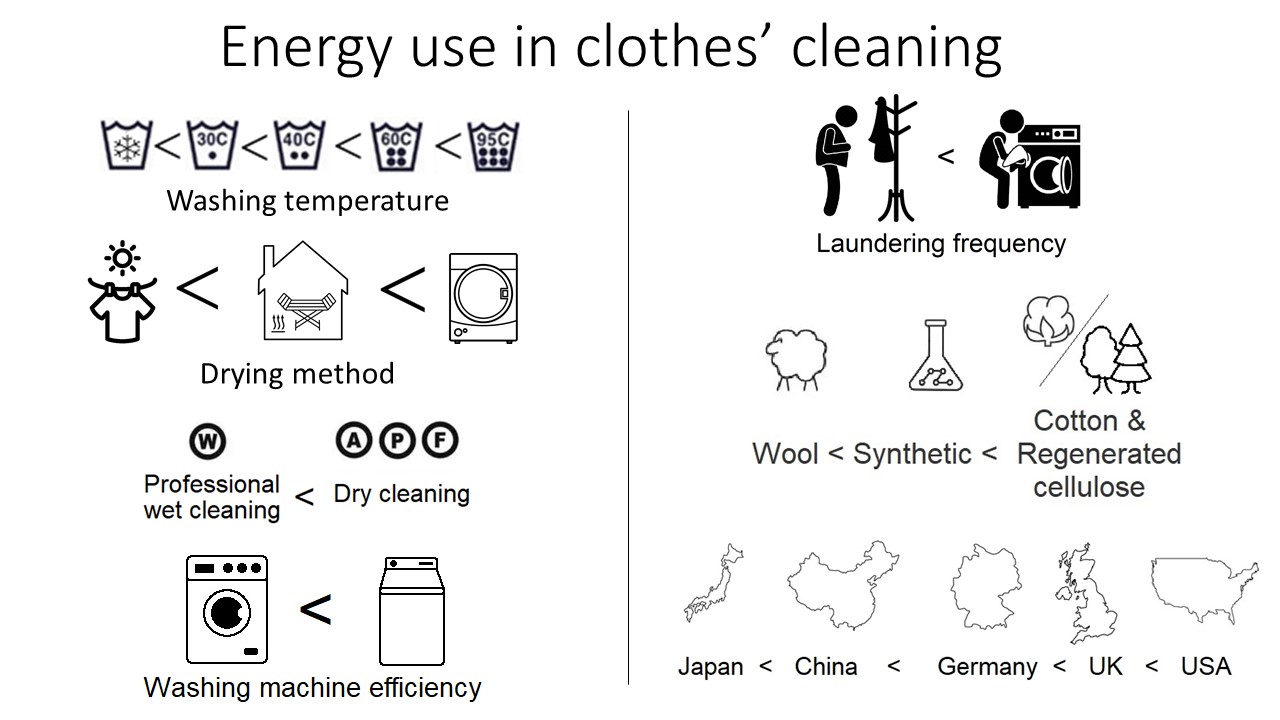
modell som viser energiforbruk klesvask

Laundry Care Regimes: Do the Practices of Keeping Clothes Clean Have Different Environmental Impacts Based on the Fibre Content?

  • av

Clothing maintenance is necessary for keeping clothing and textiles functional and socially acceptable, but it has environmental consequences due to the use of energy, water and chemicals. This article discusses whether clothes made of different materials are cleaned in different ways and have different environmental impacts. It fills a knowledge gap needed in environmental assessments that evaluate the impacts based on the function of a garment by giving detailed information on the use phase. The article is based on a quantitative wardrobe survey and qualitative laundry diary data from China, Germany, Japan, the UK and the USA.

The largest potential for environmental improvement exists in reducing laundering frequency and in the selection of washing and drying processes, and through a transition to fibres that are washed less frequently, such as wool. Adopting best practice garment care would give larger benefits in countries like the US where the consumption values were the highest, mainly due to extensive use of clothes dryers and less efficient washing machines combined with frequent cleaning. These variations should be considered in environmenta assessments of clothing and when forming sustainability policies. The results indicate the benefits of focusing future environmental work on consumer habits and culture and not only technologies.

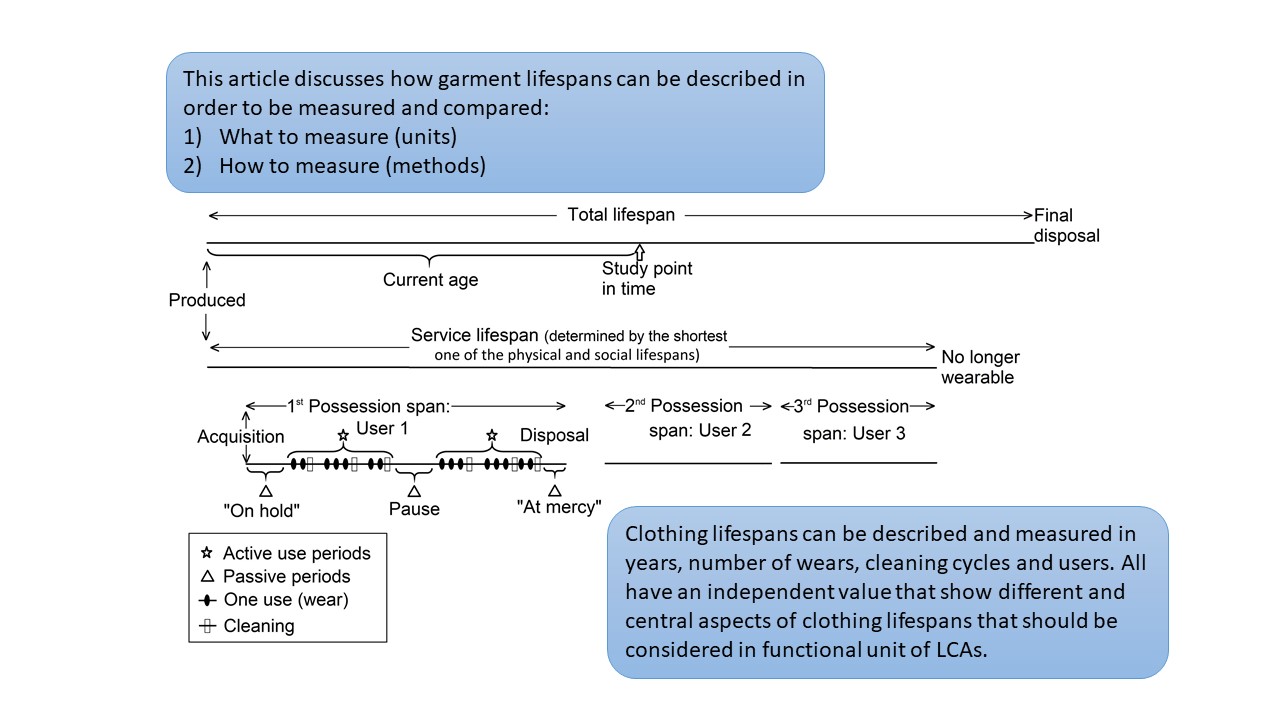
Clothing Lifespans: What Should Be Measured and How

  • av

Increasing the use of each product, most often called longer lifespans, is an effective environmental strategy. This article discusses how garment lifespans can be described in order to be measured and compared. It answers two sub-questions: (1) what to measure (units), and (2) how to measure (methods). We introduce and define terms related to clothing lifespans and contribute to discussions about an appropriate functional unit for garments in life cycle assessments (LCA) and other environmental accounting tools. We use a global wardrobe survey to exemplify the units and methods.

Clothing lifespans can be described and measured in years, the number of wears, cleaning cycles, and users. All have an independent value that show different and central aspects of clothing lifespans. A functional unit for LCAs should emphasise both the number of wears for all users as well as the service lifespan in years. Number of wears is the best measure for regular clothing, while number of years is most suited for occasion wear, because it is important to account for the need of more garments to cover all the relevant occasions during a specified time period. It is possible to study lifespan via carefully constructed surveys, providing key data relating to actual garment use.

Environmental impacts associated with the production, use, and end-of-life of a woollen garment

The textiles industry is a substantial contributor to environmental impacts through the production, processing, use, and end-of-life of garments. Wool is a high value, natural, and renewable fibre that is used to produce a wide range of garments, from active leisure wear to formal wear, and represents a small segment of the global fashion industry. Woollen garments are produced by long, global value chains extending from the production of ‘greasy’ wool on sheep farms, through processing to garment make-up, retail, consumer use, and end-of-life. To date, there have been limited life cycle assessment (LCA) studies on the environmental impacts of the full supply chain or use phase of garments, with the majority of wool LCA studies focusing on a segment of the supply chain. This study aimed to address this knowledge gap via a cradle-to-grave LCA of a woollen garment.

Klær og miljø: Innkjøp, gjenbruk og vask

Rapporten diskuterer klesanskaffelser og vedlikehold i dagens Norge basert på en spørreundersøkelse om bærekraftig forbruk. Respondentene rapporterte at de hadde anskaffet i gjennomsnitt 23,5 plagg i løpet av det siste året. De yngste mennene 18-19 år og alle kvinner frem til 59 år anskaffer like mye klær. Menn anskaffer færre ettersom de ble eldre og de eldste over 60 år anskaffer minst. Kvinner derimot holder samme nivået, 28-29 plagg uavhengig av alder frem til den eldste aldersgruppen. Kvinnene over 60 år anskaffer noe mindre (totalt 20 plagg). De aller fleste (20,2 av 23,5) plagg kjøpes nye. Dette tilsvarer 86% av klærne. Det nest vanligste måten å skaffe klær er å få de som gaver med 2 plagg per person.

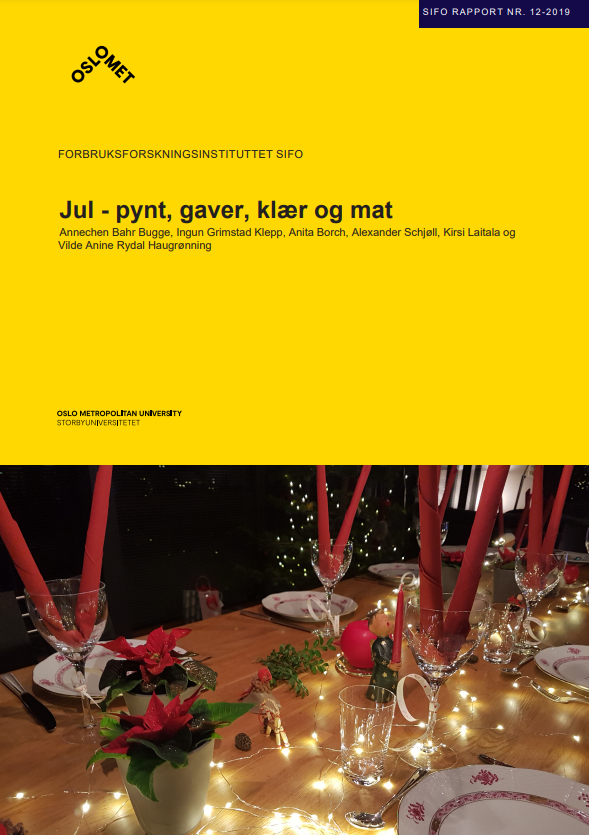
Jul – pynt, gaver, klær og mat

I denne rapporten er det sett nærmere på hvilken betydning og rolle pynt, gaver, klær og mat har i juleritualet. Resultatene av spørreundersøkelsen viser at hvordan vi feirer jul er preget av stabilitet og relativt små endringer. De aller fleste deltar i julefeiringen. Syv av ti ga uttrykk for at julen hadde stor betydning for dem. Det respondentene satt mest pris på ved ritualet var det sosiale samværet, maten og måltidene og tradisjonene. Langt færre beskrev det kristne julebudskapet eller gavene som betydningsfulle. Samlet viser rapporten at den stemningen og det sosiale samværet som mange sier de setter pris på ved julen, nettopp skapes gjennom forbrukspraksiser som å kjøpe og lage gaver, vaske, rulle og stryke, bake, koke og steke, pynte og dekke bord, kle seg til høytiden, sette god mat på bordet og dele den med kjente og kjære. Rapporten viser dessuten at vi ikke bare er sammen, men også er sammen på en annen måte, en bestemt måte nokså annerledes enn i hverdagen.