Hopp til innholdet

Wardrobe sizes and clothing lifespans

It is easy to assume that a large wardrobe is characterized by excessive clothing and high acquisition, with little use of each garment and thus a big environmental impact. However, it is also possible to think the opposite; that the large wardrobe is a result of clothes remaining in use for a long time, that disposal happens rarely, while acquisition can be normal or even low. Whatever the reason, in a large wardrobe it is more likely that clothes become old before the technical life expires. This is because many of the garments are seldom used. Small wardrobes are often presented as favourable for both people and the environment, and as part of an ecological-friendly lifestyle, but we know little about the interaction between wardrobe sizes, longevity and the environmental impact.
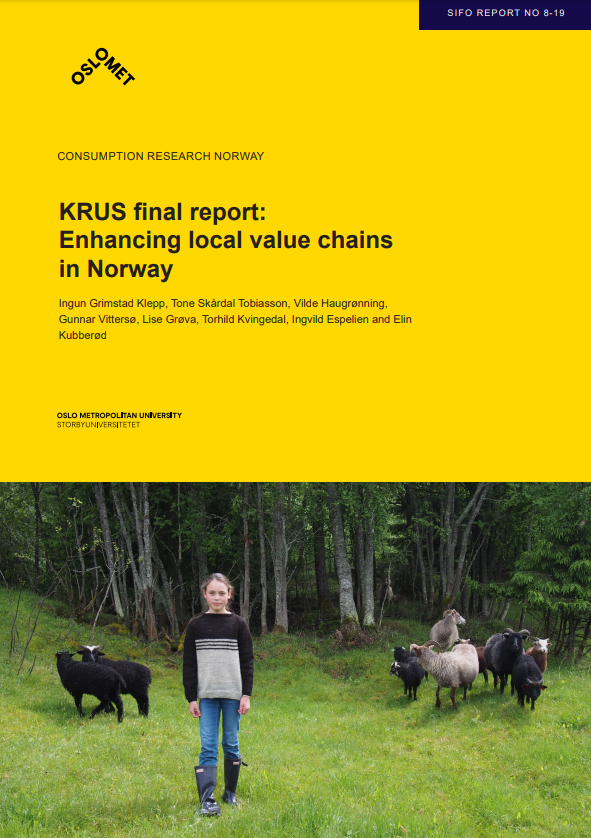
KRUS final report: Enhancing local value chains in Norway

  • av

From its initiation in 2015 to the end in 2019, KRUS had two goals: to improve the market for and the value of Norwegian wool, and survey the opportunities for local production in a move towards a goal of sustainability in the fashion sector. On a larger scale, KRUS has looked at how we can re-establish an understanding of the connection between the raw material and the finished product within the textile industry and among consumers. It is critical to understand this connection, both to ensure quality products and to reach the market potential for Norwegian wool.

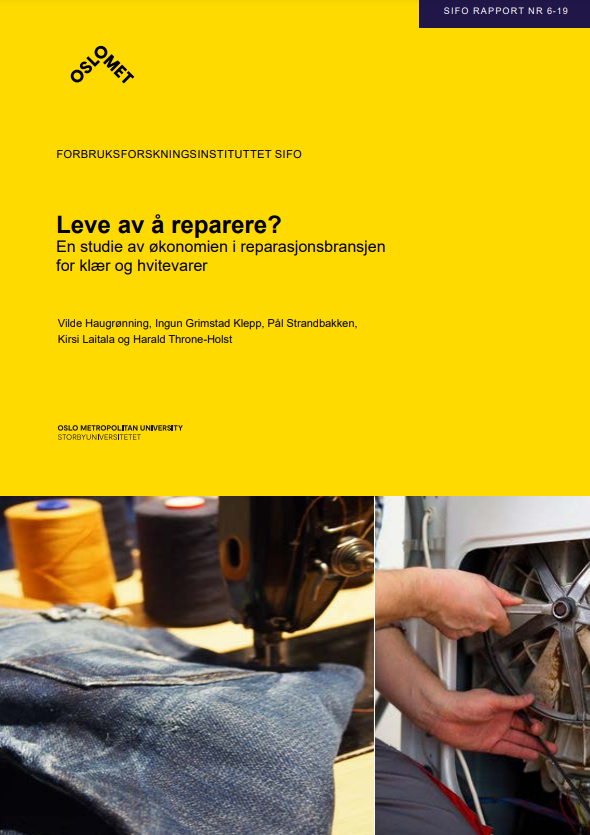
Leve av å reparere? En studie av økonomien i reparasjonsbransjen for klær og hvitevarer

Rapporten undersøker reparasjonsbransjen for klær og hvitevarer og aktørenes synspunkter på barrierer og muligheter for utvikling av tjenestene. Det er viktig å få en bredere forståelse for hvilke muligheter og barrierer de opplever i sitt arbeid med reparasjon, fordi dette kan være en viktig del av sirkulær økonomi og bærekraftig forbruk. De aller fleste reparasjoner foregår privat, og forbrukernes holdninger er også viktige for bransjen. Derfor har vi trukket forbrukernes oppfatninger inn i analysen basert på en spørreundersøkelse. Rapporten diskuterer dermed ikke bare hva som kan styrke en bransje, men også hva som kan bidra til at flere produkter blir reparert og dermed brukes lenger.
Den første delen av rapporten er en litteraturgjennomgang. Vi presenterer tidligere studier av bransjen i Norge, samt svenske erfaringer med redusert merverdiavgift. Videre følger en analyse av 15 kvalitative intervjuer med aktører i reparasjonsbransjen, 10 innen klær og 5 innen hvitevarer. I analysen har vi også inkludert datamateriale fra spørreundersøkelsen med forbrukere. Reparasjonsbransjen er svært sammensatt og består delvis av store bedrifter hvor reparasjon er en forsvinnende liten del av deres virksomhet, og av små enmanns bedrifter hvor reparasjon kan være, men ikke alltid er en viktig del av virksomheten. Likevel er det flere likhetstrekk for hva som er barrierer og muligheter for bransjen. Blant barrierer finner vi at den gjennomgående lave prisen på produkter og lav kvalitet bidrar til liten lønnsomhet for reparasjoner, og det er svært liten betalingsvilje blant forbrukere for reparasjonstjenester. Videre er tilgangen på kompetent personale en stor utfordring, som forventes å bli større i årene fremover.

A Louse in Court: Norwegian Knitted Sweaters with ‘Lus’ on Big-Time Criminals

Early one morning in 2008 I was sitting in make-up for a Norwegian television show and felt the trained hands of the make-up smooth out my face with paint. It wasn’t the first time I’d been there. With a population of 5 million there are not many clothing researchers to choose between in Norway, and with plenty of weather and outdoor activities, clothes are important. Questions such as how to dress children for physical activities outdoors are equally relevant every autumn and before every winter vacation and every Easter, when Norwegians go to their cabins, and the ideal is to spend as much time as possible outdoors. I have talked about the choice between wool and synthetic fibres and also about traditional Norwegian knitwear, but this time the subject was somewhat different.

Uniformity Without Uniforms: Dressing School Children in Norway

This chapter discusses the relationship between Norwegian schools’ ideals of equality and the way in which school clothes are regulated. Interviews with a teacher in a transitional language learning group for newly arrived immigrant children, as well as with children and parents in immigrant families, are used to discuss whether school clothes inhibit or promote integration. The material shows great willingness of children to dress like the others, as well as understanding that clothing consumption is essential for integration in school, and thus society. At the same time, this is not easily achievable either economically, culturally or practically. Little is done to make Norwegian schools inclusive in this field of consumption.

Dressing a Demanding Body to Fit In: Clean and Decent with Ostomy or Chronic Skin Disease

This article discusses what kind of strategies people with a stoma or various chronic skin conditions, such as psoriasis oratopic dermatitis, use to find clothes that fit and enable them to fit in. Based on qualitative interviews in Norway, we study how they manage to dress with a demanding body, a poor market and limited economic resources. This includes describing how purchases take place, which clothes fit, how much clothing is needed, and which laundry practices are used. Their main strategy was to reduce the requirements for their own appearance rather than to cleanliness and body odours. If they were unable to appear appropriately dressed, as a minimum odourless and stain-free, they reduced their participation in social life.

Microfibres from apparel and home textiles: Prospects for including microplastics in environmental sustainability assessment

  • av

Textiles release fibres to the environment during production, use, and at end-of-life disposal. Approximately two-thirds of all textile items are now synthetic, dominated by petroleum-based organic polymers such as polyester,polyamide and acrylic. Plastic microfibres (b5 mm) and nanofibres (b100 nm) have been identified in ecosystems in all regions of the globe and have been estimated to comprise up to 35% of primary microplastics in marine environments, a major proportion of microplastics on coastal shorelines and to persist for decades in soils treated with sludge from waste water treatment plants.
In this paper we present a critical review of factors affecting the release from fabrics of microfibres, and of the risks for impacts on ecological systems and potentially on human health. This review is used as a basis for exploring the potential to include a metric for microplastic pollution in tools that have been developed to quantify the environmental performance of apparel and home textiles. We conclude that the simple metric of mass or number of microfibres released combined with data on their persistence in the environment, could provide a useful interim mid-point indicator in sustainability assessment tools to support monitoring and mitigation strategies for microplastic pollution. Identified priority research areas include: (1) Standardised analytical methods for textile microfibres and nanofibres; (2) Ecotoxicological studies using environmentally realistic concentrations; (3) Studies tracking the fate of microplastics in complex food webs; and (4) Refined indicators for microfibre impacts in apparel and home textile sustainability assessment tools.

Care and production of clothing in Norwegian homes: Environmental implications of mending and making practices

Mending, re-design, and altering are alternatives for prolonging the use period of clothing. It is a common assumption that nobody mends clothing anymore in Western societies. This paper studies Norwegian consumers’ clothing mending and making practices. We ask how common the different mending and making activities are, has this changed during the past several years, who are the clothing menders and makers, and further, are these practices related to consumers environmental opinions?
We build on three quantitative surveys in Norway from 2010, 2011, and 2017. Many consumers do mend their clothing at least occasionally, especially the simpler tasks, such as sewing on a button and fixing an unravelled seam. Women and the elderly are more active in making and mending, whereas the young are a bit more likely to make something new out of old clothing. The mending activities were correlated with respondents’ environmental opinions. Mending clothes is more common than is usually assumed. Knowledge of current practices and barriers for clothing mending enables us to recommend measures that can potentially increase the use time of clothing. These results can be beneficial in clothing design, home economics, and crafts education as well as understanding consumer behavior and making policies that aim at environmental improvements within clothing consumption.

Does Use Matter? Comparison of Environmental Impacts of Clothing Based on Fiber Type

  • av

Several tools have been developed to compare the environmental impact of textiles. The most widely used are Higg Materials Sustainability Index (MSI) and MADE-BY Fiber Benchmark. They use data from production to evaluate the environmental impacts of textiles differentiated by fiber type. The use phase is excluded from both tools. This article discusses whether there is evidence that the use of textiles differs systematically between different fiber types and examines the consequences of comparing the environmental impacts of clothing based on differences in production of fibers alone without including differences in their use.

The empirical material in this paper is based on analysis of rating tools and a literature review on clothing use. It shows that fiber content contributes to the way consumers take care of and use their clothing. When use is omitted, major environmental problems associated with this stage, such as spread of microplastics, are also excluded. This one-sided focus on material production impacts also excludes the importance of product lifespans, quality, and functionality. The consequence is that short-lived disposable products are equated with durable products. Comparing dissimilar garments will not help consumers to make choices that will reduce the environmental burden of clothing. We need an informed discussion on how to use all materials in the most environmentally sustainable way possible.