Hopp til innholdet

Environmentally Sustainable Textile Consumption—What Characterizes the Political Textile Consumers?

The textile and clothing industry is considered as one of the most polluting industries in the world. Still, the regulation of environmental hazards connected to the industry is very limited, and much responsibility is placed on the shoulders of consumers. One of the few ways that ordinary consumers can seek to influence the textile and clothing industry is through their own consumption practices and their wallet. This article departs from the discourse on sustainable consumption and the role of the consumer as an agent for change, and the article investigates the characteristics of the consumers who practice deliberate environmentally sustainable consumption of textiles and clothing. This is done through the lens of political consumption. Based on a cross-national survey conducted in five Western European countries, factors that have been found to predict general political consumption in previous research are tested on the field of textiles and clothing. The findings demonstrate both similarities and some discrepancies with previous studies of political consumption as well as significant country variations.
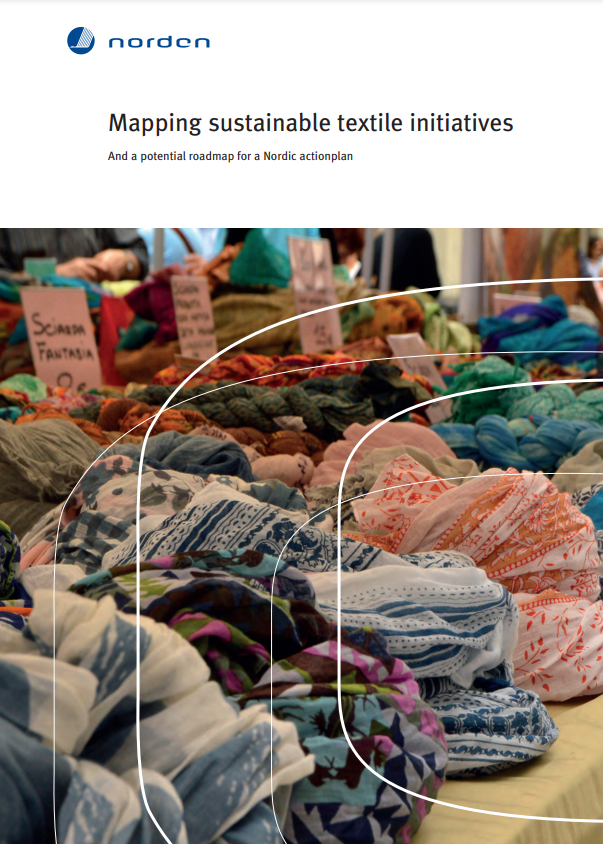

Mapping sustainable textiles initiatives: And a potential roadmap for a Nordic actionplan

This report aims to chart a plan for a coordinated Nordic effort towards sustainable development in textiles and identify ongoing initiatives in the area. The aim was an ambitious plan with a potential for significant reductions in environmental pressures, but also green growth. To reach these goals, we staked out four regions a Nordic plan should include.

Making Clothing Last: A Design Approach for Reducing the Environmental Impacts

  • av

This article discusses the extent it is possible to delay clothing disposal through improved design, thus reducing negative environmental impacts. This has been done by including user centered design methods into more traditional quantitative consumer research to give new insights for design. Empirical data on reasons for disposal of 620 clothing items from 35 persons in 16 Norwegian households was collected. In total, 70 different disposal reasons were registered, which were combined into seven main categories.

Clothing disposal habits and consequences for life cycle assessment (LCA)

  • av

This chapter discusses the effects of end-of-life scenarios to the life cycle assessment (LCA) calculations. Consumers’ decisions in the disposal phase of clothing are crucial from an environmental point of view, as they affect the lifespan of clothing, as well as the potential for reuse and recycling. In doing this, examples of Norwegian consumers’ clothing use and disposal practices are used.
We will present statistics for the current situation in Norway as well as qualitative material on clothing disposal practices and discuss disposal methods and frequencies. Instead of assuming that all clothes are disposed of equally regardless of type of garment, person and place, the LCA analyses should be nuanced in relation to knowledge of disposal practices. Analysis also shows also that if improvements are made in facilitating reuse, clothing lifespans could easily be prolonged.

His mother’s dress: growth in the number of clothes

Eivind Stø likes a tell an illustrative story about his mother who went through World War II with only one dress due to rationing. Today women have many dresses; more than we can wear out in 5 years. Since 1990, Norway’s clothing imports have almost doubled (Statistics Norway, 2014) and we did not lack clothing in 1990. This chapter discusses what we know about this change. What do we know about the number of clothes in use? When did they multiply to such an extent? What sources and methods do we have to describe this growth? In general, growth should be a more central theme in the environmental debate, especially when it comes to clothing and other items where growth in numbers is completely decoupled from a corresponding increase in satisfaction. As long as we produce (and purchase) far more clothes than we need, quantity should be an essential theme.

Patched, Louse-ridden, Tattered: Clean and Dirty Clothes

“Patched, louse-ridden, tattered—clean, beautiful, gem.” As children we recited this rhyme in Norwegian: “Lappete, lusete, fillete—ren, pen, edelsten,” as we picked petal after petal from a daisy. All the words can be understood as descriptions of the child’s future clothes. Clean is the turning point in the rhyme. Clean is thus seen as the first step on the way towards the gem, and it conveys here the same meaning as in the saying “whole and clean is the greatest finery.” Both emphasize clean clothes as crucial to the judgment of a person’s appearance. In the world of fashion it has been alleged that “anything goes.” This is probably true if we restrict “anything” to small variations in the look, decor, color, and style of clothes. However, our way of dressing also depends on more absolute norms.
This article explores the norms that deal with the relationship between clean and dirty clothes. Despite the fact that there is abundant research on cleanliness and laundering on the one hand, and clothes and clothes habits on the other, there are few points of intersection between the two fields. The article is an attempt at seeing these two themes in conjunction. It investigates how clothes, by being kept clean, make bodies socially acceptable. The article looks at how the demand for cleanliness varies in relation to age, gender, and class, and compares these demands to what we know about decency.

A methodological approach to the materiality of clothing: Wardrobe studies

The material is not just ‘a carrier of different types of symbols, but an active element in the practices. Bringing this to the fore requires new research methods. This article discusses a methodological approach, we call it a wardrobe study, which allows for the analysis of the way in which clothes relate to each other on the whole or within parts of the wardrobe. More specifically, we discuss how this method can contribute to increasing the materiality of clothes studies. The theoretical point of departure for this approach is a practice theory in which the material enters as an integral part. First, the article briefly discusses developments within the study of dress and fashion. Second, the methods combined and developed in wardrobe studies are discussed. The emphasis here is primarily not only on the weaknesses of the individual methods in practice-oriented dress studies, but also on how they jointly can contribute to the wardrobe study.

Forbrukstrender 2014

SIFO samler årlig inn store mengde data om ulike sider ved forbruket og forbrukernes situasjon i markedet. Målsettingen er å fremskaffe kunnskap om forbrukerne og hvordan forbrukermarkedene fungerer sett fra forbrukernes side. En stor del av datamaterialet er knyttet til områder der SIFO ønsker å følge utviklingen over tid. I denne rapporten har vi samlet opplysninger om forbrukstrender fra ulike SIFO-surveyer presentert av ulike forskere ved SIFO. Temaene er kroppsrelatert matforbruk og helse, forbrukernes forhold til reklame, holdninger til søndagsåpne butikker, mobilitet i tjenestemarkedet, arv og deling av klær, sko og sportsutstyr, miljø og forbruk, den økonomiske situasjonen for norske husholdninger og deres betalingsproblemer, mobil betaling.