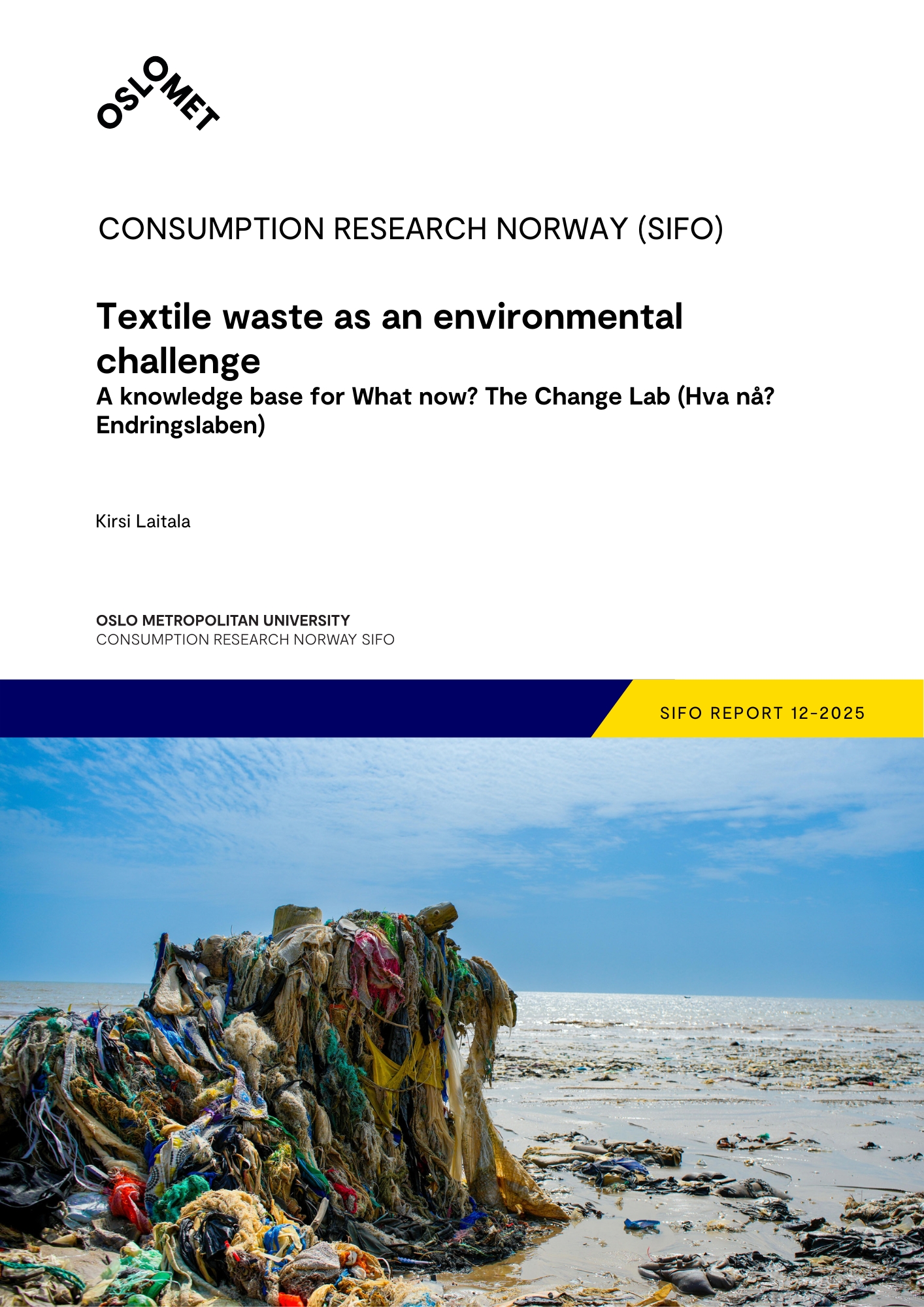
Ny rapport med kunnskapsoppsummering om miljøutfordringene knyttet til tekstilavfall

Hele rapporten finner du her: Textile waste as an environmental challenge – A Knowledge Base for What Now?

Rapporten, som er skrevet av Kirsi Laitala, diskuterer de betydelige miljøutfordringene knyttet til tekstilavfall og gir en kunnskapsbase for den norske læringsplattformen Hva nå? Endringslaben, som har som mål å styrke barn og unges kunnskap, engasjement og handlingskompetanse innen bærekraft. Den fremhever den økende tekstilproduksjonen samt den tilsvarende økningen i tekstilavfall, med omtrent 92 millioner tonn som kastes globalt hvert år. Dokumentet understreker de miljømessige konsekvensene av dette avfallet, inkludert forurensning, ressursutarming og virkninger på klimaendringer. I tillegg skisserer rapporten behovet for forbedrede reguleringer, nye forretningspraksiser og endringer i forbrukeratferd for å dempe disse utfordringene, og oppfordrer til utdanningsinitiativer som Endringslaben for å inspirere unge generasjoner til å ta mer bærekraftige valg.

I prosjektperioden med Forskningsrådet vil det bli satt opp to utstillinger, en på Kongsvinger i mars og en i Arendal i april 2026. Les mere om Endringslaben her: https://endringslaben.no/

Understanding garment durability through local lenses: a participatory study with communities across the globe

Authors: Hester Vanacker, Andrée-Anne Lemieux, Kirsi Laitala, Michelle Dindi, Sophie Bonnier & Samir Lamouri.

Abstract

The overproduction of garments, often of low quality, contributes significantly to environmental degradation, especially in the Global South. Therefore, assessing the durability of garments has attracted the attention of industry organizations and legislators. Recent research has identified both intrinsic and extrinsic dimensions of durability and their links to a circular transition. This study aims to deepen the understanding of garment durability by incorporating the local perspectives of five different global communities. Using a participatory action research methodology, semi-structured interviews were conducted with stakeholders across value chains in France, Ghana, Indonesia, Norway, and South Africa. The key findings of this study have been grouped into 8 trends that characterize garment durability: (1) quality is preferred over durability, (2) garment durability is dynamic, (3) price and brand are related to perceived durability, (4) local refers to geographical proximity, (5) local involves value creation, (6) local touches tradition, (7) traditional garments and textiles are more durable, and (8) local contexts influence garment durability. These trends indicate that local factors significantly influence the definition and practice of durability, suggesting that global legislation must consider such nuances when describing and quantifying durability in the context of garments and textiles.

The full article is available open access via Scientific Reports (rdcu.be)

Reference

Vanacker, H., Lemieux, A.-A., Laitala, K., Dindi, M., Bonnier, S., & Lamouri, S. (2025). Understanding garment durability through local lenses: a participatory study with communities across the globe. Scientific Reports, 15(1), 34962. https://doi.org/10.1038/s41598-025-19087-3