Hopp til innholdet

Local clothing: What is that? How an environmental policy concept is understood

  • av

The textile industry is characterized by global mass production and has an immense impact on the environment. One garment can travel around the world through an extensive value chain before reaching its final consumption destination. The consumer receives little information about how the item was produced due to a lack of policy regulation.

The Consumer Perception of Odour

  • av

Human olfaction sense is one of the highly underestimated senses since historical times. Fortunately, this has changed in recent times, as the perception of odour or scent by people has received increasing attention through several research works from different scientific disciplines.

Myter og sannheter om ullvask

  • av

Det eksisterer en del myter om hvordan ull best kan vaskes. Enkel og riktig klesvask er viktig både for at minst mulig av ullklær ødelegges, og for å belaste klima og miljø minst mulig.

Product lifetime in European and Norwegian policies

Formålet med denne rapporten er å få en bedre forståelse av hvordan produktlevetid har blitt posisjonert i politikken de siste tjue årene. Ved bruk av dokumentanalyse undersøker vi forekomsten og kontekstualiseringen av produktlevetid i EUs sirkulærøkonomipolitikk, norske partiprogrammer og offisielle dokumenter, dokumenter fra norske miljøorganisasjoner, forbrukerorganisasjoners politikk og produktpolitikk. Samlet finner vi at det er lite fokus på produktlevetid mellom 2000-2015, menat det har vært en stor økning i fokus de siste fem årene. Imidlertid er det fremdeles lang vei å gå i arbeidet med å utvikle tiltak som faktisk adresserer produktlevetid.

Consumer practices for extending the social lifetimes of sofas and clothing

Consumers play an essential role in efforts to extend product lifetimes (PL) and consumers’ practices can determine how long and active lives products get. Applying the framework of Social Practice Theory, this paper argues that in order to suggest changes to how consumers can contribute to longer product lifespans, research needs to focus on consumer practices. The data material consists of 4 focus group interviews with 38 participants about household goods and 29 semi-structured interviews about clothing.

Reducing environmental impacts from garments through best practice garment use and care, using the example of a Merino wool sweater

Garment production and use generate substantial environmental impacts, and the care and use are key determinants of cradle-to-grave impacts. The present study investigated the potential to reduce environmental impacts by applying best practices for garment care combined with increased garment use. A wool sweater is used as an example because wool garments have particular attributes that favour reduced environmental impacts in the use phase.

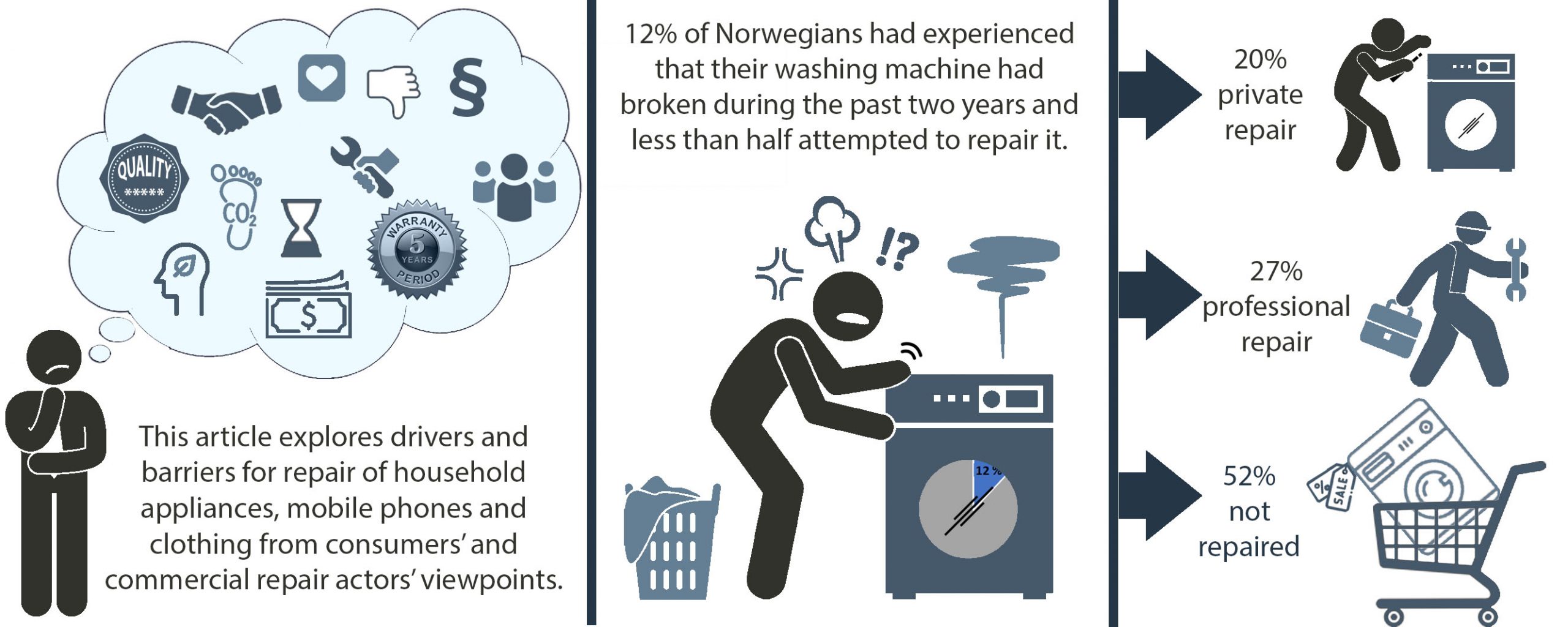
modell som viser hvordan vi reparerer vaskemaskiner i Norge

Increasing repair of household appliances, mobile phones and clothing: Experiences from consumers and the repair industry

Increasing product lifespans is one of the most effective environmental strategies and therefore repair is a part of the circular economy approach that aims to keep products and materials longer in use. This article explores drivers and barriers for repair from consumers’ and commercial repair actors view-points, in order to understand how the repair rates of household appliances, mobile phones and clothing could be increased.