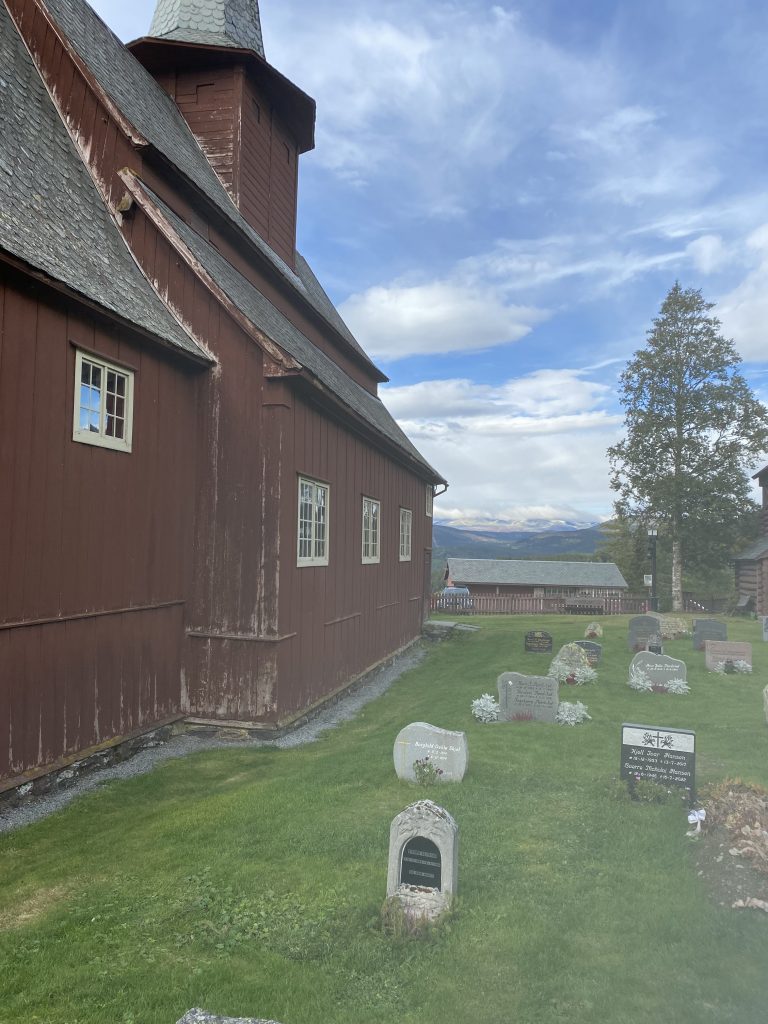
This study investigates the relationship between non-pharmaceutical interventions (NPIs) and influenza morbidity during the 1918 pandemic, with a focus on urban and rural medical districts in Norway. By integrating published secondary statistical data from 1918 from Statistics Norway with primary medical records from the Norwegian National Archive, the paper offers a novel historical data set to explore the timing and frequency of NPIs in relation to monthly reported influenza and pneumonia morbidity cases. Despite inherent limitations in the historical data, the findings suggest that a greater number of NPIs may have contributed to a delay in the onset and/or a reduction in the intensity of influenza morbidity. These results support the premise that the combined implementation of multiple NPIs was more effective in delaying and flattening the epidemic curve. The findings underscore the importance of early, coordinated and sustained non-pharmaceutical responses in mitigating the spread of infectious diseases, especially in the absence of pharmaceutical treatments or vaccines.
The paper is a collaboration between Vibeke Narverud Nyborg (first author), Hilde Orderud and Svenn-Erik Mamelund.
This research aimed to understand the impact of age on mortality risk across four influenza pandemics in multiple populations.
We found that the absolute and percentage mortality patterns emphasized different aspects of age-specific risk across pandemics, illustrating that the metric choice influences how age patterns are interpreted.
By comparing mortality data across multiple populations, this research challenges prior assumptions based on US-centric data and highlights the heterogeneity of age-specific risk across pandemics.
As part of the New CAS project: “Scarred people” – Centre for Research on Pandemics & Society (PANSOC), Centre leader Mamelund has presented his research in workshops in Tampere (17 April) and in Helsinki (21 April). He also participated in day-to-day academic and social activities in both cities. As the study context of the “Scarred people”-project was the city of Tampere, he also visited several museums and had several walks to understand the pulse and the social and economic history of the city.
Program workshop in Tampere:
“The Scarring Effects of Wars, Crises and Diseases at 20th century–Lifespan, Health and Intergenerationality“:
Jarmo Peltola and Sakari Saaritsa, Diagnoses, Scarring, selection, interaction: The longevity effects of a 1916 Typhoid Epidemic in a Finnish Industrial City
Jarmo Peltola, Leena Enbom and Sakari Saaritsa, Scarred City. Exploring Lifespan and Mortality Patterns among Former Civil War, Participants in Tampere
Virva Liski, Ilari Taskinen & Ville Kivimäki, Health at war: social and regional patterns of morbidity among Finnish soldiers in the Second World War
Emma Raitoharju, Transgenerational Epigenetic Effects of War Stress: Follow-up Study on Finnish Soldiers of World War II and Their Descendants
The event was organized by: Tampere Institute for Advanced Study, Tampere University, Economic and Social History, University of Helsinki, HEX Centre for the History of Experience, Tampere University.
Program workshop at the University of Helsinki:
“SCAR/RED: The impact of epidemics and civil conflict on population health, past and present“
Time: April 21st, 2026
Venue: TBA, University of Helsinki & Zoom
All times Eastern European Summer Time (Helsinki)
10.00-12.00
Svenn-Erik Mamelund (OsloMet Centre for Research on Pandemics and Society (PANSOC)): Social Inequalities & Pandemics
Jarmo Peltola & Sakari Saaritsa (Economic and Social History, University of Helsinki): Scarring, Selection, Interaction: The Longevity Effects of a 1916 Typhoid Epidemic in a Finnish Industrial City
Serena Vigezzi (University of Southern Denmark, Stockholm University & Economic and Social History, University of Helsinki): Lifespan Variation in the Wake of COVID-19
Tuuli Hurme (Economic and Social History, University of Helsinki): Short-Term Effects of the 1917-1919 Turmoil on Child Health in Helsinki, Finland
12-13 Lunch
13.00-14.30
Jarmo Peltola & Sakari Saaritsa (Economic and Social History, University of Helsinki): Selection, distribution and change in birth weights during the Great Depression of the 1930s in an urban near-complete count data
Moritz Oberndorfer et al. (MaxHel, University of Helsinki): Social Inequalities in Birthweight in Times of Crisis: A Population-Wide Analysis of Social Inequalities in Birthweight Before and During COVID-19 Pandemic Using Individual-Level Data from 14 Countries
Jarmo Peltola, Leena Enbom & Sakari Saaritsa (Economic and Social History, University of Helsinki): Scarred City: Exploring Lifespan and Mortality Patterns among Former Civil War Participants in Tampere, Finland
PANSOC will jointly organize this workshop with colleagues in Denmak and Switzerland. It will take place at Oslo Metropolitan University, Oslo, Norway, 28-29 January 2027. Deadline for submission is 11 September 2026.
For the 12th and final Pandemics & Society Seminar of our Spring 2026 series we are pleased to welcome Umit Tleshova (Charles University). The seminar will be held on Thursday, 7 May at the normal time (16:00 CEST). More information about our speakers and the presentation is below. You can sign up for email notifications about the seminar series, including the Zoom details, here.
About the talk:
Tleshova will present the first comprehensive six-decade quantitative analysis of gender mortality gaps across 48 countries in the WHO European Region, conducted with Dr. Klára Hulíková Tesárková, Dr. Libor Jelen, and Prof. Dagmar Dzúrová. Using sex-specific life expectancy data and decomposition analysis, the research systematically examines variations in gender gaps across three distinct country groups: post-communist CIS (Commonwealth of Independent States), post-communist EU (European Union), and Europe (others) countries. The analysis reveals significant temporal and regional variations in gender mortality gaps, with critical peaks occurring during key historical periods in both Western and post-communist European contexts. A key finding demonstrates that observed gender gap variability primarily stems from structural, between-group differences rather than country-specific characteristics. Notably, the research identifies distinct pathways through which different regions experienced changes in their gender gaps, with important implications for understanding how demographic, political, and health system factors relate to gender mortality patterns. These findings offer insights for health policymakers seeking to reduce health disparities by targeting the systemic factors that drive long-term gender mortality patterns.
About the speaker:
Umit Tleshova is a PhD candidate in Demography at the Faculty of Science, Department of Demography and Geodemography, Charles University in Prague.