Hopp til innholdet


What Affects Garment Lifespans? International Clothing Practices Based on a Wardrobe Survey in China, Germany, Japan, the UK, and the USA

Increasing the length of clothing lifespans is crucial for reducing the total environmental impacts. This article discusses which factors contribute to the length of garment lifespans by studying how long garments are used, how many times they are worn, and by how many users. The analysis is based on quantitative wardrobe survey data from China, Germany, Japan, the UK, and the USA. Variables were divided into four blocks related respectively to the garment, user, garment use, and clothing practices, and used in two hierarchical multiple regressions and two binary logistic regressions.

The models explain between 11% and 43% of the variation in clothing lifespans. The garment use block was most indicative for the number of wears, while garment related properties contribute most to variation in the number of users. For lifespans measured in years, all four aspects were almost equally important. Some aspects that affect the lifespans of clothing cannot be easily changed (e.g., the consumer’s income, nationality, and age) but they can be used to identify where different measures can have the largest benefits. Several of the other conditions that affect lifespans can be changed (e.g., garment price and attitudes towards fashion) through quality management, marketing strategies, information, and improved consumer policies.

modell som viser energiforbruk klesvask

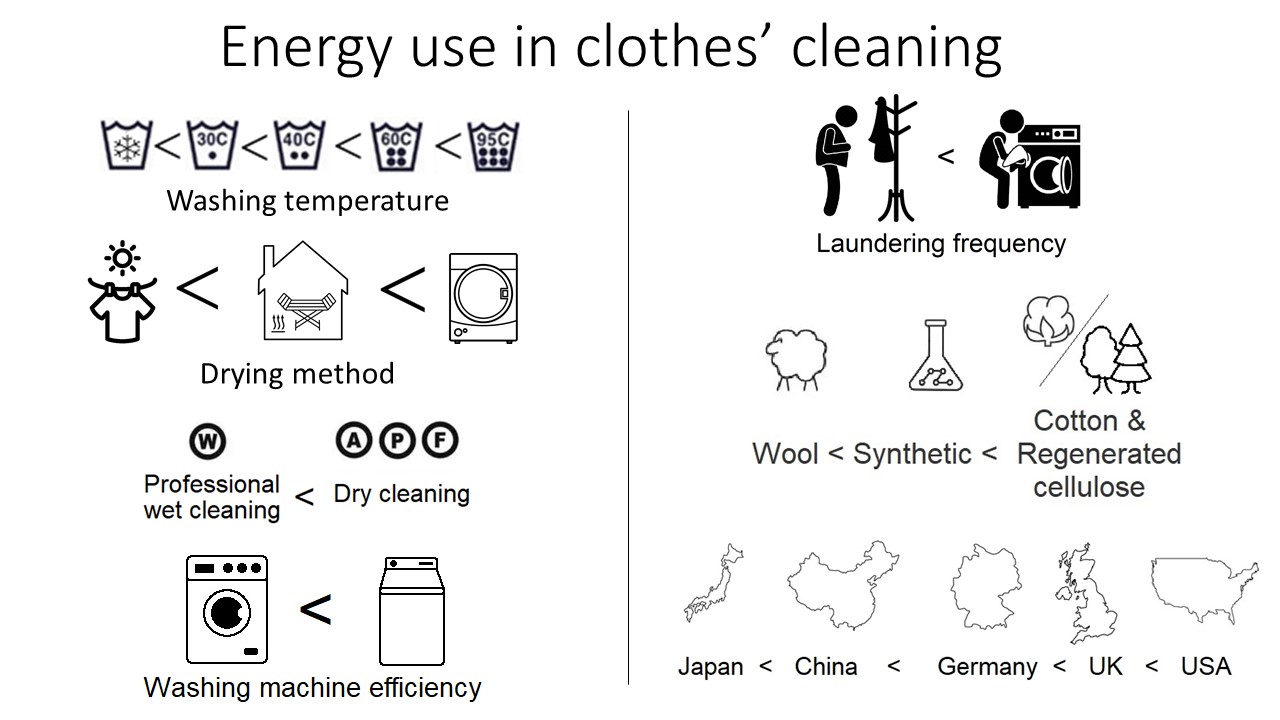
Laundry Care Regimes: Do the Practices of Keeping Clothes Clean Have Different Environmental Impacts Based on the Fibre Content?

  • av

Clothing maintenance is necessary for keeping clothing and textiles functional and socially acceptable, but it has environmental consequences due to the use of energy, water and chemicals. This article discusses whether clothes made of different materials are cleaned in different ways and have different environmental impacts. It fills a knowledge gap needed in environmental assessments that evaluate the impacts based on the function of a garment by giving detailed information on the use phase. The article is based on a quantitative wardrobe survey and qualitative laundry diary data from China, Germany, Japan, the UK and the USA.

The largest potential for environmental improvement exists in reducing laundering frequency and in the selection of washing and drying processes, and through a transition to fibres that are washed less frequently, such as wool. Adopting best practice garment care would give larger benefits in countries like the US where the consumption values were the highest, mainly due to extensive use of clothes dryers and less efficient washing machines combined with frequent cleaning. These variations should be considered in environmenta assessments of clothing and when forming sustainability policies. The results indicate the benefits of focusing future environmental work on consumer habits and culture and not only technologies.

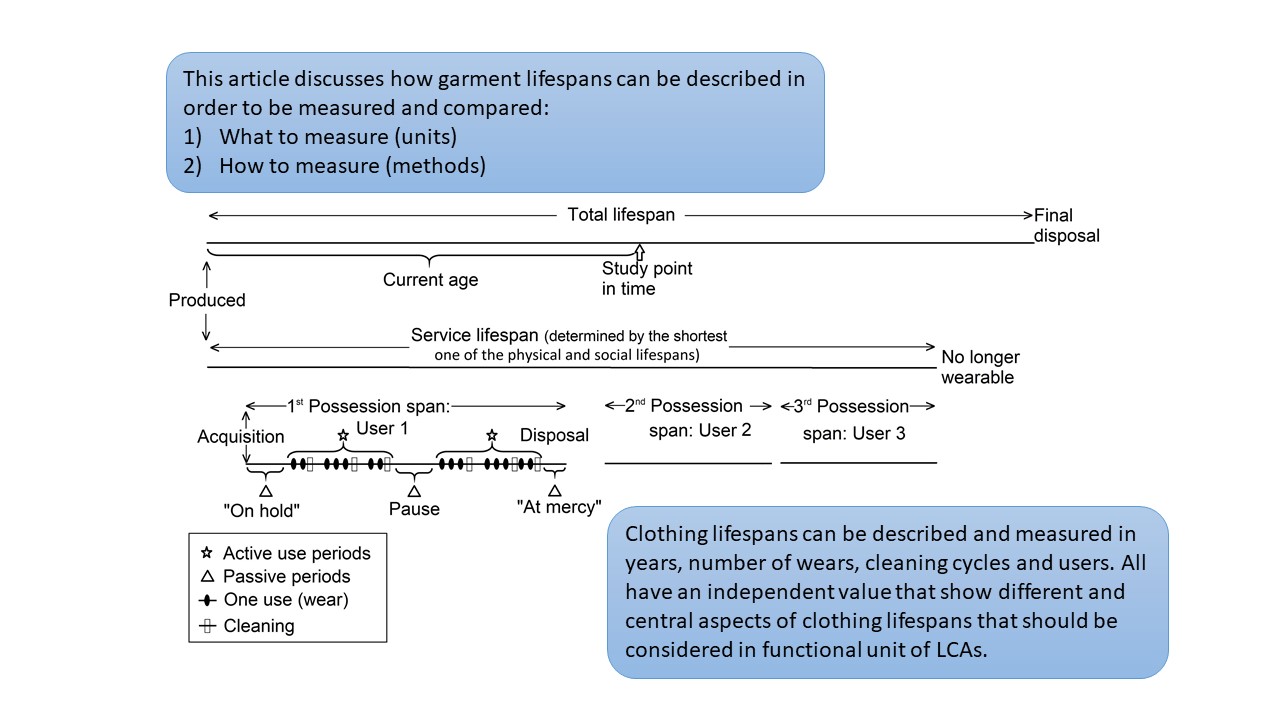
Clothing Lifespans: What Should Be Measured and How

  • av

Increasing the use of each product, most often called longer lifespans, is an effective environmental strategy. This article discusses how garment lifespans can be described in order to be measured and compared. It answers two sub-questions: (1) what to measure (units), and (2) how to measure (methods). We introduce and define terms related to clothing lifespans and contribute to discussions about an appropriate functional unit for garments in life cycle assessments (LCA) and other environmental accounting tools. We use a global wardrobe survey to exemplify the units and methods.

Clothing lifespans can be described and measured in years, the number of wears, cleaning cycles, and users. All have an independent value that show different and central aspects of clothing lifespans. A functional unit for LCAs should emphasise both the number of wears for all users as well as the service lifespan in years. Number of wears is the best measure for regular clothing, while number of years is most suited for occasion wear, because it is important to account for the need of more garments to cover all the relevant occasions during a specified time period. It is possible to study lifespan via carefully constructed surveys, providing key data relating to actual garment use.

Environmental impacts associated with the production, use, and end-of-life of a woollen garment

The textiles industry is a substantial contributor to environmental impacts through the production, processing, use, and end-of-life of garments. Wool is a high value, natural, and renewable fibre that is used to produce a wide range of garments, from active leisure wear to formal wear, and represents a small segment of the global fashion industry. Woollen garments are produced by long, global value chains extending from the production of ‘greasy’ wool on sheep farms, through processing to garment make-up, retail, consumer use, and end-of-life. To date, there have been limited life cycle assessment (LCA) studies on the environmental impacts of the full supply chain or use phase of garments, with the majority of wool LCA studies focusing on a segment of the supply chain. This study aimed to address this knowledge gap via a cradle-to-grave LCA of a woollen garment.

Wardrobe sizes and clothing lifespans

It is easy to assume that a large wardrobe is characterized by excessive clothing and high acquisition, with little use of each garment and thus a big environmental impact. However, it is also possible to think the opposite; that the large wardrobe is a result of clothes remaining in use for a long time, that disposal happens rarely, while acquisition can be normal or even low. Whatever the reason, in a large wardrobe it is more likely that clothes become old before the technical life expires. This is because many of the garments are seldom used. Small wardrobes are often presented as favourable for both people and the environment, and as part of an ecological-friendly lifestyle, but we know little about the interaction between wardrobe sizes, longevity and the environmental impact.

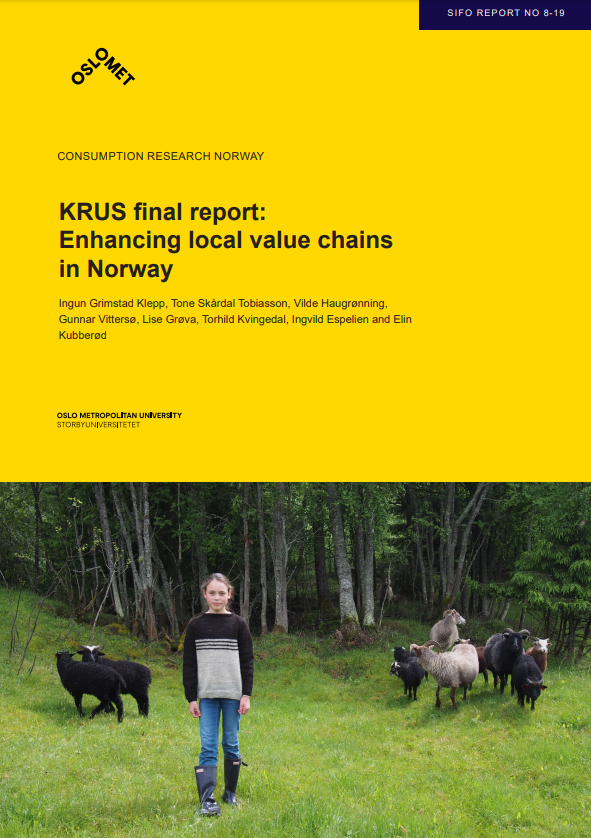
KRUS final report: Enhancing local value chains in Norway

  • av

From its initiation in 2015 to the end in 2019, KRUS had two goals: to improve the market for and the value of Norwegian wool, and survey the opportunities for local production in a move towards a goal of sustainability in the fashion sector. On a larger scale, KRUS has looked at how we can re-establish an understanding of the connection between the raw material and the finished product within the textile industry and among consumers. It is critical to understand this connection, both to ensure quality products and to reach the market potential for Norwegian wool.

A Louse in Court: Norwegian Knitted Sweaters with ‘Lus’ on Big-Time Criminals

Early one morning in 2008 I was sitting in make-up for a Norwegian television show and felt the trained hands of the make-up smooth out my face with paint. It wasn’t the first time I’d been there. With a population of 5 million there are not many clothing researchers to choose between in Norway, and with plenty of weather and outdoor activities, clothes are important. Questions such as how to dress children for physical activities outdoors are equally relevant every autumn and before every winter vacation and every Easter, when Norwegians go to their cabins, and the ideal is to spend as much time as possible outdoors. I have talked about the choice between wool and synthetic fibres and also about traditional Norwegian knitwear, but this time the subject was somewhat different.

Uniformity Without Uniforms: Dressing School Children in Norway

This chapter discusses the relationship between Norwegian schools’ ideals of equality and the way in which school clothes are regulated. Interviews with a teacher in a transitional language learning group for newly arrived immigrant children, as well as with children and parents in immigrant families, are used to discuss whether school clothes inhibit or promote integration. The material shows great willingness of children to dress like the others, as well as understanding that clothing consumption is essential for integration in school, and thus society. At the same time, this is not easily achievable either economically, culturally or practically. Little is done to make Norwegian schools inclusive in this field of consumption.

Dressing a Demanding Body to Fit In: Clean and Decent with Ostomy or Chronic Skin Disease

This article discusses what kind of strategies people with a stoma or various chronic skin conditions, such as psoriasis oratopic dermatitis, use to find clothes that fit and enable them to fit in. Based on qualitative interviews in Norway, we study how they manage to dress with a demanding body, a poor market and limited economic resources. This includes describing how purchases take place, which clothes fit, how much clothing is needed, and which laundry practices are used. Their main strategy was to reduce the requirements for their own appearance rather than to cleanliness and body odours. If they were unable to appear appropriately dressed, as a minimum odourless and stain-free, they reduced their participation in social life.