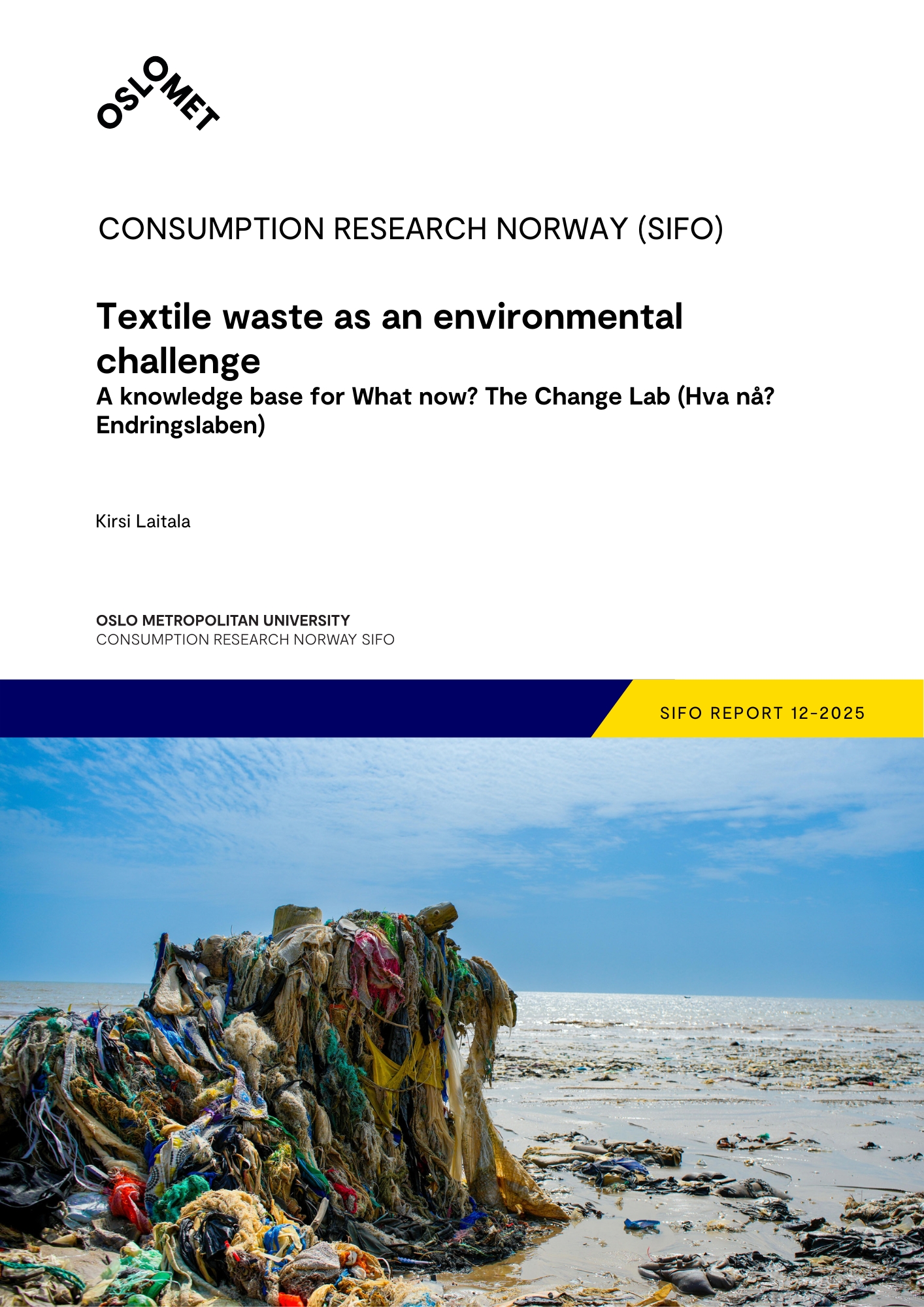
Ny rapport med kunnskapsoppsummering om miljøutfordringene knyttet til tekstilavfall
forskningsrapport om miljøutfordringer med tekstilavfall
forskningsrapport om miljøutfordringer med tekstilavfall
Authors: Hester Vanacker, Andrée-Anne Lemieux, Kirsi Laitala, Michelle Dindi, Sophie Bonnier & Samir Lamouri. Abstract The overproduction of garments, often of low quality, contributes significantly to environmental degradation, especially in the Global South. Therefore, assessing the durability of garments has attracted… Understanding garment durability through local lenses: a participatory study with communities across the globe
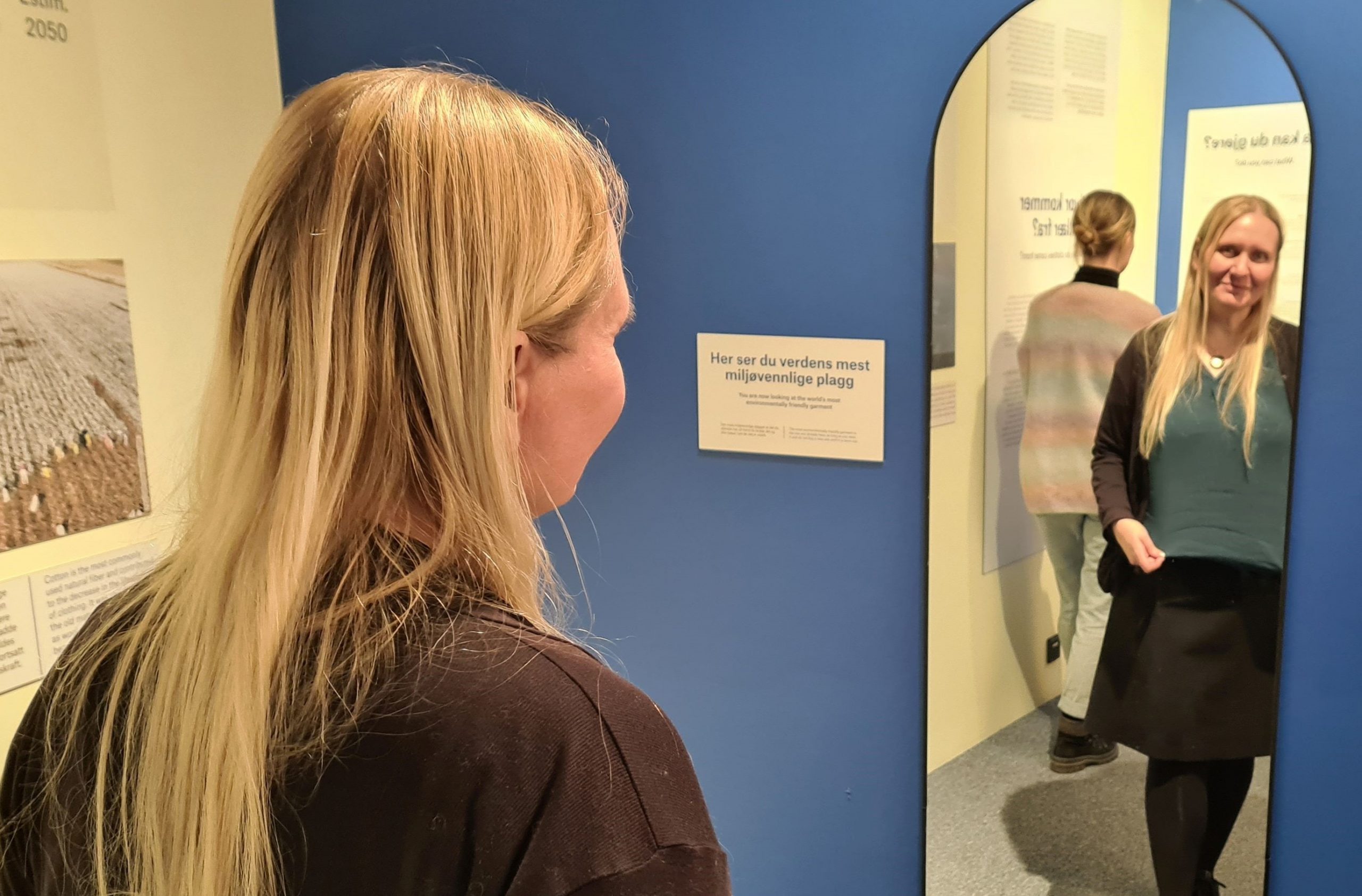
12. mars åpnet utstillingen Beyond fast fashion på Naturhistorisk museum, i et bittelite rom, men med et stort budskap: Volumene av tekstiler må ned og det mest bærekraftige plagget, er det du allerede har i… Beyond fast fashion: Mengdene og plastifiseringen får fokus på Naturhistorisk museum
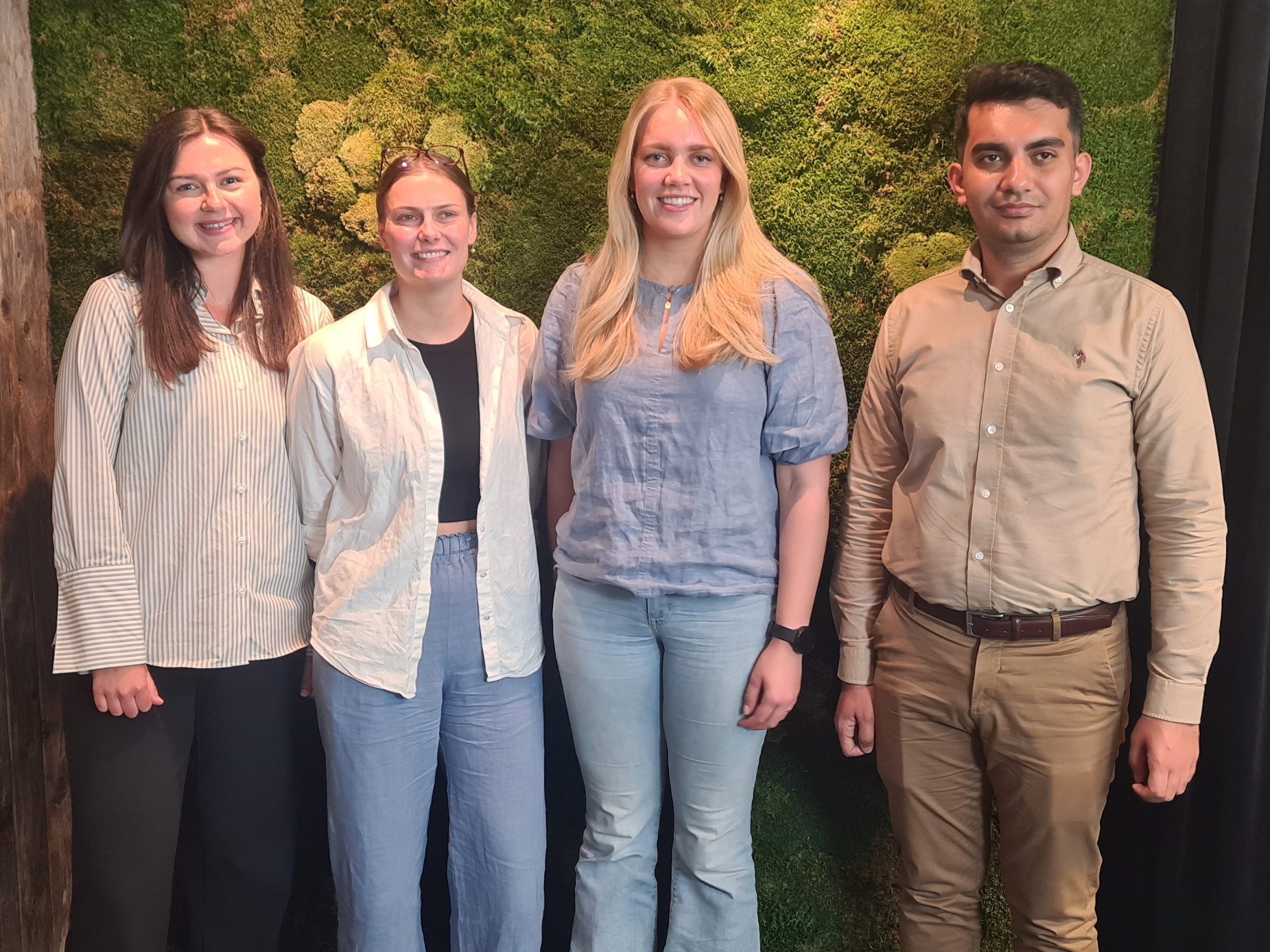
I sammenheng med forslaget for utvidet produsentansvar, foregår det i sommer et pilotprosjekt i regi av Avfall Norge og deres REdu sommerprogram for student-internship. Fire master-studenter skal gå igjennom tekstilavfall som er samlet inn på… Første steg mot målrettet produsentansvar
Først og fremst vil vi ønske deg velkommen som kollega! Dette er en veldig gledelig utvikling for Forbruksforskning Norge (SIFO) og vår klesforskningsgruppe, ved siden av selvfølgelig arbeidet i prosjektene du har ledelsen av arbeidspakker.… En samtale med Kate Fletcher
Consumers play an essential role in efforts to extend product lifetimes (PL) and consumers’ practices can determine how long and active lives products get. Applying the framework of Social Practice Theory, this paper argues that in order to suggest changes to how consumers can contribute to longer product lifespans, research needs to focus on consumer practices. The data material consists of 4 focus group interviews with 38 participants about household goods and 29 semi-structured interviews about clothing.

Increasing the length of clothing lifespans is crucial for reducing the total environmental impacts. This article discusses which factors contribute to the length of garment lifespans by studying how long garments are used, how many times they are worn, and by how many users. The analysis is based on quantitative wardrobe survey data from China, Germany, Japan, the UK, and the USA. Variables were divided into four blocks related respectively to the garment, user, garment use, and clothing practices, and used in two hierarchical multiple regressions and two binary logistic regressions.
The models explain between 11% and 43% of the variation in clothing lifespans. The garment use block was most indicative for the number of wears, while garment related properties contribute most to variation in the number of users. For lifespans measured in years, all four aspects were almost equally important. Some aspects that affect the lifespans of clothing cannot be easily changed (e.g., the consumer’s income, nationality, and age) but they can be used to identify where different measures can have the largest benefits. Several of the other conditions that affect lifespans can be changed (e.g., garment price and attitudes towards fashion) through quality management, marketing strategies, information, and improved consumer policies.
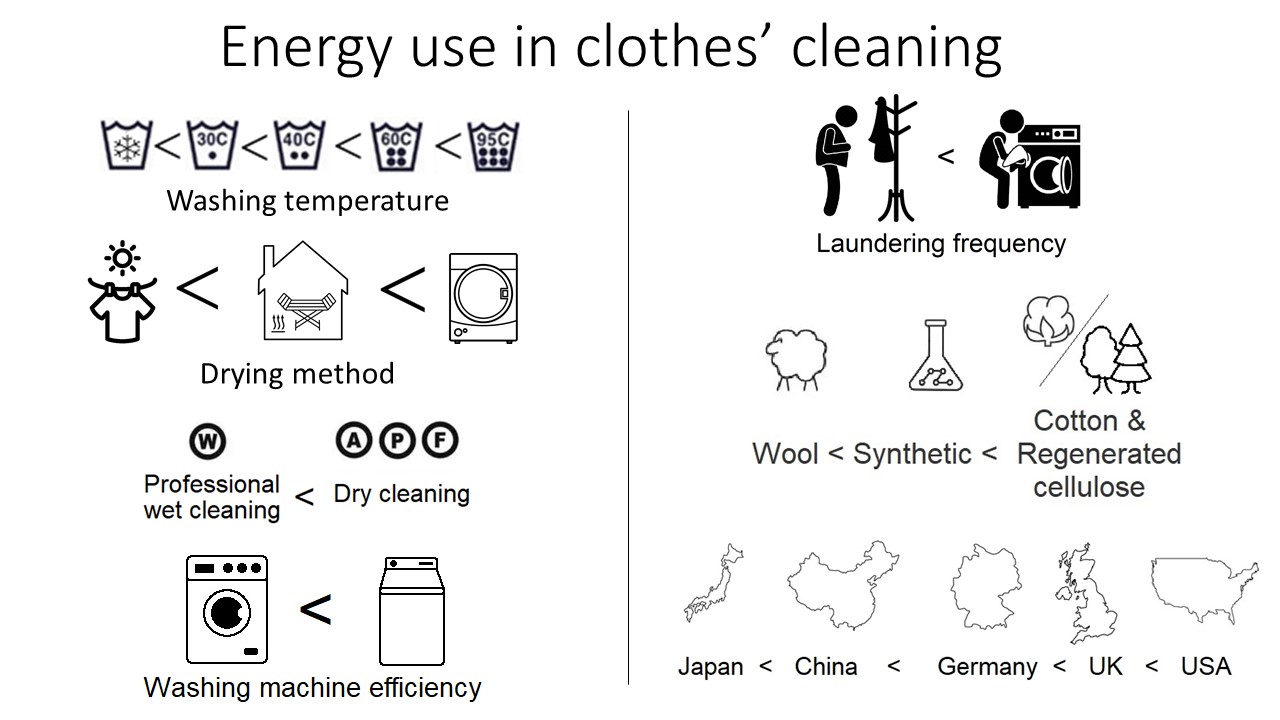
Clothing maintenance is necessary for keeping clothing and textiles functional and socially acceptable, but it has environmental consequences due to the use of energy, water and chemicals. This article discusses whether clothes made of different materials are cleaned in different ways and have different environmental impacts. It fills a knowledge gap needed in environmental assessments that evaluate the impacts based on the function of a garment by giving detailed information on the use phase. The article is based on a quantitative wardrobe survey and qualitative laundry diary data from China, Germany, Japan, the UK and the USA.
The largest potential for environmental improvement exists in reducing laundering frequency and in the selection of washing and drying processes, and through a transition to fibres that are washed less frequently, such as wool. Adopting best practice garment care would give larger benefits in countries like the US where the consumption values were the highest, mainly due to extensive use of clothes dryers and less efficient washing machines combined with frequent cleaning. These variations should be considered in environmenta assessments of clothing and when forming sustainability policies. The results indicate the benefits of focusing future environmental work on consumer habits and culture and not only technologies.
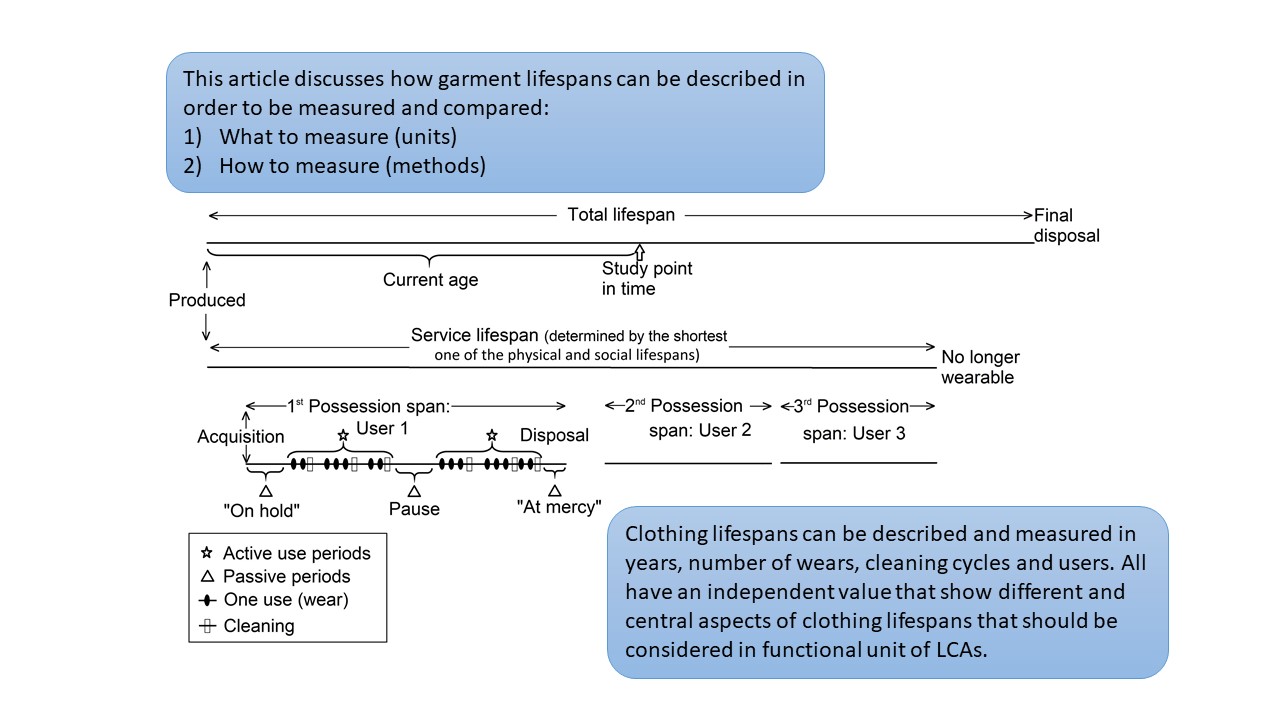
Increasing the use of each product, most often called longer lifespans, is an effective environmental strategy. This article discusses how garment lifespans can be described in order to be measured and compared. It answers two sub-questions: (1) what to measure (units), and (2) how to measure (methods). We introduce and define terms related to clothing lifespans and contribute to discussions about an appropriate functional unit for garments in life cycle assessments (LCA) and other environmental accounting tools. We use a global wardrobe survey to exemplify the units and methods.
Clothing lifespans can be described and measured in years, the number of wears, cleaning cycles, and users. All have an independent value that show different and central aspects of clothing lifespans. A functional unit for LCAs should emphasise both the number of wears for all users as well as the service lifespan in years. Number of wears is the best measure for regular clothing, while number of years is most suited for occasion wear, because it is important to account for the need of more garments to cover all the relevant occasions during a specified time period. It is possible to study lifespan via carefully constructed surveys, providing key data relating to actual garment use.
It is easy to assume that a large wardrobe is characterized by excessive clothing and high acquisition, with little use of each garment and thus a big environmental impact. However, it is also possible to think the opposite; that the large wardrobe is a result of clothes remaining in use for a long time, that disposal happens rarely, while acquisition can be normal or even low. Whatever the reason, in a large wardrobe it is more likely that clothes become old before the technical life expires. This is because many of the garments are seldom used. Small wardrobes are often presented as favourable for both people and the environment, and as part of an ecological-friendly lifestyle, but we know little about the interaction between wardrobe sizes, longevity and the environmental impact.