This is the fifth annual report for the Centre for Research on Pandemics & Society (PANSOC). As in previous years, we report here on our research mission and perspectives, projects and funding applications, the team and institutional collaborations, and outcomes/activities during 2025.
1. Short presentation of the Centre – research perspectives and main goals
PANSOC is an OsloMet Centre of Research Excellence (CRE) that conducts internationally innovative research on the societal, economic, and historical dimensions of pandemics. The Centre’s core mission remains to understand social and biological risk factors and inequalities—drawing lessons from both contemporary and historical pandemics—to improve pandemic preparedness and inform public policy. Its unique multidisciplinary focus bridges social science, public health, and history and seeks to deepen global understanding of pandemic impacts and responses.
2. Research projects and funding applications
In 2025, PANSOC continued to advance its core research agenda:
- Ongoing research from CRE (internal funding), MERIT, PANRISK, CorRisk and CAS projects (external funding) continued to yield new insights into socioeconomic determinants of pandemic outcomes and compliance with interventions. These externally funded projects form a backbone of PANSOC’s research inquiry and show that research continues even after project periods and funding have ended.
- The team has continued to engage with funding bodies and high-profile research calls to sustain long-term, ambitious pandemic research programs internationally. This includes Mamelund being invited to Advanced Grant in 2024 (grade A and recommended funding).
- Throughout the year, seminar series and collaborative research engagements extended PANSOC’s project network and created fertile ground for future funding proposals across Europe and beyond.
- This includes a new stay at CAS for a Short Term Residential Fellowship in November and December 2025 to work on a New CAS-project: Indigenous Peoples & Pandemics: Data Completeness & Vaccine Access Disparities – Centre for Research on Pandemics & Society (PANSOC). This project was based on our 2022-23 stay at CAS doing research on Social Science Meets Biology | CAS.
- Benjamin Schneider, prior post-doc at PANSOC got a Young FRIPRO Grant from the Research Council of Norway in 2025. The project, which Dr. Schneider developed when at PANSOC, will be based at the University of Oslo, but with a partner at the Work Research Institute at OsloMet, will study “Technological Change, Labor Representation, and Job Quality: A Comparative Historical Analysis, c. 1830—1980.”
3. Research team and institutional collaborations
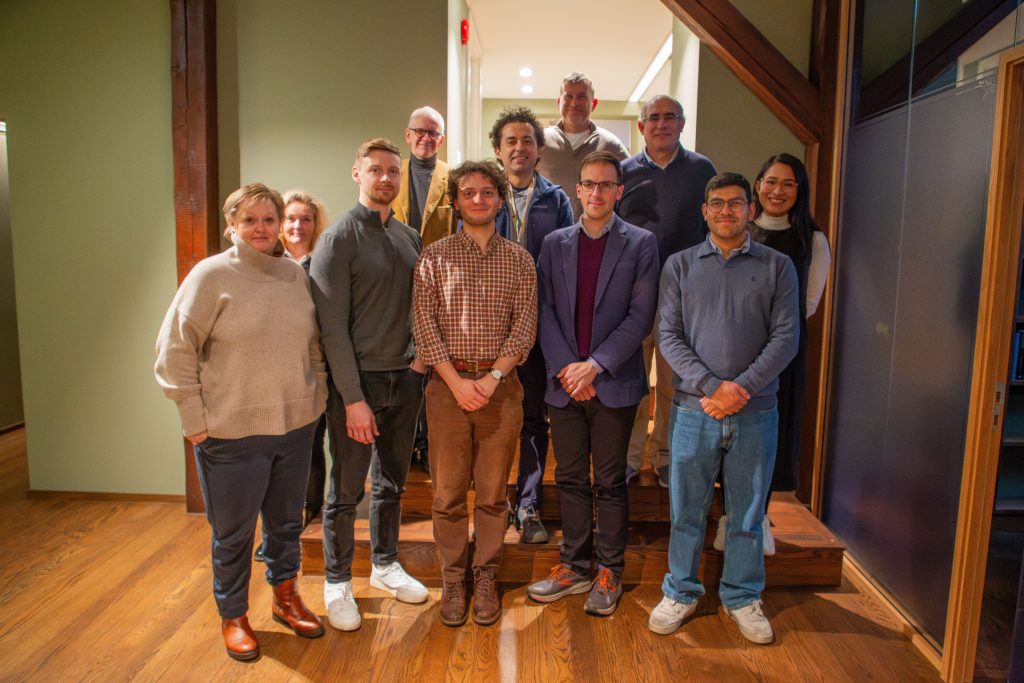
PANSOC’s research team in 2025 consisted of senior researchers, postdoctoral fellows, and MA students (New incoming MA-student – Centre for Research on Pandemics & Society (PANSOC)) with diverse expertise spanning pandemic historiography, epidemiology, and social science. The Centre’s collaborative network includes academic partners from numerous universities and research centres across Europe, North America and Australia.
In 2025, a notable highlight for the Centre was the recognition received by Centre leader Svenn-Erik Mamelund, who was ranked among the top 0.05 % of lifetime scholars globally in the pandemic research field (highlighting the Centre’s research influence). He also continued to be listed among the Stanford/Elsevier top-2 % scientists in public health.
Centre leader Mamelund was nominated name of the year in Academia in 2025 by the readers of the Newspaper Khrono. This is the third time Mamelund has been nominated for this prize. First times were in 2021 and 2020. In the latter instance he was one of three finalists.
Former PANSOC post-doc won 2nd prize in poster award at Heidelberg University Symposium – Centre for Research on Pandemics & Society (PANSOC)
4. Research outcomes and activities
Seminars and Knowledge Exchange
A key part of PANSOC’s activities in 2025 was its Pandemics & Society Seminar Series:
- In Spring 2025, PANSOC hosted a wide range of seminars on topics including historical and contemporary pandemics, infectious disease dynamics, and methodological approaches to pandemic studies (6 webinars in total).
- The Fall 2025 seminar series continued to showcase global scholarship on pandemic history, demography, and public health, including presentations on Black Death impacts, influenza history, and tuberculosis in colonial Africa (9 webinars in total).
- The final seminar of 2025, held on 11 December, explored the concept of “kinship memory” after COVID-19, using demographic microsimulation to understand how the pandemic may be remembered by future generations.
These seminar activities not only enriched PANSOC’s academic environment but also strengthened global networks and offered public access to cutting-edge research discussions.
Publications and Dissemination
PANSOC members continued peer-reviewed research outputs (18 articles, see below) and scholarly dissemination across journals and platforms. They also contributed to public discourse on pandemic preparedness and the historical context of infectious disease outbreaks.
Outreach and Visibility
5. Summary
In 2025, PANSOC upheld its mission to advance understanding of pandemics through multidisciplinary inquiry and global engagement. The Centre’s persistent seminar programming, research activities, and international collaborations reinforced its position in the academic and policy landscapes. Recognition of the Centre leader’s scholarly impact affirmed PANSOC’s contribution to pandemic studies internationally. Through continued research, outreach, and knowledge dissemination, PANSOC remains committed to generating socially relevant insights that advance pandemic preparedness and reduce societal vulnerabilities.
Master’s students finishing in 2025
Amal Hassan (2025): Adherence to non-pharmaceutical interventions (NPIs). A quantitative study of NPI adherence among immigrants and non-immigrants in Eastern Oslo, Norway, during the COVID-19 pandemic in 2021.
Papers published in 2025
- Subedi, Raj Kumar; Mamelund, Svenn-Erik; Delgado, Iris; Matute, Isabel; Laborde, Carla Castillo; Joaquin-Damas, Elienai; Chowell, Gerardo (2025). Poverty and Ethnic Patterns in COVID-19 Excess Mortality: Evidence from Chile, 2020-2022. American Journal of Epidemiology. https://doi.org/10.1093/aje/kwaf274
- Dimka, Jessica L.; Schneider, Benjamin M.; Mamelund, Svenn-Erik (2025). A systematic review to understand the long-term mental health effects of influenza pandemics. Scandinavian Journal of Public Health. https://doi.org/10.1177/14034948251391601
- Maia, Ana Sofia Monteiro; Pereira, Margarida Miguel Costeira e; Mamelund, Svenn-Erik; Amaro, Joana Maria Correia; Fraga, Sílvia Jesus da Silva; Leão, Teresa Isabel Costa (2025). “Be Mothers as if we Were not Workers, Be Workers as if we Were not Mothers”: A Qualitative Study on Parenthood’s Impact on Careers and Well-Being. Journal of Family Issues. https://doi.org/10.1177/0192513×251400278
- Gerardo, Chowell; Hamed, Karami; Mamelund, Svenn-Erik; Alexandra, Smirnova (2025). Global excess tuberculosis mortality during COVID-19: a country-level modeling study of policy and development correlates, BMC Public Health. https://doi.org/10.1186/s12889-025-24858-8
- Correia, Amaro, Joana Maria; Costa, Leão, Teresa Isabel; Mamelund, Svenn-Erik; Sofia, Monteiro Maia, Ana; E., Pereira, Margarida Miguel Costeira; Alejandro, Perelman, Julian; Jesus, da Silva Fraga, Sílvia (2025). Balancing Work and Parenthood – A Comparative Analysis of Policies across European Countries. Journal of Child and Family Studies. https://doi.org/10.1007/s10826-025-03194-w
- Ibsen, Tanja Louise; Zotcheva, Ekaterina; Bergh, Sverre; Gerritsen, Debby; Livingston, Gill; Lurås, Hilde; Mamelund, Svenn-Erik; Rokstad, Anne Marie Mork; Strand, Bjørn Heine; Voshaar, Richard C. Oude; Selbæk, Geir (2025). Cognitive function, physical function, and mental health in older adults amid reduced primary and specialist healthcare service use during COVID-19: the HUNT study. GeroScience. https://doi.org/10.1007/s11357-025-01909-x
- Blinkova, Alexandra; U., Khakurel; G., Gaddy, H.; Mamelund, Svenn-Erik ; M., Bekker-Nielsen Dunbar (2025). Construction and curation of a data set of historical mental health incidence in Norway, Scientific Data. Vol. 12.
https://doi.org/10.1038/s41597-025-05795-y
- Pereira, Margarida; Dimka, Jessica; Mamelund, Svenn-Erik (2025). The New Syndemic of Obesity and COVID-19 in Urban Areas. Hentilä, Helka-Liisa; Luusua, Aale; Rönkkö, Emilia; Sailo, Annukka; Suorsa, Anna (Red.). Pandemics and Urban Planning: Multidisciplinary Perspectives on Cities, Planning and Disease. s. 161-178. Springer Nature Switzerland. https://doi.org/10.1007/978-3-031-97348-2_10
- Adams, Mikaëla M.; Dimka, Jessica; Mamelund, Svenn-Erik; Sattenspiel, Lisa (2025). “I Would Advise That It Be Kept from the Schools at All Cost”: The Influenza of 1918–1920 at Nonreservation Indian Boarding Schools. Ethnohistory. Vol. 72.
https://read.dukeupress.edu/ethnohistory/article/7
- Dunbar, Maria Bekker-Nielsen; Chowell, Gerardo; Mamelund, Svenn-Erik (2025). Inclusion of Deprivation in Endemic-Epidemic Models. Vienna Yearbook of Population Research. Vol. 23. https://doi.org/10.1553/p-4b4e-mkcd
- Sattenspiel, Lisa; Mamelund, Svenn-Erik; Dahal, Sushma; Wissler, Amanda; Chowell, Gerardo; Tinker-Fortel, Emma (2025). Death on the permafrost: revisiting the 1918-1920 influenza pandemic in Alaska using death certificates. American Journal of Epidemiology. Vol. 194. https://doi.org/10.1093/aje/kwae173
- Mamelund, Svenn-Erik (2025). Fars Tale: Er Akademia en felle for arbeiderklassens barn?. Nossum, Rolf Tomas; Breen, Olav (Red.). s. 149-153. Agder Vitenskapsakademi.
- Delgado, Iris; Dahal, Sushma; Matute, Maria I.; Ramírez, Paola A. Rubilar; Mamelund, Svenn-Erik; Chowell, Gerardo (2025). Socioeconomic inequalities in Chile during the COVID-19 pandemic: A regional analysis of income poverty. PLOS ONE. Vol. 20.
https://doi.org/10.1371/journal.pone.0323409
- Ibsen, Tanja Louise; Zotcheva, Ekaterina; Bergh, Sverre; Gerritsen, Debby L.; Livingston, Gill; Lurås, Hilde; Mamelund, Svenn-Erik; Rokstad, Anne Marie Mork; Strand, Bjørn Heine; Thingstad, Anne Pernille Mæhle; Voshaar, Richard C. Oude; Selbæk, Geir (2025). The role of social media in mitigating the long‐term impact of social isolation on mental and cognitive health in older adults during the COVID‐19 pandemic : the HUNT study. International Journal of Geriatric Psychiatry. Vol. 40. https://doi.org/10.1002/gps.70097
- Kakhurel, Uddhav; Sattenspiel, Lisa; Mamelund, Svenn-Erik (2025). Role of Nonpharmaceutical Interventions during 1918–1920 Influenza Pandemic, Alaska, USA. Emerging Infectious Diseases. Vol. 31. https://doi.org/10.3201/eid3107.241048
- Ibsen, Tanja Louise; Zotcheva, Ekaterina; Bergh, Sverre; Gerritsen, Debby L.; Livingston, Gill; Lurås, Hilde; Mamelund, Svenn-Erik; Rokstad, Anne Marie Mork; Strand, Bjørn Heine; Voshaar, Richard C. Oude; Selbæk, Geir (2025). A longitudinal cohort study on dispensed analgesic and psychotropic medications in older adults before, during, and after the COVID-19 pandemic : the HUNT study. BMC Geriatrics. Vol. 25. https://doi.org/10.1186/s12877-025-05745-8
- Vibeke Narverud Nyborg (2025): The use of public health legislation during the 1918–1920 Influenza pandemic in Norway, Continuity & Change, vol 39(2),
- Diego A. Gentner-Polanco, María J. Ávila-Amezcua, Brandon G. Tapia-Hernández, Gerardo Chowell-Puente, Svenn-Erik Mamelund, Pedro C. Santana-Mancilla (2025): Design and evaluation of a balanced scorecard to measure the impact of COVID-19 on a Mexican higher education institution, Avances en Interacción Humano-Computadora, vol 9(1): 185-190, https://doi.org/10.47756/aihc.y9i1.165