Hopp til innholdet

Stemmer fibermerkingen?

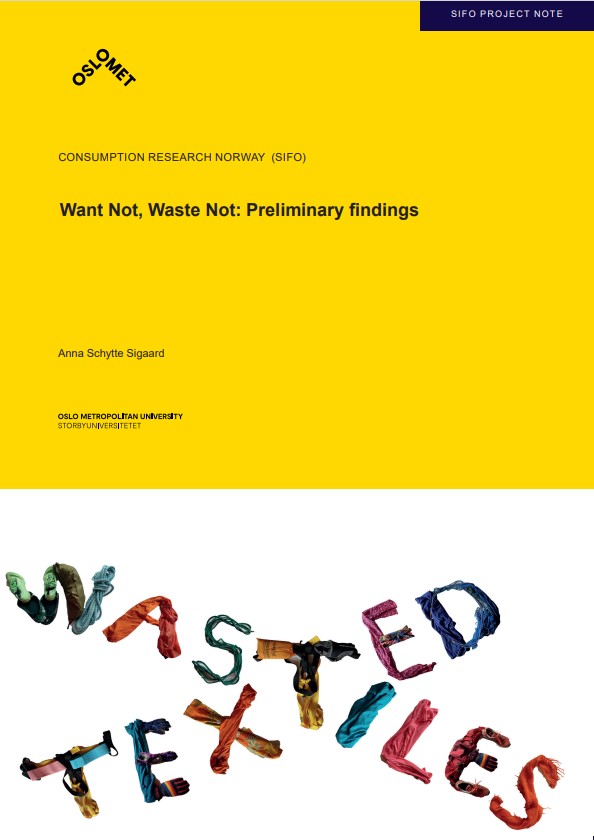
Vi sjekker merkelappen med Matoha FabriTell fiberskanner. Forfattere: Anna Schytte Sigaard, Ingun Grimstad Klepp og Tone Skårdal Tobiasson I prosjektet Wasted Textiles har en av utfordringene vært å identifisere hvilke fibre klær faktisk består av,… Stemmer fibermerkingen?

Product lifetime in European and Norwegian policies

Formålet med denne rapporten er å få en bedre forståelse av hvordan produktlevetid har blitt posisjonert i politikken de siste tjue årene. Ved bruk av dokumentanalyse undersøker vi forekomsten og kontekstualiseringen av produktlevetid i EUs sirkulærøkonomipolitikk, norske partiprogrammer og offisielle dokumenter, dokumenter fra norske miljøorganisasjoner, forbrukerorganisasjoners politikk og produktpolitikk. Samlet finner vi at det er lite fokus på produktlevetid mellom 2000-2015, menat det har vært en stor økning i fokus de siste fem årene. Imidlertid er det fremdeles lang vei å gå i arbeidet med å utvikle tiltak som faktisk adresserer produktlevetid.

Durable or cheap? Parents’ acquisition of children’s clothing

Parents are faced with a plurality of choices and concerns when it comes to the acquisition of clothing for their children. This paper explores how parents employ longevity in consumption of children’s clothing from a practice-oriented perspective. The material consists of 6 focus groups with 40 parents who have at least one child under the age of 18. The aim of the groups was to establish children’s clothing needs: how many they need of each garment, how long parents expect the garment to last and what they understand as quality in clothing.

Consumer practices for extending the social lifetimes of sofas and clothing

Consumers play an essential role in efforts to extend product lifetimes (PL) and consumers’ practices can determine how long and active lives products get. Applying the framework of Social Practice Theory, this paper argues that in order to suggest changes to how consumers can contribute to longer product lifespans, research needs to focus on consumer practices. The data material consists of 4 focus group interviews with 38 participants about household goods and 29 semi-structured interviews about clothing.

Global differences in consumer practices affect clothing lifespans

  • av

Most studies of clothing and related habits are carried out within a country. However, apparel production and sales are a highly globalized industry, with many of the same large chains operating worldwide. It is thus quite possible that the use of the same mass-produced clothing differs between various geographical areas. Based on a practice theoretical approach, we have studied differences in consumption, use and disposal of clothes in different countries that may affect the lifespan of apparel.

The paper is based on an international survey in five countries with large apparel markets: China, Germany, Japan, UK and the USA. 200 respondents from each country answered to a comprehensive web-based survey on their wardrobe content. We found differences in practices that could affect the lifespans of clothing in these five countries. At the same time, we find many similarities. For clothing acquisition, buying new items dominates in all the five markets, and washing machines contribute to the main chore of keeping clothes clean. Home production and second-hand clothes constitute a very small part of clothing consumption in all five countries. Many respondents showed low sewing skills, and repair activities were done irregularly. Thus, many of the challenges to increasing the lifespans of clothing are similar for all the five countries. At the same time, there are significant differences. These differences open up for the possibility to learn «best practice» by studying the countries and transferring knowledge between regions. When defining use phase in LCA and other sustainability tools, it must be taken into account that despite the fact that clothing is a global industry, consumption is part of local practice.


What Affects Garment Lifespans? International Clothing Practices Based on a Wardrobe Survey in China, Germany, Japan, the UK, and the USA

Increasing the length of clothing lifespans is crucial for reducing the total environmental impacts. This article discusses which factors contribute to the length of garment lifespans by studying how long garments are used, how many times they are worn, and by how many users. The analysis is based on quantitative wardrobe survey data from China, Germany, Japan, the UK, and the USA. Variables were divided into four blocks related respectively to the garment, user, garment use, and clothing practices, and used in two hierarchical multiple regressions and two binary logistic regressions.

The models explain between 11% and 43% of the variation in clothing lifespans. The garment use block was most indicative for the number of wears, while garment related properties contribute most to variation in the number of users. For lifespans measured in years, all four aspects were almost equally important. Some aspects that affect the lifespans of clothing cannot be easily changed (e.g., the consumer’s income, nationality, and age) but they can be used to identify where different measures can have the largest benefits. Several of the other conditions that affect lifespans can be changed (e.g., garment price and attitudes towards fashion) through quality management, marketing strategies, information, and improved consumer policies.

Clothing Lifespans: What Should Be Measured and How

  • av

Increasing the use of each product, most often called longer lifespans, is an effective environmental strategy. This article discusses how garment lifespans can be described in order to be measured and compared. It answers two sub-questions: (1) what to measure (units), and (2) how to measure (methods). We introduce and define terms related to clothing lifespans and contribute to discussions about an appropriate functional unit for garments in life cycle assessments (LCA) and other environmental accounting tools. We use a global wardrobe survey to exemplify the units and methods.

Clothing lifespans can be described and measured in years, the number of wears, cleaning cycles, and users. All have an independent value that show different and central aspects of clothing lifespans. A functional unit for LCAs should emphasise both the number of wears for all users as well as the service lifespan in years. Number of wears is the best measure for regular clothing, while number of years is most suited for occasion wear, because it is important to account for the need of more garments to cover all the relevant occasions during a specified time period. It is possible to study lifespan via carefully constructed surveys, providing key data relating to actual garment use.