Hopp til innholdet

Does Use Matter? Comparison of Environmental Impacts of Clothing Based on Fiber Type

  • av

Several tools have been developed to compare the environmental impact of textiles. The most widely used are Higg Materials Sustainability Index (MSI) and MADE-BY Fiber Benchmark. They use data from production to evaluate the environmental impacts of textiles differentiated by fiber type. The use phase is excluded from both tools. This article discusses whether there is evidence that the use of textiles differs systematically between different fiber types and examines the consequences of comparing the environmental impacts of clothing based on differences in production of fibers alone without including differences in their use.

The empirical material in this paper is based on analysis of rating tools and a literature review on clothing use. It shows that fiber content contributes to the way consumers take care of and use their clothing. When use is omitted, major environmental problems associated with this stage, such as spread of microplastics, are also excluded. This one-sided focus on material production impacts also excludes the importance of product lifespans, quality, and functionality. The consequence is that short-lived disposable products are equated with durable products. Comparing dissimilar garments will not help consumers to make choices that will reduce the environmental burden of clothing. We need an informed discussion on how to use all materials in the most environmentally sustainable way possible.

Use phase of apparel: A Literature review for Life Cycle Assessment with focus on wool.

  • av

This report presents a literature review of clothing use phase. The purpose is to support improved methodological development for accounting for the use phase in Life Cycle Assessment (LCA) of apparel. All relevant textile fibres are included in the review. However, the main focus is on wool. We ask whether the use of wool has different environmental impacts than clothes in other fibres. The report builds on a review of literature from the past 20 years. The review showed that clothing made from different materials are used, and reused in different ways. Wool is washed differently as it has about ten degrees lower washing temperature than the average laundry in Europe. Wool is also more likely to be either dry-cleaned or washed by hand than other textiles. Moreover, when dried, it is less likely to be tumble-dried.

Billige og dårlige klær – få klager

I Norge har prisene på klær falt betydelig de siste tiårene. Forbrukerne har fått økt kjøpekraft og antallet klær vi kjøper har økt betraktelig (Klepp & Laitala, 2016, s. 67). I dag er den vanligste måten å skaffe klær på gjennom innkjøp av fast fashion, som kjennetegnes av store internasjonale selskap, vekt på markedsføring fremfor saklig informasjon, og vekt på raske endringer fremfor gode råvarer og kvalitet i produksjon. Omsetningen foregår i kjedebutikker med fokus på salg og salgsvarer og ikke på fagkunnskap. I denne rapporten vil vi se på hvordan denne utviklingen har påvirket vår tilfredshet med klærne. Billigere klær gjør at det er lettere for forbrukerne å kjøpe klær spontant, eller kjøpe klær som ikke er helt slik de ønsker (Greenpeace, 2016). Er det mange som angrer på kjøp de har gjort? Og hva gjør de dersom de angrer? Før vi analyserer spørsmålene vi stilte i SIFO survey 2017 om disse temaene, vil vi legge fram hvilke rettigheter forbrukerne har.

Wool as an Heirloom: How Natural Fibres Can Reinvent Value in Terms of Money, Life-Span and Love

  • av

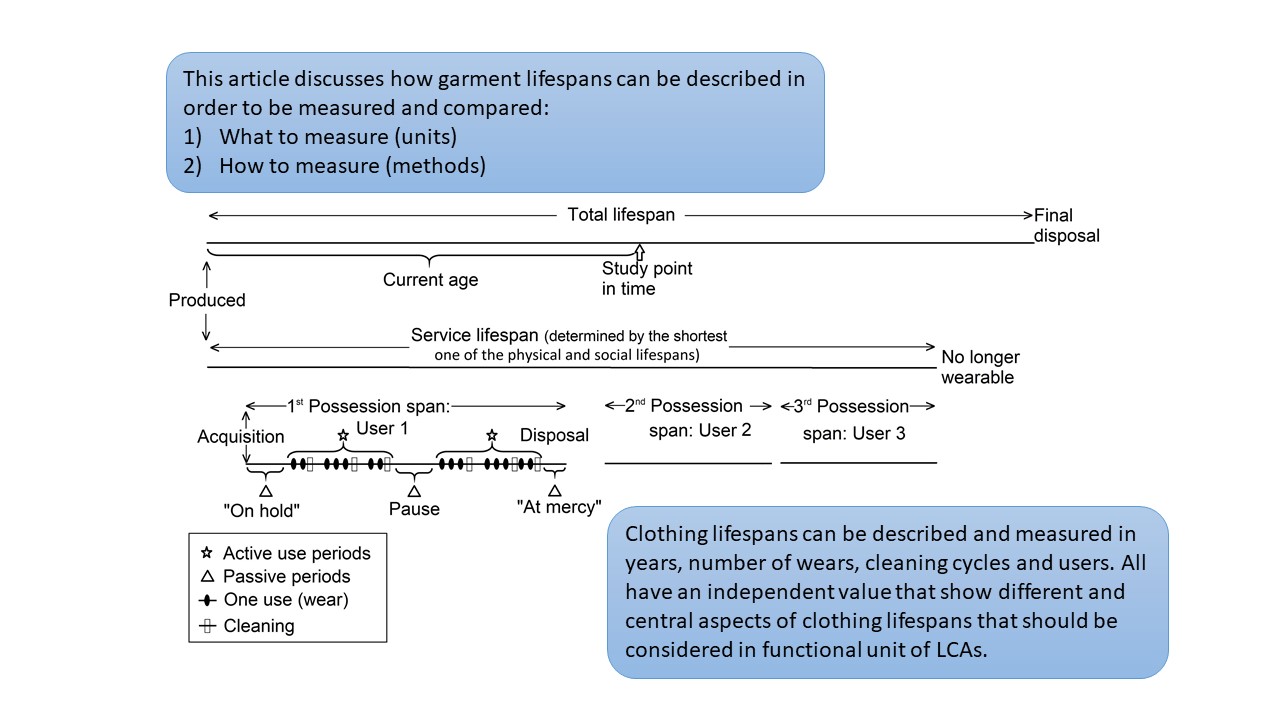
This paper addresses a main challenge for natural fibres; falling prices and increased focus on quantity versus quality. This is a challenge not only related to economic issues and profit, but is also unsustainable in an environmental perspective and in light of the challenges the textile sector and the world face. The paper uses wool as an example and in a surprising approach links the history and century-old traditions of natural fibers to an environmental thinking which supplements the traditional thinking around circular economy and LCA. Fabrics with a long life are the ones that have the lowest environmental impact (Fletcher and Tham2015; Laitala2014). Longevity or lifespan is a complex phenomenon in which both technical and social, or aesthetic aspects, are intertwined.

Klesforbruk i Norge

Denne rapporten gir en samlet gjennomgang av sentrale temaer omkring klesforbruket i Norge. Rapporten er skrevet for å danne grunnlag for en oppdatering av SIFOs Referansebudsjett innen klær og sko og samtidig gjøre kunnskapen om klesforbruk lettere tilgjengelig for alle interesserte. De enkelte kapitlene tar opp ulike sider ved forbruk av klær som har relevans for SIFOs Referansebudsjett. Vi diskuterer den totale mengden klær og klærs levetid, og går gjennomalle forbruksfasene fra anskaffelse, bruk i ulike anledninger, vedlikehold, gjenbruk og til avhending.

Klærs levetid – LCA på liv og død

  • av

Et av de mest fremtredende trekkene ved de siste 50 års tekstilforbruk er veksten i mengde. Import av klær har økt med 67 % i de siste tjue årene, og ligger nå på 15 kg per innbygger i Norge (SSB, 2014). Vi vet lite om denne veksten, men at den henger sammen med en nedgang i priser og en oppgang i kjøpekraft, er åpenbar. I samme periode har andelen av husholdningenes forbruk av klær og sko falt fra 6,6 % til 5,4 % av utgiftene (SSB, 1999, 2013). Til tross for denne nedgangen har klesforbruket målt i volum økt. Dette har ikke skjedd uten miljøkonsekvenser. Carbon trust (2011) har estimert at 3 % av globale klimautslipp, målt i CO2-ekvivalenter, stammer fra produksjon og vask av klær. I tillegg kommer utslipp av skadelige kjemikalier, uetiske arbeidsforhold, problemer med dyrevelferd, og høyt forbruk av energi, vann og land-arealer (Fletcher, 2008).

Making Clothing Last: A Design Approach for Reducing the Environmental Impacts

  • av

This article discusses the extent it is possible to delay clothing disposal through improved design, thus reducing negative environmental impacts. This has been done by including user centered design methods into more traditional quantitative consumer research to give new insights for design. Empirical data on reasons for disposal of 620 clothing items from 35 persons in 16 Norwegian households was collected. In total, 70 different disposal reasons were registered, which were combined into seven main categories.

Clothing disposal habits and consequences for life cycle assessment (LCA)

  • av

This chapter discusses the effects of end-of-life scenarios to the life cycle assessment (LCA) calculations. Consumers’ decisions in the disposal phase of clothing are crucial from an environmental point of view, as they affect the lifespan of clothing, as well as the potential for reuse and recycling. In doing this, examples of Norwegian consumers’ clothing use and disposal practices are used.
We will present statistics for the current situation in Norway as well as qualitative material on clothing disposal practices and discuss disposal methods and frequencies. Instead of assuming that all clothes are disposed of equally regardless of type of garment, person and place, the LCA analyses should be nuanced in relation to knowledge of disposal practices. Analysis also shows also that if improvements are made in facilitating reuse, clothing lifespans could easily be prolonged.

Consumers’ clothing disposal behaviour – a synthesis of research results

  • av

Consumer decisions on clothing disposal are important from an environmental point of view, as they have an effect on the lifespan of clothing, as well as the potential for reuse and recycling. This article summarizes what is known about consumers’ clothing disposal behaviour based on empirical literature published during the past 30 years. The goal of this synthesis is to integrate empirical research, find generalizable results, evaluate the used research methods and identify central issues for future research. Most clothing disposal studies concentrate on disposal channels, behavioural motivations, disposal reasons and demographics of consumers that behave in specified ways.
Many consumers prefer to deliver clothing for reuse rather than to dispose of them, but convenience is paramount. Common disposal reasons for apparel were wear and tear, poor fit and fashion or boredom, in addition to lack of storage space. Survey methods are most common, which indicates the need of other research designs that preferably include the clothing items in method triangulation. Studied samples are dominated by young women and students, and research on more heterogeneous samples is needed.