Lunsjpåfyll video
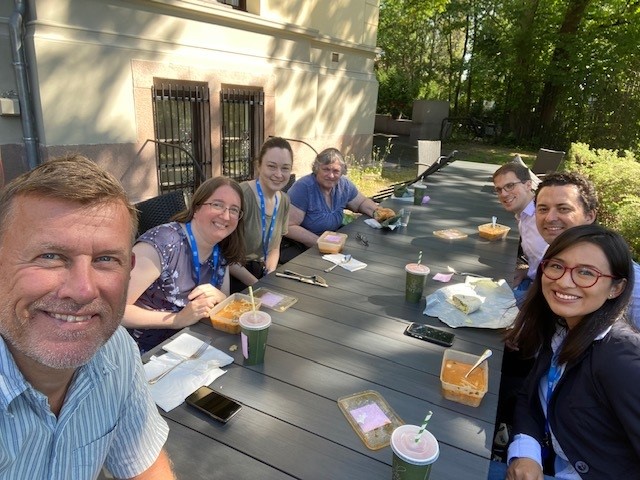
While visiting us at PANSOC, Kaspar Staub gave a talk for OsloMet’s lunsjpåfyll series. You can now watch the video here:
Pandemics are one of the most pressing global threats to human life and security, and they have especially serious impacts on Indigenous people throughout the world.
The Centre for Advanced Study (CAS) funded project Social Science Meets Biology: Indigenous People and Severe Influenza Outcomes – CAS, to be held from August 2022 to June 2023, will bring together interdisciplinary researchers to foster conversations that integrate medical, epidemiological and social perspectives. The primary aims are to increase understanding of the commonalities and varieties of Indigenous experiences when faced with pandemic diseases and better appreciate the diversity of pandemic consequences faced by Indigenous vs. non-indigenous peoples.
As part of this project, we welcome applications from advanced PhD students and post-PhD academics at all career stages for a short visit to Oslo during the 2022-2023 academic year. The venue is CAS at the The Norwegian Academy of Science and Letters | Det Norske Videnskaps-Akademi (dnva.no) in Oslo.
Applicants with Indigenous background are especially welcomed, but non-Indigenous researchers are also encouraged to apply. Visiting researchers will be expected to give a talk on their research and will have the opportunity to discuss potential collaborations and proposals with CAS fellows.
We encourage applications from science-oriented researchers with interests in Indigenous people’s experiences with historical, current, and future pandemics. Examples of topics of interest are:
The visiting researcher program will cover transportation costs to Oslo and hotel accommodations for 1-2 weeks.
Please send a CV and cover letter with a short description (1-2 pages) of your research interests and objectives for a visit to Oslo, as well as anticipated timing or availability for travel, to Professor and group leader Svenn-Erik Mamelund (masv@oslomet.no).
APPLICATION DEADLINE: 15 August, 2022

We are pleased to announce the fall webinar series. All talks will be held Thursdays at 1600 CET (Oslo time) unless otherwise noted. Please contact jessicad@oslomet.no if you need a link.
15 September: Kirsty Short, The University of Queensland, “Obesity and viral disease: lessons for pandemic preparedness.”
22 September: Nele Brusselaers, Antwerp University & Karolinska Institutet, “How science affected Covid-19 policy in Sweden.”
29 September: Sushma Dahal & Gerardo Chowell, Georgia State University, “COVID-19 mortality among Indigenous and non-Indigenous populations in Mexico.”
6 October: Alexi Gugushvili, University of Oslo, “The COVID-19 Pandemic and War: The Case of Ukraine.”
20 October, 1500 CET: Masato Shizume, Waseda University, The Great Influenza Pandemic in Japan: Policy Responses and Socioeconomic Consequences.”
27 October: Ben Schneider, Oslo Metropolitan University, TBA
3 November: Heather Battles, The University of Auckland, “A historical syndemic? Measles and scarlet fever in the Victorian goldfields.”
17 November: Esyllt Jones, University of Manitoba, TBA
1 December: Tobias A. Jopp and Mark Spoerer, University of Regensburg, “Tracing the temporal and spatial course of the Spanish flu in Germany.”

PANSOC welcomes applications from advanced PhD students and post-PhD academics at all career stages for a short visit to Oslo during the 2022-2023 academic year.
Visiting researchers will be expected to give one public talk on their research and one internal talk (for example, a methods workshop or discussion of current or future work). Visitors will also have the opportunity to discuss potential collaborations and proposals with PANSOC-affiliated researchers.
We encourage applications from researchers in all fields of social sciences and humanities with interests in the social aspects of historical, current, and future pandemics. We are particularly interested in topics such as:
The visiting researcher program will cover transportation costs to Oslo and hotel accommodations for one week.
Please send a CV and cover letter with a short description (1-2 pages) of your research interests and objectives for a visit to Oslo, as well as anticipated timing or availability for travel, to Svenn-Erik Mamelund (masv@oslomet.no).
APPLICATION DEADLINE: 31 July, 2022
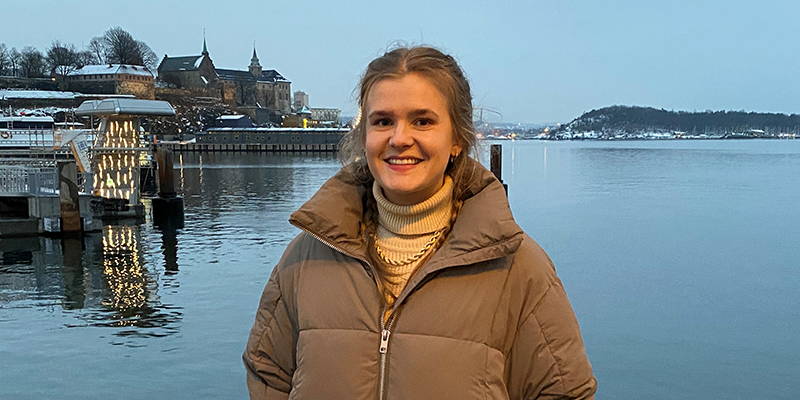
Here they are: these PANSOC affiliated researchers all submitted their masters theses this week on pandemic topics. Congrats, we are so proud of you!

Picture shows from left to right, Carla Hughes, Lara Steinmetz and Christina Torjussen, at a conference in Bergen fall of 2021.

PANSOC has received excellent news this Friday: co-leader Jessica Dimka has passed step 1 and has been invited to interview for an ERC Starting Grant. Her proposed project, EpiDynamics, focuses on interactions and feedback between seasonal infectious diseases and chronic health conditions in order to understand health, demographic, and ultimately evolutionary changes in human populations over time.

Watch Carolyn Orbann from the University of Missouri talk about “Co-circulating respiratory diseases at the end of the 1918 influenza pandemic.”:
https://drive.google.com/file/d/1wG_MNSGx8FQWiBvSvOWiL2oYLh_Xcwxo/view?usp=sharing
Hope to see you next semester for the PANSOC webinar series (more details soon!)
Other past webinars:

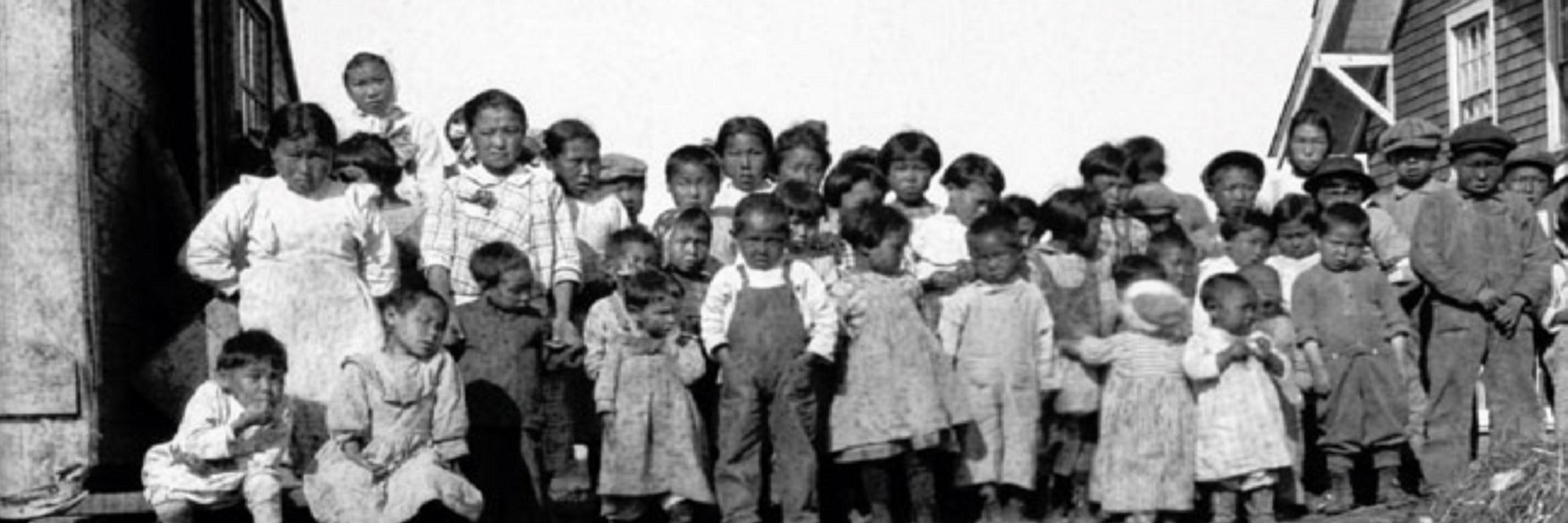
Photo: Orphans after the “Spanish” flu pandemic in Nushagak, Alaska, summer of 1919. Source: Alaska Historical Library
In this new paper in Scandinavian Journal of Public health, titled Indigenous peoples and pandemics – Daniele E. Alves, Svenn-Erik Mamelund, Jessica Dimka, Lone Simonsen, Mathias Mølbak, Søren Ørskov, Lisa Sattenspiel, Lianne Tripp, Andrew Noymer, Gerardo Chowell-Puente, Sushma Dahal, Taylor P. Van Doren, Amanda Wissler, Courtney Heffernan, Kirsty Renfree Short, Heather Battles, Michael G. Baker, 2022 (sagepub.com), we have done a review of the literature on Indigenous vs. non-Indigenous disparities in mortality during the 1918 and 2009 influenza pandemics as well as the ongoing COVID-19 pandemic.
The paper concludes that there there were large disparities in mortality in 1918 and in 2009. However, there are simply not enough high quality data, which makes it difficult to investigate whether Indigenous peoples have a larger COVID-19 mortality risk than non-Indigenous persons.
This paper is the first of several collaborative papers that will come out of the 2022-2023 CAS-project titled Social Science Meets Biology: Indigenous People and Severe Influenza Outcomes – CAS and led by PANSOC leader Mamelund

If you missed Vibeke Narverud Nyborg talk about Different approaches to Public Health Legislation as means in fighting the influenza pandemic 1918 to 1920, watch the video here:
https://drive.google.com/file/d/1nHUYYH4hiVvuef_3G7u8UL3xhYSWuY4S/view?usp=sharing
Other past webinars are available as well:

Carolyn Orbann, University of Missouri, will present “Co-circulating respiratory diseases at the end of the 1918 influenza pandemic.”
The 2020-2021 flu season was among the lowest on record, largely due to the wide circulation of COVID-19 and the measures in place for pandemic control. In this talk, I will present evidence on a variety of respiratory diseases circulating in the US state of Missouri during the 1918 flu pandemic. We will discuss how mortality rates from diseases that typically cause predictable mortality were impacted by the influenza pandemic and how we might understand those changes using a syndemic framework.
Carolyn Orbann is Associate Teaching Professor of Health Sciences at the University of Missouri – Columbia. Her current research interests include infectious disease in historic human populations and the impact of culture on disease spread. She uses historic data, including primary and secondary sources, to understand epidemics in the past, primarily 1918 flu and diseases of colonization in 18th century California. She uses computer simulation models to test ideas about the impact of human culture on infectious disease dynamics.
Contact jessicad@oslomet.no for a Zoom link.