‘Creating’ variety without waste: Pre-industrial dress practices as inspiration for updating the sustainability discourse
Authors: Ingun Grimstad Klepp, Bjørn Sverre Hol Haugen, Marie Ulväng, Pernilla Rasmussen, Ingrid Haugsrud

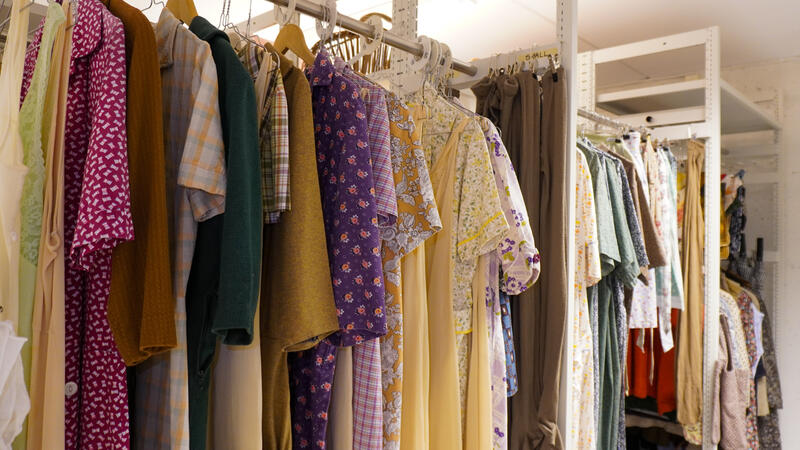
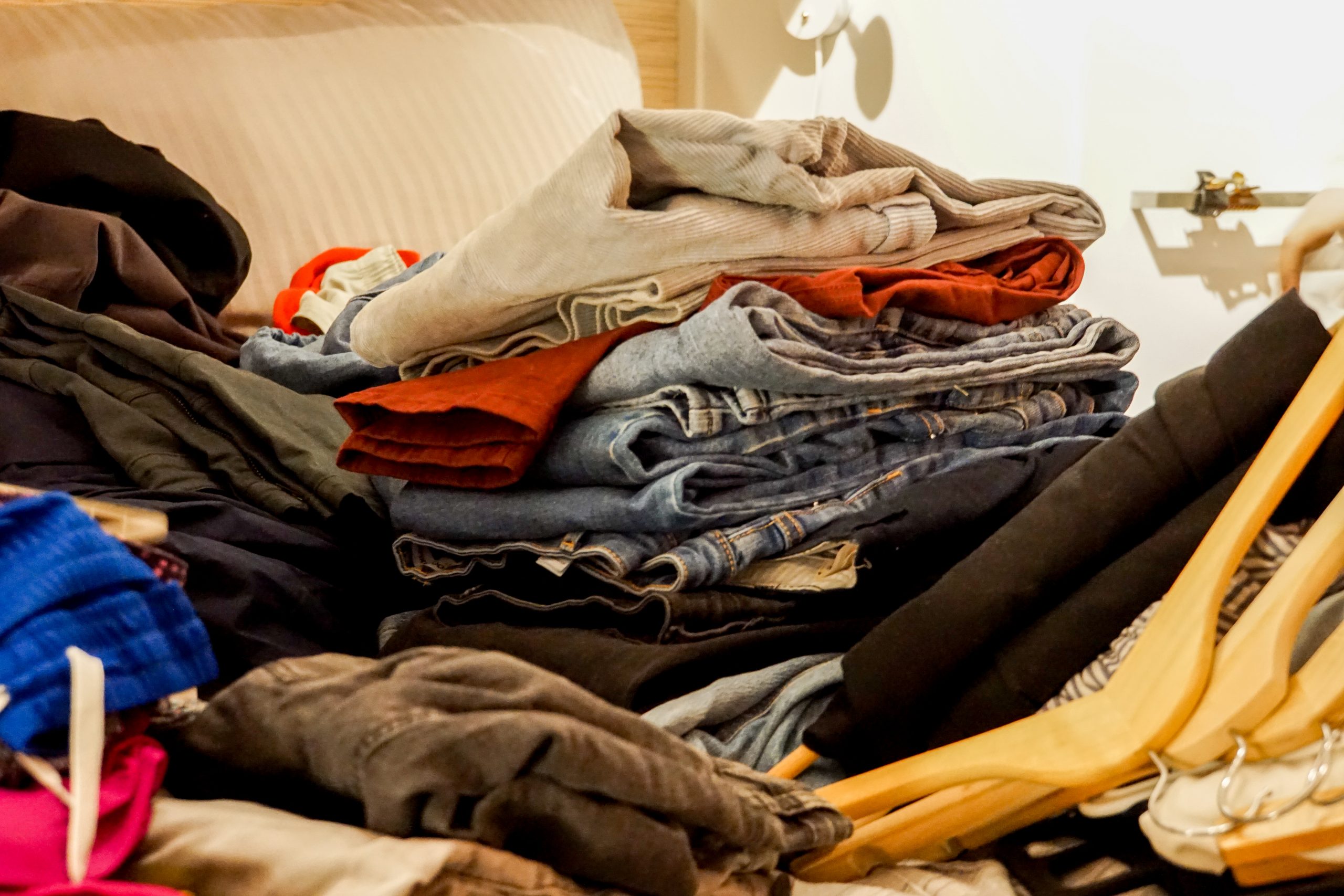
This study explores how ideas of variety were created and practised among women and men of different social strata in Norway and Sweden before the big changes in the second half of the nineteenth century. Three researchers with in-depth knowledge of clothing during that period look at their material through questions they developed based on current clothing and sustainability discourse. The material consists of both written (diaries, inventories, etc.) and oral sources and clothes. We look at acquisition and use of clothes in the period of 1780–1850 to understand how variety was achieved to discuss whether historical research can inform today’s debate on clothing and the environment. Despite strong limitations in terms of regulations for trade, strict dressing codes, expensive textiles and a restricted economy, variety was achieved. An important prerequisite was that the fabrics themselves were seen as valuable and durable, while the shape, trimmings, accessories and the like could be varied. Buying new ready-made clothes was not yet an option. Access to clothes and accessories was an intricate web involving both caring, sharing (lending, renting, inheritance and shared access) and alterations done by amateurs and professionals. The wardrobe was a well-planned system with movement between occasions and over time, consisting of clothes with different functions and temporalities. The present debate with an emphasis on circular economy solutions and the industry as the main stakeholder overlook clothing as a complex cultural and historical phenomenon. Variety in clothes can be achieved in much less resource-intensive ways by focusing on more valuable fabrics.

Reference

Klepp, Ingun Grimstad ; Haugen, Bjørn Sverre Hol; Ulväng, Marie; Rasmussen, Pernilla; Haugsrud, Ingrid (2024). ‘Creating’ variety without waste: Pre-industrial dress practices as inspiration for updating the sustainability discourse. Clothing Cultures. Vol. 11.
https://doi.org/10.1386/cc_00088_1

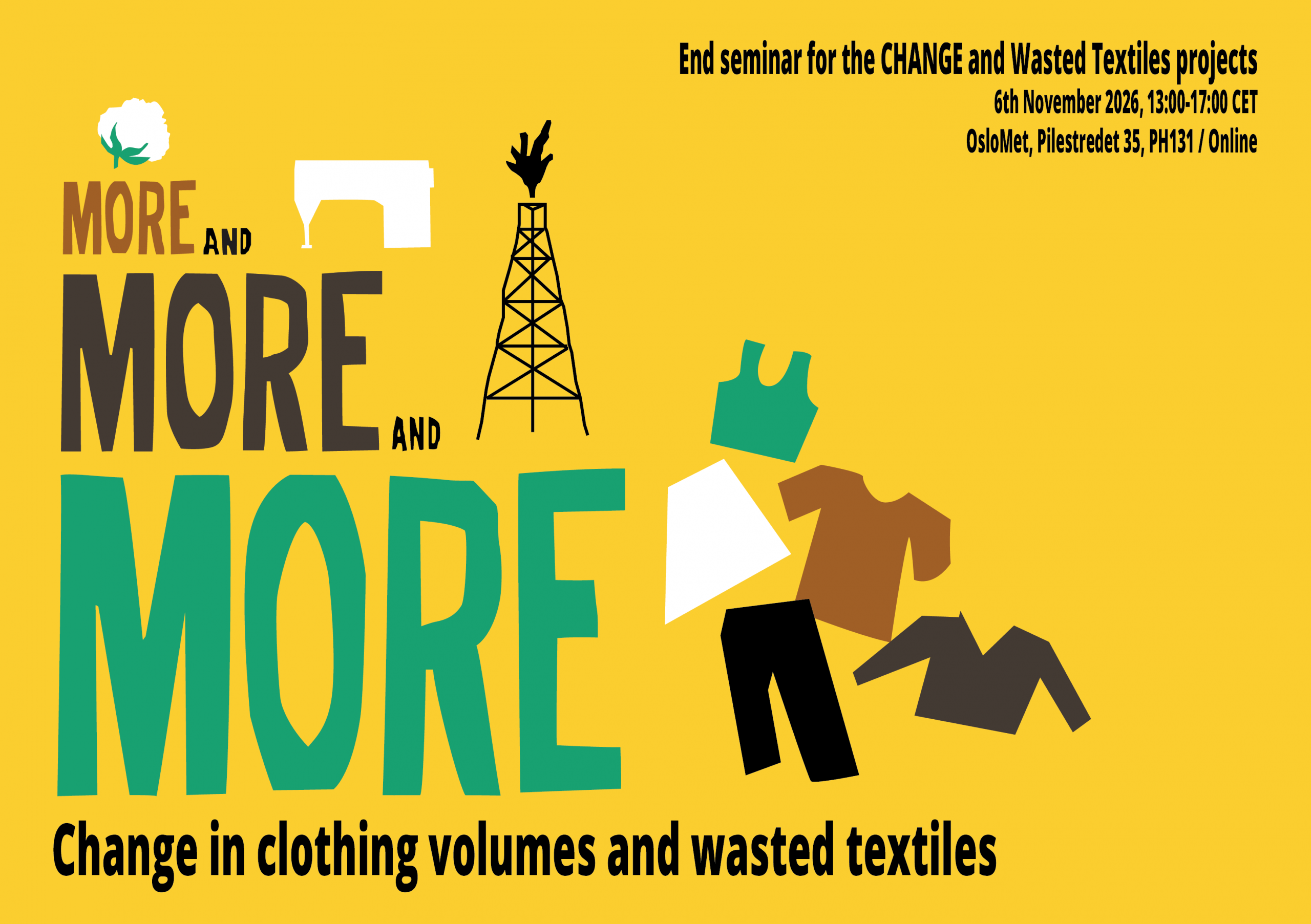
MORE and MORE and MORE: Change in clothing volumes and wasted textiles

Hybrid seminar torsdag 6. november 2025, 13:00-17:00 CET.
OsloMet, Pilestredet 35 / Online.
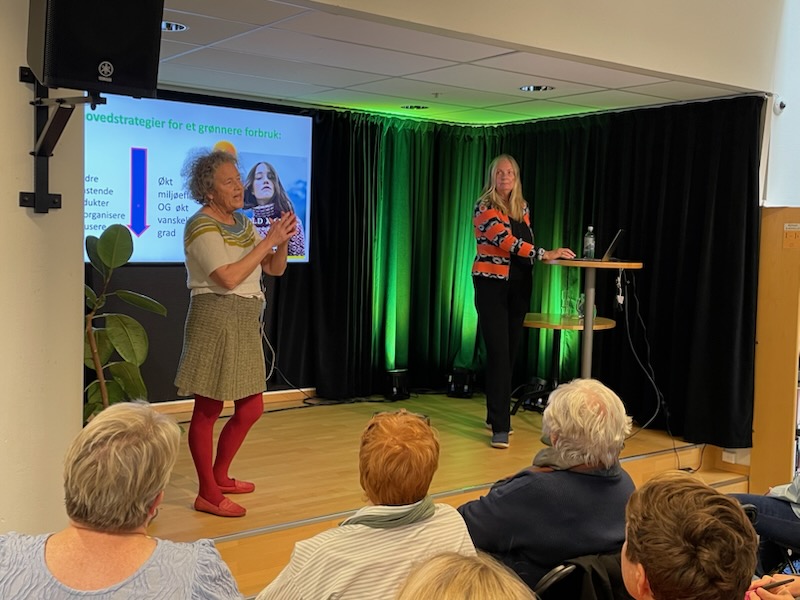
Vi inviterer til sluttseminar for CHANGE og Wasted Textiles projektene.

The title and the illustration of the seminar are inspired by the book «More and More and More: An All-Consuming History of Energy» by Jean-Baptiste Fressoz, which describes how energy innovation has not led to energy transitions, but rather the use of more and more and more energy. We found this to be a suitable title also for a seminar that concludes two projects, which have studied the drivers of the increasing volumes of clothing from two different angles.

The seminar will be chaired by Prof. Kate Fletcher, MMU, and Jens Måge, SirkNorge and present central findings from both projects, ranging from historical knowledge to contemporary consumption and political implications of the research, through to following and future research.

While the final program is still in the making, we invite you to save the date.


PROGRAMME

13:00 – Welcome

13:05 – Context

Two projects, two approaches to the same problem
// Ingun Grimstad Klepp, Professor in Clothing and Sustainability, SIFO, OsloMet

13:20 – New knowledge

Circular Habits, Linear Results – Do Repair and Reuse Slow Wardrobe Growth?
// Kirsi Laitala, Senior Researcher, SIFO, OsloMet

More than enough: Gender and clothing volumes in Norwegian wardrobes
// Vilde Haugrønning, PhD Candidate, SIFO, OsloMet

Textile disposal volumes from Norwegian households
// Anna Schytte Sigaard, PhD Candidate, SIFO, OsloMet

The limitations of product durability and longevity to reduce environmental impacts
// Irene Maldini, Senior Researcher, SIFO, OsloMet

Sustainability impact analysis of Extended Producer Responsibility for the Norwegian consumer textiles sector
// Meron Assefa Arega, Senior Researcher, SINTEF

Working to reduce plastic and production volumes in fashion education and business
// A conversation between Gisle Mardal, NF&TA and Tone Skårdal Tobiasson, NICE Fashion

The upcoming EPR legislation and the market experiences we have gained to date
// Kerli Kant Hvass, Assistant Professor, Aalborg University

Direct impact: Experiences from open discussions over museum objects
// Bjørn Sverre Hol Haugen, Norsk Folkemuseum

16:00 – Offspring

New projects and applications: Continuations of and reactions to the examined perspectives
// Ingun Grimstad Klepp, Professor in Clothing and Sustainability, SIFO, OsloMet. and Kate Fletcher, Professor of Sustainability, Design and Fashion Systems, MMU

16:25 – Mingling and refreshments

Watch the seminar recording below:

Rogaland rundt: Finnes bærekraftige klær?

Ingun Grimstad Klepp og undertegnede har vært på turné og det var så vellykket at vi gjerne vil dele med våre lesere. Ikke for å tromme på egne brystkasser, men fordi det muligens kan inspirere andre – når det gjelder hvordan vi diskuterer bærekraft og tekstiler.

Det er lenge siden sist vi var på Sør-Vestlandet, og det var med stor spenning vi dro av sted til Rogaland, som jo er nærmest selve arnestedet for norsk ullindustri. Her er det flest sauer og her er Norges desidert største spinneri. Og ikke minst har Fatland to store anlegg her, på Jæren og i Ølen. Det var Rogaland Husflidslag som hadde invitert oss, og maken til gjestmildhet og organisasjon av en sømløs turné-plan skal man lete lenge etter. I tillegg viste Rogaland seg fra sin beste side, værmessig, etter en regnfylt første dag med en spektakulær regnbue som bonus.

Tema for turnéen var ‘Bærekraftige klær, finnes de?’ og det engasjerte tydeligvis – for husflidslagene klarte å fylle både bibliotek og kulturhus. Men før vi barker løs på arrangementene, så hadde vi blitt booket med en gjesteforelesning for søm og tekstil/kjole og draktsyerfaget på Godalen VG1, VG2 og VG3, så cirka 40-50 elever. Det var rett og slett et lykketreff, da Kristel Erga som underviser der, var med i et SIFO prosjekt (Textile Waste) for mange, mange år siden og fikk være med på lanseringen av Campaign for Wool i London i vårt sted.

Full aktivitet i avdelingen for søm og tekstil/kjole og draktsyerfaget på Godalen VGS.

Før foredraget fikk vi innblikk i studiet, og fikk se noen veldig fine bluser under arbeid, samt forklær som personalet i skolens kantine skal bruke. For oss ble det en fin øvingsarena med foredraget, særlig siden et mye yngre publikum trengte at vi forklarte ting ekstra nøye. Og vi fikk selvsagt kjørt oss i spørsmålene som kom etterpå – intelligente og velreflekterte som de var.

Særs blide fabrikknerder på besøk hos Woodling, Siv Elise Seland til venstre.

Så sto en tur til Woodling fabrikken på programmet, nøye planlagt da vi først var på de kanter! Det ble en opplevelse for fabrikknerdene. Med syv Shima Seiki ‘whole garment’ strikkemaskiner installert på låven i Undheim, syd for Sandnes, med sauer rundt på alle vollene, fikk vi se Siv Elise Selands eventyrlige moteeventyr ta form. Hun bruker noe norsk ull fra Sandnes Garn (som har investert i bedriften), og én av maskinene har grov nok ‘gage’ for den norske ullen. Vi fikk også slått av en prat med mor Seland, som vi møtte forrige gang vi var på gården og som er aktiv i familiebedriften, og vi kunne jo ikke annet enn være imponert over hva som har skjedd siden den gang.

Og så: turné! Vi fikk skikkelig hakaslepp av hvor mange som dukket opp på biblioteket i Sandnes, og stoler måtte stadig settes opp i lokalet fordi det strømmet på. Utfordringen var da å få en god forståelse for at ‘bærekraft’ er noe det ikke noe det er enighet om. I Norge er vi ganske enige om at ull og naturfibre er bærekraftige, i EUs ‘tellesystem’ PEFCR er de ikke enige med dette. Der vinner syntetiske materialer. Samtidig er den store ironien at Devolds svanemerkede norske ullgenser målt opp mot en ‘kinesisk’ (Temu?) polyestergenser scorer 92 prosent bedre enn Devold. Tygg på den pastillen. Det siste var jo da ‘bomben’ i foredraget og det avstedkom ivrig diskusjon.

Her snakker vi om Multifiberavtalen.

Etter Sandnes bibliotek, gikk turen (med hurtigbåt) til Suldal kulturhus, og en mindre forsamling, og så til Haugesund for avslutningen med stort oppmøte i det utrolig koselige biblioteket. Her følte vi at foredraget endelig ‘satt’, selv om diskusjonen var mer utfordrende. Var ikke reparasjon/gjenbruk mm veien til frelse? Det ble utfordrende å få frem balansen: Ja, vi heier på, men så lenge overproduksjon dominerer, monner det for lite. Det å få en forståelse for dynamikken – hva som påvirker hva – er stadig en utfordring, slik vi har opplevd med EUs politiske apparat og med forskere med klokketro på at ‘more durable, repairable and recyclable’ fører til lavere miljøbelastninger, uten at denne sammenhengen stemmer med det vi vet om klesforbruk.

Fra Unn Søiland Dale utstillingen i Haugesund

På en liten vandring rundt i Haugesund, tok vi en tur innom Unn Søiland Dale utstillingen i gågaten. Det var et herlig gjensyn med fransk couture og norskeikoniske strikkemønstre som vi tidligere hadde opplevd i en bakgård på Grünerløkka, og som nå hadde fått en hedersplass i Unn Søiland Dales hjemby. Takket være datteren Vigdis Yran Dales iherdige jobbing.

Foredraget og tematikken reiser videre denne høsten, og følger du med på sidene her så dukker det kanskje opp i nærheten av nettopp deg.

Tema i foredraget: Er resirkulert polyester det som skal redde oss? Tydeligvis, siden vi fant dette i en butikk i Haugesund.

Prosjektene som bidro til turnéens innhold: Amazing Grazing, Tekstilbønder og motelandbruk, CHANGE og Wasted Textiles.

Hvordan kle oss godt, uten å belaste miljøet unødvendig?

Tid: Torsdag 2. oktober kl. 18:00 (dørene åpner 17:30)

Sted: Jektefartsmuseet, 26 Kvernhusveien, Bodø

Ingun Grimstad Klepp inviterer til et ærlig og engasjerende foredrag om klær, bærekraft og hverdagsvalg. Her får du konkrete tips til hvordan du kan tenke smartere om klær, vask og vedlikehold – og hvorfor det faktisk betyr noe. Du får også mulighet til å få svar på alt du lurer på, da Ingun er åpen for spørsmål etter foredraget.

Foredraget er perfekt for deg som vil gjøre mer miljøvennlige valg, men ikke helt vet hvor du skal begynne – enten det handler om hva du kjøper, hvordan du vasker eller hvordan du tar vare på det du allerede har.

Ingun Grimstad Klepp er etnolog og professor i klær og bærekraft ved Forbruksforskningsinstituttet SIFO. Hun har forsket i en årrekke på klesforbruk, husarbeid og tekstiler, og er medforfatter av bøkene Lettstelt, Lettkledd og Lettfiks – en populær serie om miljøvennlige klesvaner og klesglede.

Inngang: 150 NOK (+ gebyr)
Vengen Skafferi holder åpent for salg av kaffe og kake

Tro og viten i arbeidet med levetid: To nye artikler

De aller fleste vil tenke at varer som varer lenge er en god ting for miljøet. Det er på et vis så selvsagt at det ikke blir stilt spørsmål ved.  Men vitenskap er å stille spørsmål, også de vi tror vi vet svaret på og så finne bevis (empiri) som kan bekrefte eller avkrefte. 

Tekst Ingun Grimstad Klepp

Hvordan vil lenger levetid spare miljøet? Hva slags empirisk forskning er det som viser det?  Materialet for å besvare spørsmålet er tidligere forskning. Mange påstår at lengre levetid er det beste for miljøet, problemet er bare at de ikke vet det.

109 publikasjoner om produktlevetid innenfor alle typer forbruksvarer er gjennomgått. Dette er forskning om ting som elektronikk, hvitevarer, biler, klær og så videre. Disse påstår at lenger levetid sparer miljø. Vi har forfulgt påstandene for å se om de er belagt med empiri eller med referanser til andre. I dette arbeidet fant vi 85 publikasjoner til, slik at det analyserte materiale til sammen er 194 vitenskapelige tekster.

Overraskende

Det overraskende, ja nær sagt sjokkerende, er at i disse fant vi kun 8 studiene som faktisk bygde på empiri. Og de var langt mer beskjedne i sine konklusjoner. I motsetning til de antatte produksjonsbesparelsene som følge av produktlevetid i de aller fleste av publikasjonene inkludert LCA-ene, stiller resultatene fra disse publikasjonene enten spørsmål ved om slike besparelser forekommer, eller de fremhever at besparelsene er begrensede.

Diskusjonen om levetid har eksplodert i både forskning og politikk. Det haster derfor med å utvikle kunnskap som ikke bygger på tro. Vi er derfor stolte av våre to nye artikler. Den ene som viser hva vi vet – og fremfor alt ikke vet – om sammenhengen mellom levetid og miljøbelastninger, og den andre om hvordan levetid brukes politisk i EUs tekstilstrategi. Begge artiklene har Irene Maldini som førsteforfatter og hun har jobbet som en helt med de to, sammen med Ingun og Kirsi.

Avslørende

Vi kan ikke huske å ha publiserte noe noen gang som er så avslørende og som så grunnleggende er på kollisjonskurs med alt fra sunn fornuft, gode forskningskolleger og dessverre også deler av våre tidligere arbeider. Vi som andre forskere bør vite hva vi sier, og nettopp ikke skrive ting fordi det høres ut som om det stemmer. All ære til Irene for hennes mot og klarsyn.

Nå håper vi på debatt! Både om hvordan levetidsforskningen – og kanskje miljøforskningen – kan komme over i et bedre spor. Også hvordan det er mulig at forskning er blitt så upresis, uetterrettelig og ja… blind. Det gjelder også om det politiske, hvordan alle forsøk på å utvikle politikk som omhandler mengder effektivt knebles, gjennom å oversettes til at det er produkters levetid som skal forlenges, og ikke deres antall som må reduseres. 

Les artikkelen her.

The environmental impact of product lifetime extension: a literature review and research agenda
Authors: Irene Maldini, Ingun Grimstad Klepp & Kirsi Laitala

Abstract

Consumer goods environmental policy is increasingly focusing on product durability and product lifetime extension (PLE) to reduce their impact. Given the growing societal relevance of PLE, this review investigates the discourse about its environmental effects, and the empirical knowledge that substantiates this discourse. One hundred and nine relevant articles were selected from 388 distinctive records identified in two databases, Scopus and Web of Science. The statements about the environmental effects of PLE in these publications were extracted and analysed, and a detailed process of backward citation tracking was followed to identify the empirical base substantiating these statements, leading to 85 additional publications that were included in further analyses.

The findings show that the main environmental benefits expected from PLE are related to reductions in the volume of goods produced, which result from expected reductions in demand due to delayed product replacement. However, this reasoning is based on two under-researched assumptions about consumer and industry behaviours: that the demand for new products is driven by replacement, and that decisions on production volumes in the industry are driven by consumer demand. The empirical base in the field is dominated by quantitative assessments that reproduce these assumptions rather than studying them. The findings from a handful of field studies that investigate the presumed behaviour, question that it applies. Therefore, a research agenda is proposed to better understand the relations between product lifetimes and material flows and the influence of consumer and industry behaviour over them. Moreover, given the current gap between the durability discourse and the empirical knowledge that would be needed to substantiate it, recommendations are made for academics, policy makers, advocacy groups, and businesses environmental strategists to moderate their expectations from product longevity measures.

Click here to read the full article (elsevier.com).

Clothing Research scores at SCORAI 2025
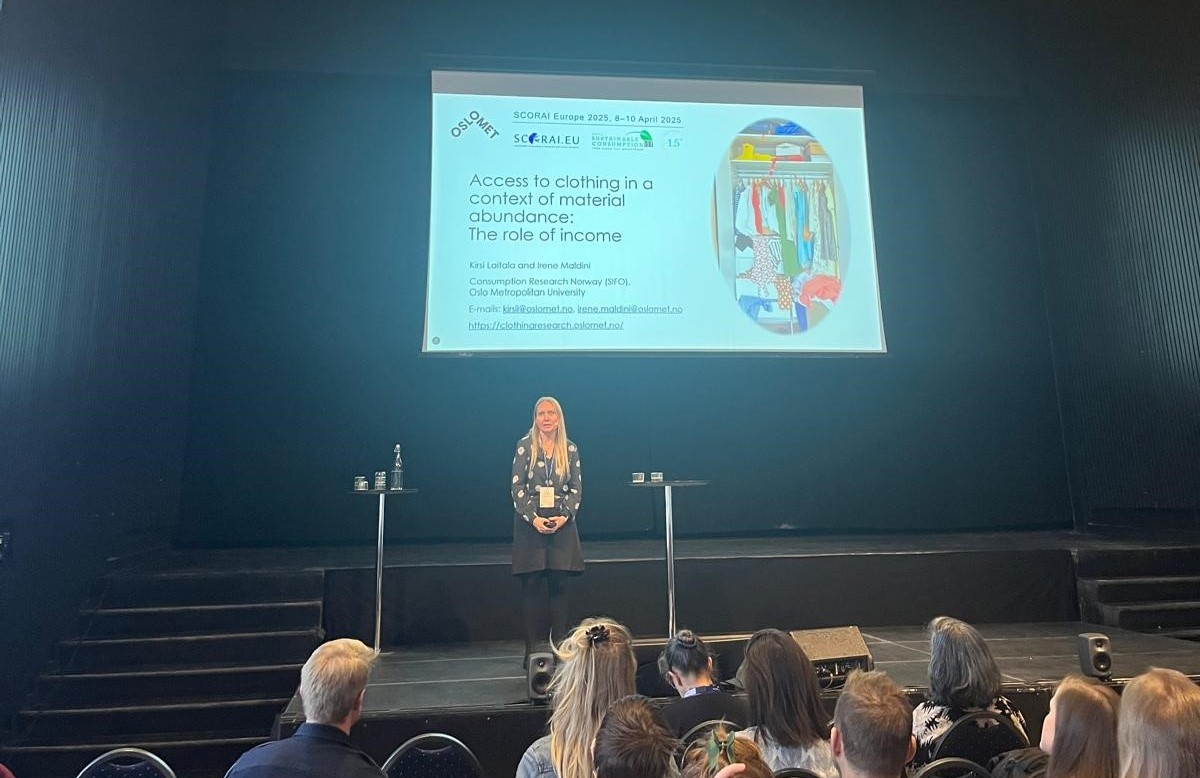
The 2025 SCORAI Europe Conference took place at Lund University in Sweden on April 8-10. SCORAI (Sustainable Consumption Research and Action Initiative) is an international network of researchers and practitioners focused on sustainable consumption. This year’s theme, Mainstreaming Sustainable Consumption, brought together a community of thinkers and doers – including several researchers from SIFO.

By Anna Schytte Sigaard

Kirsi Laitala presented a paper from the CHANGE project, co-authored with Irene Maldini, titled “Access to Clothing in a Context of Material Abundance: The Role of Income.” The presentation was part of the session on “Consumption Corridors: Guaranteeing Human Wellbeing Through Upper and Lower Limits to Consumption.” Based on consumer surveys conducted in Norway, Germany, Japan, the UK, and the USA, the study highlighted the need to reduce clothing consumption in affluent societies to achieve social justice and environmental sustainability, noting that clothing consumption continues to grow despite its significant environmental impact.

By examining the relationship between household income and clothing consumption, the research reveals that income does not significantly affect the total number of clothing acquisitions, likely due to decreases in the relative price of clothing and access to second-hand clothing. However, higher income does correlate with increased expenditure, purchases of new clothing, and product prices. The findings suggest that future policies aimed at reducing consumption volume in affluent nations should be combined with others that preserve equitable consumption levels in different income groups, involving stakeholders such as clothing companies, resellers, and municipalities.

PhD Research Contributions

SIFO researchers Vilde Haugrønning and Anna Schytte Sigaard also took stage in the “Practice Theory & Sociology” session. Vilde presented her work titled “The feminization of clothing consumption: Exploring drivers behind garment accumulation from a practice-oriented perspective”. Drawing on fieldwork with 15 Norwegian couples, her research allowed for a gendered comparison between couples that take part in many of the same practices and share the everyday life. Findings showed that acquisition is driven by everyday occasions, emphasizing the habitual nature of clothing consumption. In addition, women’s wardrobes were typically larger and growing faster, particularly among younger participants. While many participants, especially women, expressed a desire to reduce their clothing consumption, structural barriers made this difficult. The findings highlight that clothing acquisition is not simply a matter of personal choice or need, but rather a complex process influenced by gendered expectations around appearance, dress, and social practices.

Vilde talked about “The feminization of clothing consumption: Exploring drivers behind garment accumulation from a practice-oriented perspective”.

Anna’s presentation, “Cultural Conventions and the Contradictions of Sustainable Clothing Consumption”, shared early findings from in-depth interviews with 28 Norwegian households about textile disposal. Combining theories of social practice with convention theory, the analysis identified a variety of underlying justification people draw on, ranging from market to civic to environmental reasoning. Interestingly, while many participants referenced sustainability, these justifications often clashed with other cultural norms that still promote acquisition and disposal. The study highlights the tension consumers face when navigating the ideals and realities of sustainable consumption.

Anna’s theme was “Cultural Conventions and the Contradictions of Sustainable Clothing Consumption”.

SIFO researchers Kirsi Laitala, Harald Throne-Holst, and Ingrid Haugsrud were co-authors in two presentations from the Horizon Europe project CARE. Harald presented “Sustainable Interventions in Clothing Consumption and Food Waste: A Systematic Literature Review,” which was part of the “Interventions Toward Circular Consumption” session. Nina Mesiranta from Tampere University presented “Circular Consumption Behaviour Change from a Practice Theoretical Lens: A Systematic Literature Review,” in the session on “Practice Theory & Sociology.” Both presentations were based on a systematic literature review conducted in the CARE project.

The reviews focused on interventions and their effectiveness in shifting consumer behavior toward more circular and sustainable practices, particularly in food waste and clothing consumption. From a theoretical standpoint, our research aimed to assess the extent to which interventions with practice theory or practice theory-based elements have been applied. We found that the most effective interventions combined multiple strategies or adopted a systems approach. The results of these studies are crucial for guiding future efforts to shift consumer behavior and practices toward greater sustainability, as they highlight effective intervention strategies and provide valuable empirical evidence to inform policy development, helping to design more impactful programs and initiatives.

Harald on stage.

SIFO also presented two posters:

  • “The Impact of Shopping Practices on Reusable Bag Consumption: A Nationally Representative Study from Norway” by Hanna Seglem Tangen and Live Bøyum, and
  • “Invasive Products – The Case of Disposable Gloves in Norwegian Everyday Life” by Atle Wehn Hegnes, Kirsi Laitala, and Nina Heidenstrøm.

Both poster presentations aimed to reduce plastics consumption by examining single products such as plastic bags and disposable gloves, to better understand the conditions of their use practices.

Other Conference Contributions on Clothing and Textiles

Two dedicated sessions focused on clothing and textile research.

«Sufficiency business models: Fashion sector case studies” highlighted production-side strategies for a more sustainable fashion industry. Topic included reuse and recycling, marketing approaches to reduced consumption, circular strategies among designers, circular fashion business models, and the “Wellbeing Wardrobe” as a tool for just transitions in the industry.

“Fashion and Textiles”, chaired by Lars Fogh Mortensen (European Environmental Agency), opened with findings from the EEA’s latest report “Circularity of the EU textiles value chain in numbers[1].

  • Arjan de Koning (Leiden University) presented findings based on an examination of the post-consumer textile management chain in the Netherlands including a mapping of stakeholders. They found that tension existed between actors in this network when interests became competing. In addition, they discussed the problems with the legal definition of textile waste as “intention to dispose” as this creates heterogenous perspectives on what waste is and is not.
  • Frida Eggert (Lund University) presented findings from her PhD project about secondhand shopping on digital platforms. She has explored the Swedish platform Sellpy enables different modes of shopping. Findings showed that the platform made slow and fast shopping, two opposed models of secondhand clothes shopping, possible at the same time.
  • Nicole Berggren (Lund University) explored the repair intention-behavior gap through a case study of Nudie Jeans.
  • Mariko Takedomi Karlsson (Lund University) initiated her presentation with a reference to the SIFO publication “The Plastic Elephant”[2]. They carried out a policy document analysis on plastic and textiles investigating the coherence across and between relevant European Commission’s strategies anchored in the Circular Economy Action Plan (CEAP) as well as subsidiary instruments such as directives and regulations. Tentative results indicated a limited coherence between the plastic and textile strategies regarding problem definition and scope, e.g. plastics are mainly discussed in the textiles strategy in relation to microplastic pollution, but not in relation to how integrated plastics and textiles truly are regarding issues of (eco)toxicological risks, fossil fuel use, and climate impacts of production. In addition, the textile strategy differed from other strategies which largely focused on protecting the consumer (for example from hazardous chemicals) whereas the textile strategy focused on consumer responsibility.
  • Jason Graham-Nye (University of Technology Sydney) presented their project on sustainable nappy alternatives. They carried out a qualitative field trial of compostable nappies with a collection system in Sydney and presented findings related to the complexities of implementing this sustainable alternative. Among other things, they found that the busy everyday life of parents allowed little room for adoption of new practices. However, their efforts had eventually been successful in Samoa where different systems of waste management had allowed for implementation.

[1] https://www.eea.europa.eu/en/analysis/publications/circularity-of-the-eu-textiles-value-chain-in-numbers

[2] https://oda.oslomet.no/oda-xmlui/handle/11250/3086387

Utskiftninger på CHANGE

Klesgruppa ønsker hjertelig velkommen til Rita Dominici som har kommet på et intership til SIFO.

Rita Dominici er andreårsstudent i masterprogrammet i «Sosiologi og Samfunnsforskning» ved University of Trento. Hun tok en bachelorgrad i sosiologi ved Universitetet i Bologna med en avhandling med tittelen «Fashion as a Social Phenomenon and Consumption Field: The Rise of Fast Fashion and New Paths Towards Sustainability» hvor hun forsket på trender for forbruk av klær, med fokus på aktuelle fenomener innen produksjon og forbruk i tekstilindustrien. Hun kommer til å jobbe i CHANGE-prosjektet i sitt intership.

Kinga, som har vært med oss siden september, er nå på vei videre i sin karriere og skal starte som produktutvikler i Tufte Wear. Vi ønsker henne lykke til videre!

Comparing Male and Female Wardrobes: Gender Dynamics in the Practice of Dressing

Authors: Vilde Haugrønning, Ingrid Haugsrud

Abstract

This chapter explores the influence of gender on clothing consumption and the impact on differences in clothing volumes between men and women. Based on a qualitative and quantitative wardrobe study, we employ Schatzki’s (2002) social ontology of practice combined with Butler’s (1990) gender performance concept to examine the relationship between gender and clothing consumption in 15 households in Norway. The findings show that women had on average 497 items and the men had 258 items, and the main difference between male and female wardrobes was due to the number of items per occasion. These findings highlights the complexities and tensions faced by women in navigating clothing norms and maintaining a balance in the practice of dressing between appropriate dress, feminine expressions and having an ideal and more sustainable wardrobe. This chapter contributes to a better understanding of the interplay between occasions and gender dynamics that shape clothing consumption patterns. Moreover, it illustrates the potential of ‘occasion’ as an analytical concept and the implications of gender in clothing consumption, challenging the prevailing studies on clothing and fashion that often overlook the nuanced practices and actions that influence clothing volumes.

Klikk her for full artikkel (emerald.com) eller ta kontakt med forfatterne.

Overcoming barriers for «strong» sustainable consumption policy: the case of the Amsterdam Doughnut

Forfatter: Irene Maldini

Abstrakt


This case study of the Amsterdam Doughnut highlights how barriers for “strong” sustainable consumption policy pinpointed in the literature were to some extent overcome in the city policy of Amsterdam, the Netherlands, in the period of 2018–23. The study builds on interviews conducted in 2020 and 2023 with key stakeholders participating in the policymaking process, and on the analysis of relevant policy documents. It identifies a few factors that played a role as levers of the barriers mentioned in the literature. These factors facilitated the inclusion of upper consumption limits in a few policy areas at a conceptual and strategic level. However, resistance to “strong” sustainable consumption measures hindered their translation into concrete actions, targets, and implementation. Lastly, a change of emphasis in the city strategy towards the “social foundation” of the Doughnut Economy framework during the period under study led to a stronger focus on the lower levels of sufficiency, leaving the emphasis on the upper levels behind.

Klikk her for full tekst (taylorFrancis.com).