‘Creating’ variety without waste: Pre-industrial dress practices as inspiration for updating the sustainability discourse
Authors: Ingun Grimstad Klepp, Bjørn Sverre Hol Haugen, Marie Ulväng, Pernilla Rasmussen, Ingrid Haugsrud

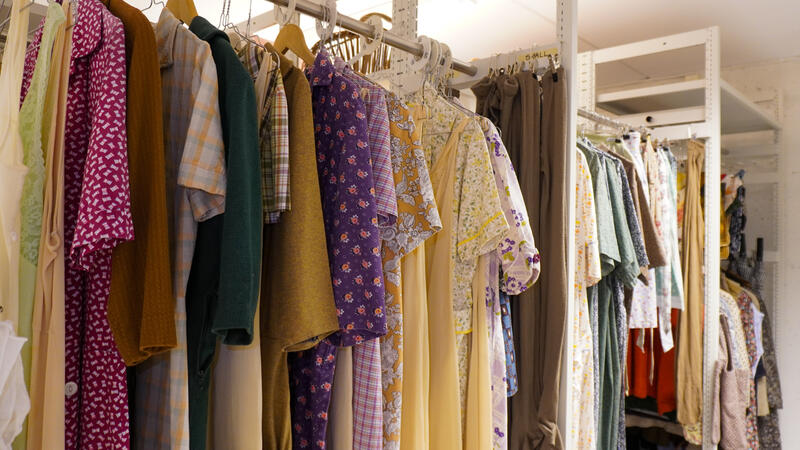
This study explores how ideas of variety were created and practised among women and men of different social strata in Norway and Sweden before the big changes in the second half of the nineteenth century. Three researchers with in-depth knowledge of clothing during that period look at their material through questions they developed based on current clothing and sustainability discourse. The material consists of both written (diaries, inventories, etc.) and oral sources and clothes. We look at acquisition and use of clothes in the period of 1780–1850 to understand how variety was achieved to discuss whether historical research can inform today’s debate on clothing and the environment. Despite strong limitations in terms of regulations for trade, strict dressing codes, expensive textiles and a restricted economy, variety was achieved. An important prerequisite was that the fabrics themselves were seen as valuable and durable, while the shape, trimmings, accessories and the like could be varied. Buying new ready-made clothes was not yet an option. Access to clothes and accessories was an intricate web involving both caring, sharing (lending, renting, inheritance and shared access) and alterations done by amateurs and professionals. The wardrobe was a well-planned system with movement between occasions and over time, consisting of clothes with different functions and temporalities. The present debate with an emphasis on circular economy solutions and the industry as the main stakeholder overlook clothing as a complex cultural and historical phenomenon. Variety in clothes can be achieved in much less resource-intensive ways by focusing on more valuable fabrics.

Reference

Klepp, Ingun Grimstad ; Haugen, Bjørn Sverre Hol; Ulväng, Marie; Rasmussen, Pernilla; Haugsrud, Ingrid (2024). ‘Creating’ variety without waste: Pre-industrial dress practices as inspiration for updating the sustainability discourse. Clothing Cultures. Vol. 11.
https://doi.org/10.1386/cc_00088_1

Kledd for tilhørighet: Barns bruk av klær for å skape likhet

Authors: Ingrid Haugsrud, Ingun Grimstad Klepp & Clara Julia Reich

Clothes are an important part of everyday life. Having the right clothes
for the occasion and weather is a strong norm that is crucial to fitting in. Based
on wardrobe studies with 9 12-year-old boys and girls, as well as interviews with
22 parents, we have investigated the children’s wardrobe and their efforts to appear
properly dressed in their own, peers’ and parents’ eyes. Uniforms are an alternative
to current school dress practices that both adults and children are familiar with.
Children perceive it as a way to play with other styles, or as a way to create equality.
Adults highlight the potential of school uniforms to mitigate commercial pressure.
The children emphasized the value of being similarly dressed and showed inventive
and fun ways to develop competence around creating equality. To be oneself is to
be like one’s peers. Children take active responsibility for creating equality.

Klikk her for å lese hele kapittelet.

Comparing Male and Female Wardrobes: Gender Dynamics in the Practice of Dressing

Authors: Vilde Haugrønning, Ingrid Haugsrud

Abstract

This chapter explores the influence of gender on clothing consumption and the impact on differences in clothing volumes between men and women. Based on a qualitative and quantitative wardrobe study, we employ Schatzki’s (2002) social ontology of practice combined with Butler’s (1990) gender performance concept to examine the relationship between gender and clothing consumption in 15 households in Norway. The findings show that women had on average 497 items and the men had 258 items, and the main difference between male and female wardrobes was due to the number of items per occasion. These findings highlights the complexities and tensions faced by women in navigating clothing norms and maintaining a balance in the practice of dressing between appropriate dress, feminine expressions and having an ideal and more sustainable wardrobe. This chapter contributes to a better understanding of the interplay between occasions and gender dynamics that shape clothing consumption patterns. Moreover, it illustrates the potential of ‘occasion’ as an analytical concept and the implications of gender in clothing consumption, challenging the prevailing studies on clothing and fashion that often overlook the nuanced practices and actions that influence clothing volumes.

Klikk her for full artikkel (emerald.com) eller ta kontakt med forfatterne.

Clothing Care – The Palgrave Handbook of Sustainability in Fashion

Forfattere: Ingrid Haugsrud, Ingun Grimstad Klepp and Kirsi Laitala

Abstract

The impact of the fashion industry on the environment is undoubtedly size-able. In response, the last decade has seen various changes in the fashion industry landscape, from new digital technologies that enhance zero waste productions, the emergence of the digital platform economy, to the development of innovative materials. This Handbook captures key innovations within the fashion industry and brings together work from leading academics, but also practitioners in the field. Offering a comprehensive and global perspective, it covers core topics such as: technological innovations and their impact on sustainable fashion, alternative models of consumption, the circular economy, the role of activism and the future of sustainable fashion. With clear managerial implications, chapters uniquely supplement conceptual work with short practitioner-led case studies that bridge the gap between theory and practice, making this a valuable resource for students and researchers.

Klikk her for lenke til boka og teksten (springer.com)

The devaluation of stockings

Authors: Tone Rasch, Ingrid Haugsrud, Kirsi Laitala and Atle Wehn Hegnes

Abstract

Consumer practices related to how we use and take care of products have changed throughout history. Especially within clothing consumption, the changes have accelerated in the Twentieth Century. In this paper, we use thin nylon stockings for women as an example product to see how their value, use, care, and lifetimes have evolved. The material is based on a literature review on nylon stockings from 1940 to today, accompanied by an analysis of consumers’ written narratives from 1990 where people were asked to describe their use and memories of stockings and pantyhose. Our contemporary data is based on consumer focus groups on product lifetimes and plastic materials conducted in 2021 and 2022. The tight-fitting nylon stockings for women were launched around World War II by the American company DuPont. Cheap nylon substituted luxurious silk stockings and increased their popularity throughout the 1950s and 1960s. Around 1970, synthetic substances were devalued when fashion changed from elegance to more casual styles, and the political opposition to plastic as environmental damage and a symbol of the established society permeated the growing youth culture. Consequently, nylon stockings went out of fashion. Today, thin pantyhose is seen as disposable consumables with low value. Thin stockings represent a good example of how we value and take care of delicate items has a significant contribution to their lifetimes. Looking into the historical context is beneficial for learning about the points in time when changes occurred and how they contribute to consumer practices.

Click here to download and read the full article.

Click here to download and read the full conference proceedings (aalto.fi)

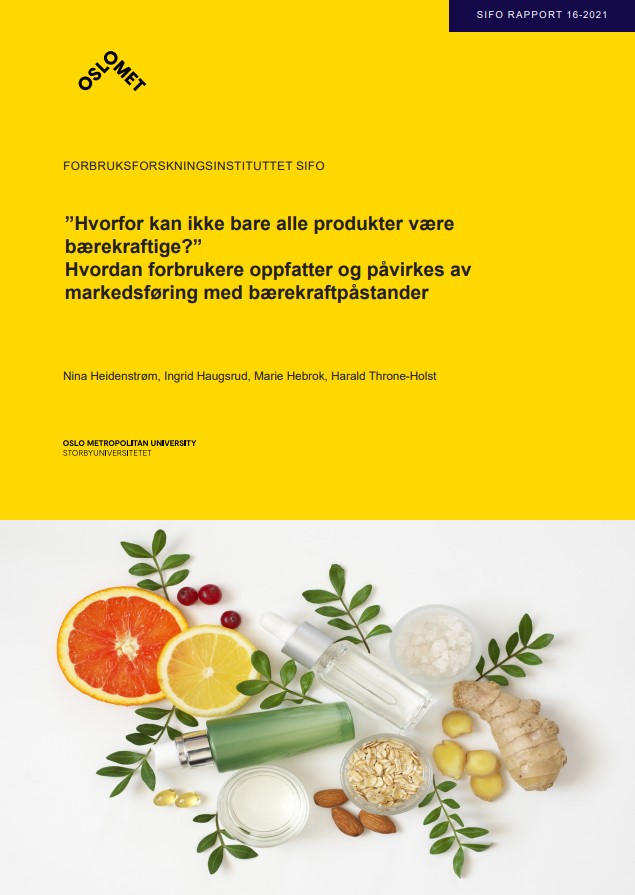
”Hvorfor kan ikke bare alle produkter være bærekraftige?” Hvordan forbrukere oppfatter og påvirkes av markedsføring med bærekraftpåstander

Nina Heidenstrøm, Ingrid Haugsrud, Marie Hebrok & Harald Throne-Holst

Sammendrag

Formålet med denne rapporten er å få en bedre forståelse av hvordan markedsføring med bærekraftpåstander kommuniseres til norske forbrukere gjennom nettbutikker og sosiale medier, og hvordan forbrukerne oppfatter og håndterer markedsføringen. Rapporten ser spesielt på to produktkategorier; klær og kosmetikk. En skrivebordsstudie analyserer markedsføringens tekstlige og visuelle utforming, og data fra fokusgrupper brukes for å forstå hvilke ressurser og begrensninger forbrukerne har i møte med markedsføringen. Skrivebordsstudien viser at markedsføringen av klær og kosmetikk benytter seg av store og felles samfunnsfortellinger om hvordan vi skal møte klimautfordringene gjennom forbruksendringer. Fortellingene bruker emosjoner, moral og logikk i sine argumenter, som forsterkes gjennom symboler og visuelle atmosfærer. Resultatene fra fokusgruppene viser at informasjon og kunnskap om markedsføring med bærekraftpåstander per i dag ikke er tilstrekkelig, og det er lav tillit til påvirkere i sosiale medier, forhandlere, og produsenter. Tilliten er høy til myndighetene, som samtidig anses å være ansvarlige for å regulere markedsføringen.

Rapporten avsluttes med fire læringspunkter for å utbedre forbrukernes forståelse av markedsføring med bærekraftpåstander:

i) standardisere og kontekstualisere informasjon,

ii) videreutvikle det nordiske miljømerket,

iii) regulere feilbruk av vitenskapelig kunnskap og

iv) lage retningslinjer for visuelle virkemidler. 

Abstract

This report aims to gain a deeper understanding of how marketing with sustainability claims is communicated to Norwegian consumers through online stores and social media, and how consumers perceive and handle such marketing. The report looks specifically at two product categories: clothing and cosmetics. A desktop study analyses the textual and visual design of the marketing, and data from focus groups are used to understand what resources and limitations consumers have when facing sustainability claims. The desktop study shows that marketing of clothing and cosmetics is constructed using shared cultural narratives about how we should understand and act on the global climate crisis through changed patterns of consumption. The narratives use emotions, moral and logic in their arguments, which are reinforced through symbols and visual atmospheres. The focus group results show that information and knowledge about marketing with sustainability claims are insufficient, and there is a low level of trust in social media influencers, retailers, and manufacturers. There is a high level of trust in national authorities, who are also considered to be responsible for regulating marketing. The report concludes with four learning points to improve consumers’ understanding of marketing with sustainability claims: i) standardise and contextualise information, ii) further develop the Nordic eco-label, iii) regulate misuse of scientific knowledge, and iv) create guidelines for visual techniques in marketing.

Klikk her for å lese hele rapporten.